Cedar Siding · Southwest Ohio
Cedar siding in Beavercreek and southwest Ohio: hail, woodpeckers and a short staining season
Home › Wood siding › Southwest Ohio · Reviewed by the Siding Pros USA editorial team · · 19 min read
Cedar siding in Beavercreek, Kettering, Mason and the towns around them faces three local tests. Spring hail, woodpeckers that favor stained cedar, and a finishing season that, by our calculation from NOAA normals, runs only from early May to early October.
Cedar siding around Dayton and Cincinnati, in four points
- Hail comes in spring. April through June hold 66 percent of the 304 severe hail reports we counted in Greene, Montgomery, Warren, Butler and Hamilton counties from 2006 to 2025.
- Birds and bees go for bare or stained wood. Wildlife experts name natural and dark-stained cedar as a woodpecker favorite, and Ohio State says stain does not keep carpenter bees out.
- The finishing season is short. Dayton's normal overnight low stays at 50°F or warmer only from May 5 to October 4. Below that, the Wood Handbook warns, most latex paint does not cure properly.
- Rot risk is middling, not low. By our calculation Dayton scores 60.1 on the Forest Service decay index for 1991 to 2020. The laboratory's own table for 1971 to 2000 gave it 52.9.

Our Count
Our count: 304 severe hail reports across five southwest Ohio counties
We went through twenty yearly files of the NOAA Storm Events Database and kept each county report of hail an inch across or larger.
| County | Suburbs | Reports, 1 inch or larger | Days with such reports | 1.75 inches or larger | Largest |
|---|---|---|---|---|---|
| Greene | Beavercreek, Bellbrook, Fairborn, parts of Kettering and Centerville | 50 | 22 | 18 | 3.00 in |
| Montgomery | Kettering, Centerville, Miamisburg, part of Springboro | 61 | 25 | 11 | 3.00 in |
| Warren | Mason, Springboro, Lebanon, part of Loveland | 45 | 24 | 4 | 2.00 in |
| Butler | West Chester Township, Liberty Township | 65 | 31 | 12 | 2.50 in |
| Hamilton | Blue Ash, Montgomery (city), Anderson Township, part of Loveland | 83 | 38 | 7 | 2.00 in |
| Five counties | 304 | 91 | 52 | 3.00 in |

Across the five counties the reports fall on 91 separate days, and on 32 of those days hail that size was logged in two counties or more. Four times a single day reached four of the five: June 2, 2009, May 25, 2011, April 16, 2013 and April 8, 2020.
Beavercreek and Greene County
Greene County logged 50 reports on 22 days. Eighteen of them were 1.75 inches or more, the size the Weather Service calls golf ball, and the largest stone measured 3.00 inches. May and June hold 56 percent. Severe hail is lumpy here: in seven of the twenty years the county logged no report at all.
Kettering, Miamisburg and Montgomery County
Montgomery County logged 61 reports on 25 days, with eleven at golf ball size or larger and a largest stone of 3.00 inches. June stands out on its own, with 23 reports, and June plus April make up 64 percent.
Springboro, Mason, West Chester and Blue Ash
The Cincinnati side logs more reports but smaller stones. Hamilton County has the most reports of the five, 83, yet its largest was 2.00 inches. Warren County stands out for wind instead: 11 thunderstorm wind reports of 65 knots or more, against 5 in Greene.
How we counted
Each yearly NOAA file carries a revision code, and we used the ones on the server in October 2026, listed under Sources. We kept county rows only. The cutoff is the Storm Prediction Center's: “Hail 1 inch in diameter or larger.” Our Greene and Montgomery totals match an earlier count we built from the same files.
What the count leaves out
These are reports that reached the National Weather Service, so a storm with no one to see it leaves no line in the file. We show no trend by year. We also skip the damage column, which holds estimates rather than audited losses.
Your County
Which county is your suburb in?
Hail is counted by county, and several suburbs cross a county line. The Census Bureau's 2020 list of Ohio places shows which counties each one touches.
| Suburb | County | Severe hail reports in that county, 2006 to 2025 |
|---|---|---|
| Beavercreek | Greene | Greene 50 |
| Kettering | Montgomery and Greene | Montgomery 61, Greene 50 |
| Centerville | Montgomery and Greene | Montgomery 61, Greene 50 |
| Miamisburg | Montgomery | Montgomery 61 |
| Springboro | Warren and Montgomery | Warren 45, Montgomery 61 |
| Mason | Warren | Warren 45 |
| Liberty Township | Butler | Butler 65 |
| West Chester Township | Butler | Butler 65 |
| Blue Ash | Hamilton | Hamilton 83 |
| Montgomery (city) | Hamilton | Hamilton 83 |
| Anderson Township | Hamilton | Hamilton 83 |
| Loveland | Hamilton, Warren and Clermont | Hamilton 83, Warren 45 (Clermont not counted) |
One trap in the names: the city of Montgomery lies in Hamilton County, not in Montgomery County. If you search for cedar siding in Montgomery, OH, check which of the two the contractor means. Loveland touches three counties; we did not count Clermont.
Our Calculation
Our calculation: a five-month window for staining cedar near Dayton
From NOAA's daily climate normals, by our calculation, Dayton's normal overnight low is 50°F or warmer from May 5 to October 4. That makes 153 days in a row, and none outside them.
| Month | Dayton normal low | Cincinnati normal low | Latex paint by the 50°F rule |
|---|---|---|---|
| April | 42.9°F | 43.7°F | Nights too cold |
| May | 53.8°F | 53.7°F | From May 5 |
| June | 62.7°F | 62.1°F | Yes |
| July | 66.1°F | 65.9°F | Yes |
| August | 64.3°F | 64.6°F | Yes |
| September | 56.8°F | 57.3°F | Yes |
| October | 45.9°F | 45.7°F | Until October 4 |

Why the night low decides
The Forest Products Laboratory's Wood Handbook sets the line for latex paint at 50°F, held for a full day, and adds that the dew point is a good guide to the night's low. Its warning is plain: “Most latex paints do not coalesce properly” below that. A warm afternoon in April is not enough if the night drops to the low 40s.
The same book has a second reason to finish inside the window. “For low-density species such as cedar, finish the wood as soon as possible after installation, or better yet, prime it before installation.” New cedar hung in November waits months for its first coat.
The Cincinnati side of the region
Cincinnati's airport runs a day longer, from May 4 to October 4, 154 days. A normal is a thirty-year average, not a forecast, and some paints are rated for colder air. The label on the can has the last word.
Our Calculation
Our calculation: the decay index for Dayton and Cincinnati
By our calculation from NOAA 1991 to 2020 normals, Dayton scores 60.1 and Cincinnati 61.6 on the climate index the Forest Products Laboratory uses for decay in wood above ground.
| Month | Dayton mean temp | Dayton rain days | Dayton points | Cincinnati points |
|---|---|---|---|---|
| January | 29.4°F | 13.4 | 0.00 | 0.00 |
| February | 32.8°F | 11.3 | 0.00 | 0.00 |
| March | 42.1°F | 12.1 | 2.15 | 2.72 |
| April | 53.7°F | 13.0 | 6.23 | 6.60 |
| May | 64.0°F | 14.1 | 10.73 | 10.18 |
| June | 72.7°F | 11.9 | 11.18 | 10.94 |
| July | 76.0°F | 10.6 | 10.39 | 10.91 |
| August | 74.5°F | 8.1 | 6.71 | 7.85 |
| September | 67.7°F | 8.6 | 6.10 | 5.85 |
| October | 56.0°F | 9.5 | 4.55 | 4.03 |
| November | 44.1°F | 9.9 | 2.09 | 2.29 |
| December | 34.3°F | 11.8 | 0.00 | 0.19 |
| Year | 53.9°F | 134.3 | 60.1 | 61.6 |

The method dates from T.C. Scheffer's 1971 paper. A month scores only when its mean is above 35°F and it has more than three rainy days. Dayton's December, January and February add nothing, while May through September supply 75 percent of the year's points.
What changed since 1971 to 2000
The laboratory's 2009 table, built on 1971 to 2000 normals, gave Dayton 52.9, Cincinnati 57 and Columbus 58.9. Its map has three bands: under 35, 35 to 65, and over 65. Both cities stay in the middle band, now within five points of the top one. For comparison, our Houston page works the same index out above 80.
Storm Season
Can hail damage cedar siding?
It can, and the Weather Service's line for severe hail, one inch, is the size counted above. Cedar is a light, low-density wood, so the marks show.
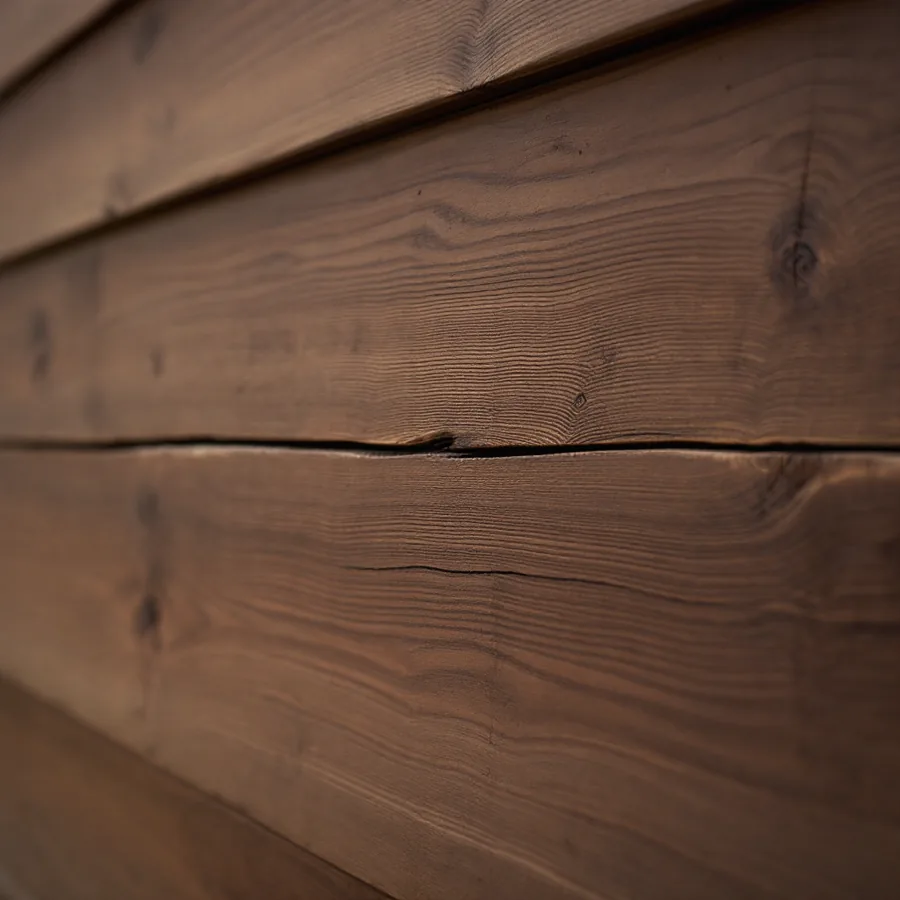
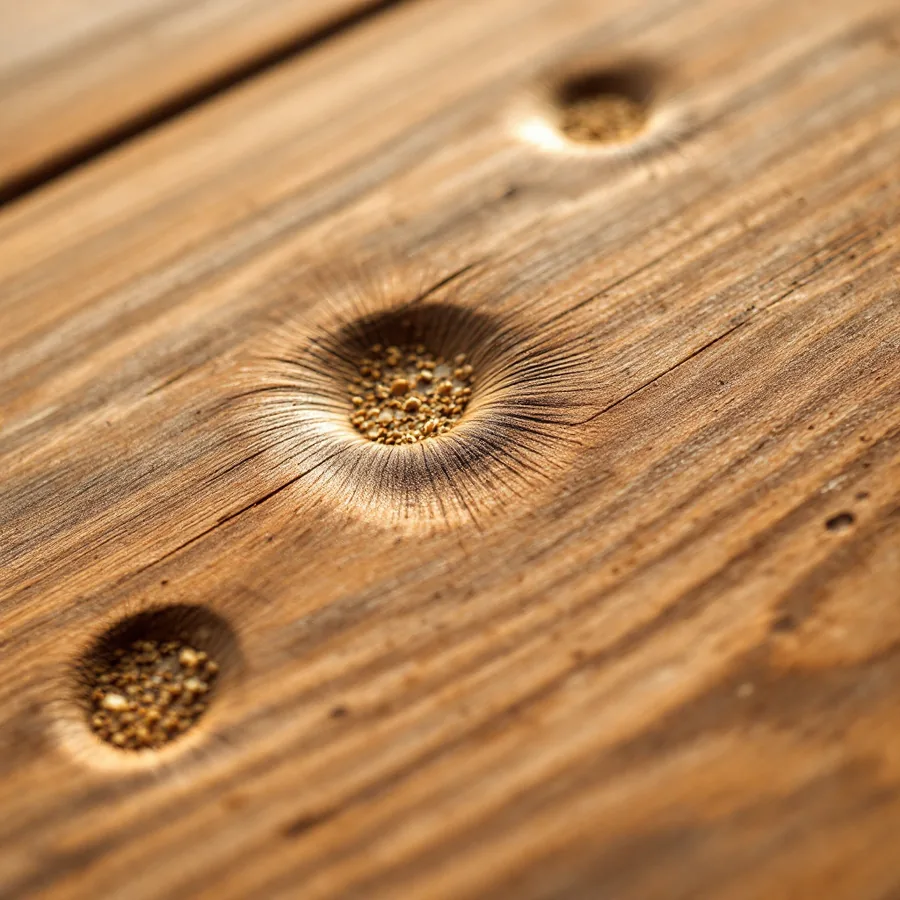
Look for three things after a storm: boards split along the grain, small dents where the fibers are crushed, and spots where stain or paint has been knocked off. The bare spots matter most. The Wood Handbook found that cedar left in the sun for only weeks before painting holds paint for far less time, so a chip left open all summer is a future peel.
Cedar siding hail damage: what to photograph
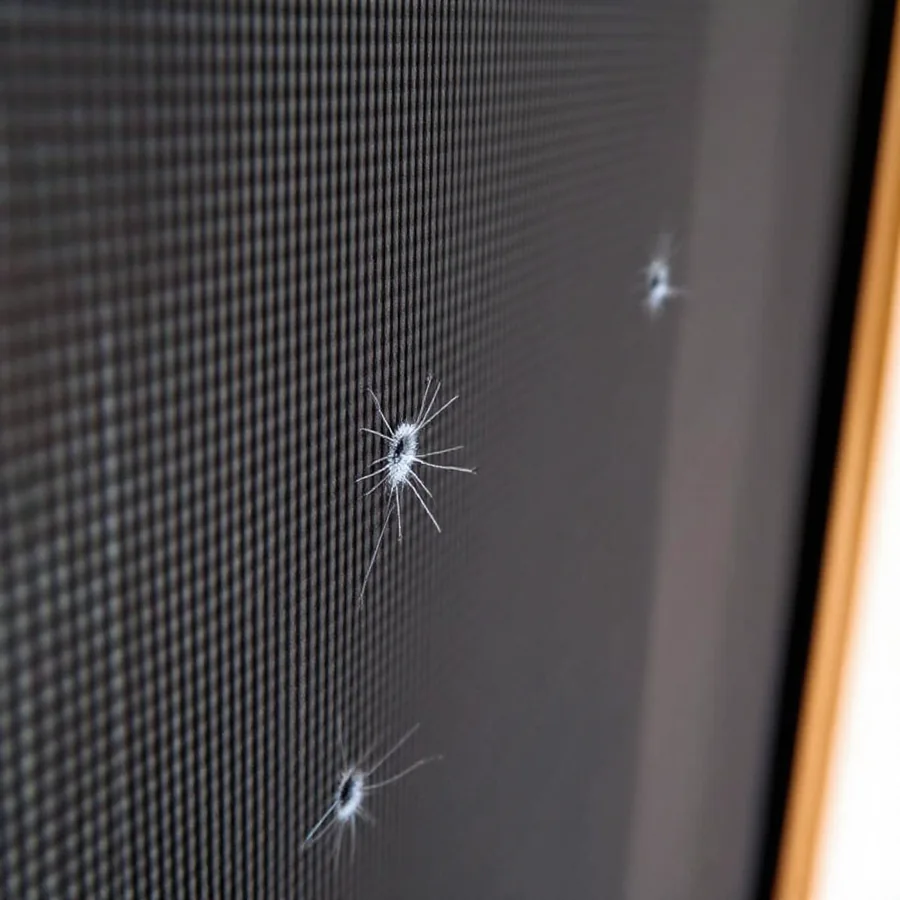
Photograph each wall with the date before anything is touched, then take close-ups with a coin for scale. Dented gutters, screens and a car parked outside are useful evidence of stone size. Then read your own policy before signing anything with a contractor who knocked on the door.
Birds
Woodpecker holes in cedar siding: why the birds pick cedar
Do woodpeckers like cedar siding? A state wildlife agency and a university extension say so in plain words, and a study of more than a thousand houses points the same way.
Connecticut's wildlife agency writes that woodpeckers “are attracted to natural, dark-stained, unpainted cedar and redwood siding”. University of Missouri Extension adds: “Cedar-sided homes in particular experience a high incidence of damage”. A Cornell Lab of Ornithology survey of houses in Ithaca, New York, found that “earth-tone-stained houses were more likely to be damaged than houses painted in brighter colors.”

Nest holes, drumming and feeding furrows
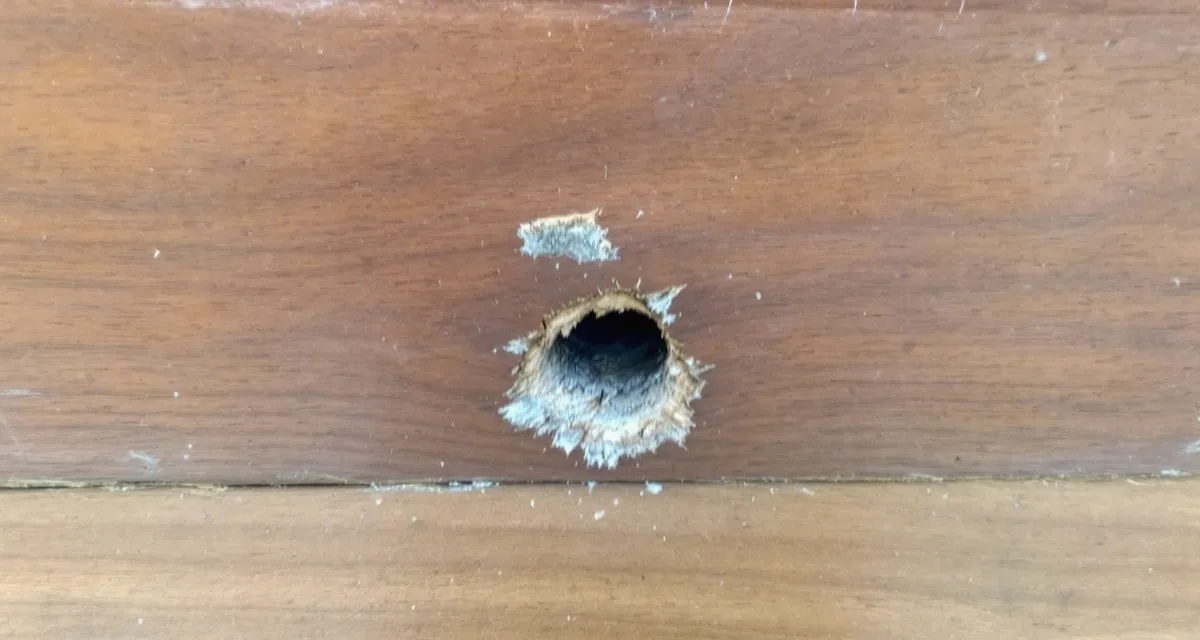
Drumming is the loud tapping in early spring that marks a territory, and it rarely does real harm. Big round holes near the eaves are nest or roost cavities, and the Cornell Lab places nest building “between late April and May.” Connecticut notes that drilling picks up again in fall, when holes serve as winter roosts. Long, narrow furrows along seams mean the bird is hunting insects inside the wall.
How to keep woodpeckers away from cedar siding
Start early, because a bird with a drumming habit is hard to move. Missouri Extension suggests first taking away ledges and cracks the bird can grip. In a 2007 test at 16 sites, reflective streamers stopped the damage at half of them, though the Cornell researchers wrote that “nothing deterred woodpeckers all the time”. For a wall hit year after year, both agencies point to bird netting hung from the eaves and angled back to the siding, or metal flashing over the spot.
Woodpeckers are protected birds
The Migratory Bird Treaty Act bars taking protected birds without federal permission, and Missouri Extension says woodpeckers are covered. Lethal control needs a depredation permit from the U.S. Fish and Wildlife Service. Sticky repellents are out too: Connecticut warns they foul feathers and stain siding.
Repair
How to fix woodpecker holes in cedar siding
Deal with the reason first, then the board. A patched hole over a wall full of bee larvae gets opened again.
Read the pattern. Small, irregular holes or furrows along a seam point to insects. The Cornell Lab names carpenter bee larvae as a common target.
Check for a nest. In late April and May a fresh round hole may hold a nest. Close it before or after the nesting season, not during it.
Patch or replace. Small holes take exterior filler. A hole through the board, or several in one course, calls for a new piece of matching cedar.
Refinish the whole board. A bare patch draws birds and bees alike. Finish it inside the warm-night window above.
Insects
Carpenter bees: the round holes under the eaves
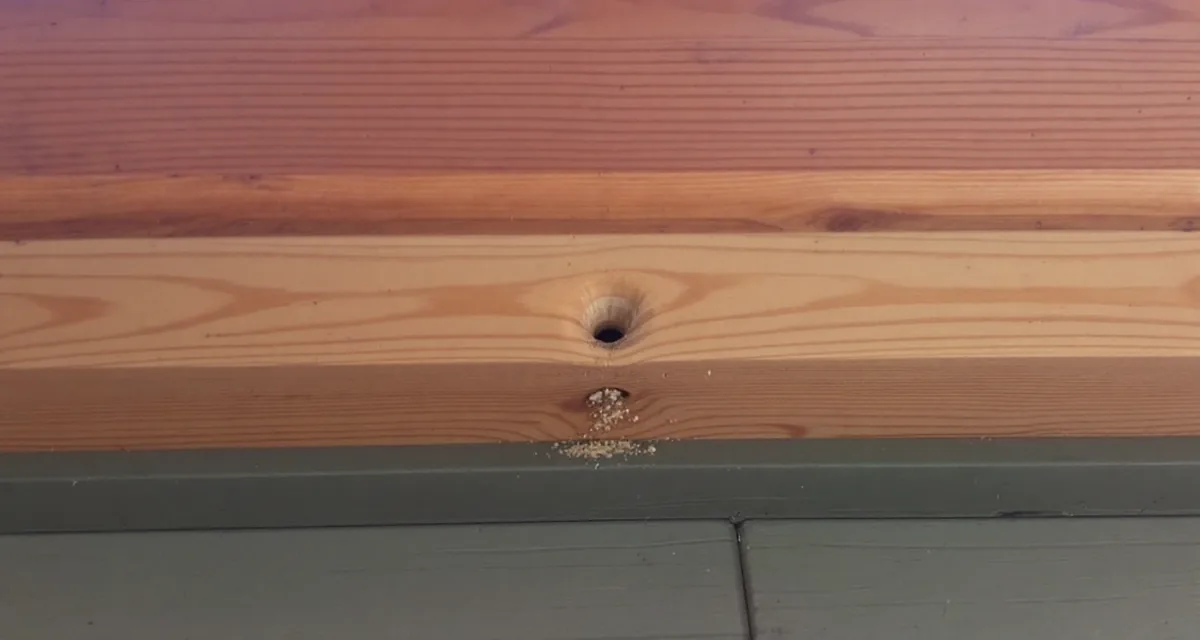
A neat, round hole a little under half an inch across, often on the underside of fascia or trim, is the work of a carpenter bee.
Ohio State University's fact sheet HYG-2074 describes an entrance “slightly less than a half-inch wide”. The bee bores in across the grain, turns, and tunnels 4 to 6 inches along it. Adults come out in April and early May. Eastern carpenter bees prefer softwoods such as cedar, and a tunnel reused for years can reach 10 feet.
Why stain does not stop them
The finish decides a lot. The fact sheet is blunt: “Wood stains will not prevent damage from carpenter bees.” Well-painted wood is avoided. Woodpeckers then dig into the tunnels for the larvae, which is why bees and bird holes so often turn up on the same wall.
Sealing the holes
Ohio State suggests plugging each hole and sealing it with putty or a glued dowel. Bees shut inside a sealed tunnel usually do not chew their way out, the fact sheet notes.
Finish
Cedar siding paint or stain: what lasts in southwest Ohio
Paint lasts longest and keeps bees off; stain shows the grain and needs coats more often. Here are the Wood Handbook's figures for each finish.
| Finish | How the wood looks | Service life |
|---|---|---|
| Water-repellent preservative | Grain visible, tan to brown, fades to gray | 1 to 3 years |
| Tinted clear finish | Grain and color slightly changed | 2 to 3 years |
| Semitransparent stain | Grain visible, color as chosen | 4 to 8 years on saw-textured or weathered wood |
| Solid-color stain | Grain and natural color hidden | 6 to 15 years |
| Paint, primer and two top coats | Grain and natural color hidden | 10 to 20 years |
The handbook's footnote matters: service life depends on preparation, climate, exposure and the wood itself. Around Dayton, the local pests tilt the choice. Stain does not stop carpenter bees, and earth-tone stain draws more woodpecker damage than bright paint in the Cornell survey. A cedar wall near woods, where both are common, has a case for paint or solid-color stain.
Cedar's natural color comes from extractives that can bleed through paint. The handbook advises a stain-blocking primer under any opaque finish on western redcedar and redwood.
Cedar siding rough or smooth side out
The handbook's old rule of thumb was “to paint smooth wood and stain saw-textured wood.” It also notes that coatings on saw-textured surfaces generally last longer. If the plan is semitransparent stain, the rough face out is the usual choice, and the table's 4 to 8 years assumes it.
Can you leave cedar siding untreated?
You can, and it turns gray. Weathering wears the surface away slowly, about a quarter inch in a century by the handbook's estimate. The catch comes later. In a laboratory test, primed and painted cedar boards that first sat a week in the sun began peeling after 13 years. Boards left out 16 weeks peeled within 3. Wood that has gone silver-gray is, in the handbook's words, severely sunburned, and paint will not hold on it without heavy sanding. Bare wood is also what bees and woodpeckers choose.



Fasteners
Cedar siding nails or screws, and the black streaks around them
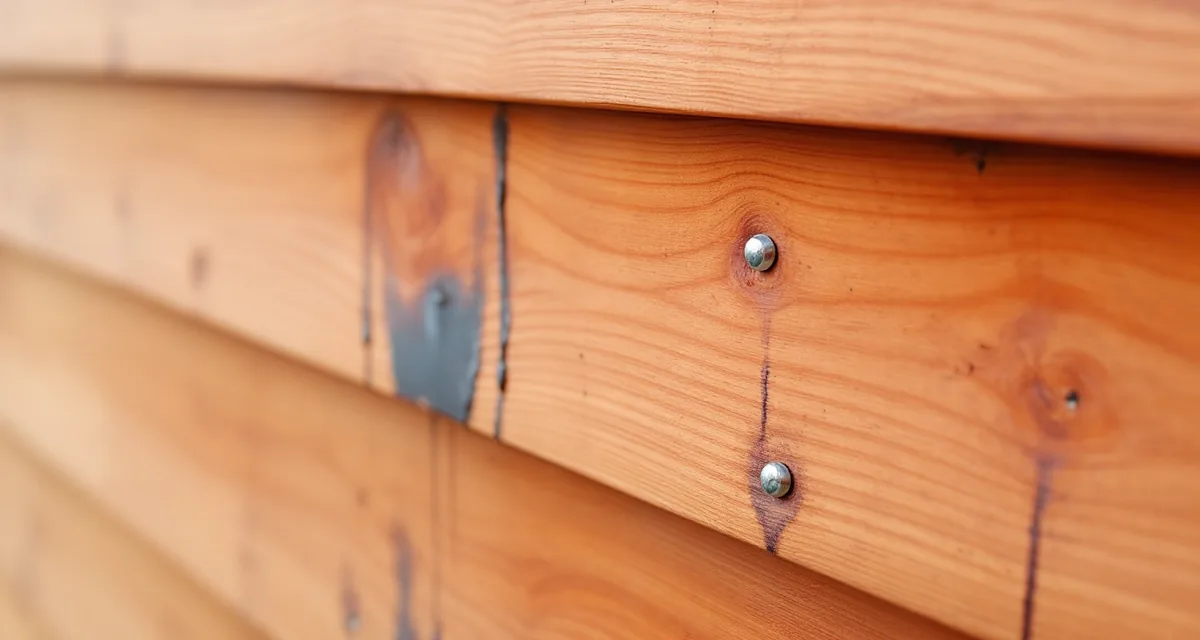
The metal matters more than the shape. Cedar is rich in tannins, and plain steel reacts with them to leave dark streaks under every fastener.
The Wood Handbook says to expect this iron stain with plain carbon steel on western redcedar, redwood and oak. “To our knowledge, stainless steel fasteners are safe from iron stain.” If stainless is not used, high-quality hot-dip galvanized fasteners to ASTM A153 are “far less likely” to stain. The handbook also admits the problem is common, “even when contractors do the work.” Write stainless fasteners into the quote, whether they are nails or screws.
Repair Or Replace
Can cedar siding be repaired, or is it time for replacement boards?
Most cedar walls can be repaired a course at a time. The question is where the water came from, because rot needs wet wood, not damp air.
The Wood Handbook puts the line at the fiber saturation point: serious decay occurs only above it, at about 30 percent moisture. “By itself, the water vapor in humid air will not wet wood sufficiently to support significant decay”. Rain, a leak or soil contact does that. So cedar siding rot repair starts with the source: a missing kickout flashing, a gutter spilling on the wall, a board touching mulch.
Matching the profile
Cedar siding replacement boards have to match the profile (bevel, tongue and groove or shakes), the thickness and the face texture. Take a cut piece to the lumber yard. Prime or stain every face of a new board, cut ends included: the handbook notes that liquid water enters end grain 10 to 100 times faster than the faces. New wood will not match weathered boards at once, so plan to refinish the whole wall.
When cedar siding should be replaced
Replacement makes sense when soft wood runs beyond a few boards, the sheathing behind is wet, or the same wall keeps losing to woodpeckers. For a wall hit again and again, Connecticut's agency even suggests protective aluminum or vinyl siding. Our siding repair guide covers the general steps; our wood siding page compares species.

Alternatives
Cedar siding vs Hardie board, vinyl and LP SmartSide around Dayton
The useful comparison here is local: what each material does with woodpeckers, bees, the finishing season and freezing weather. We list only what a source says.
| Local test | Cedar | Fiber cement (Hardie) | Vinyl | LP SmartSide |
|---|---|---|---|---|
| Woodpeckers | Named a favorite by Connecticut DEEP and MU Extension | — | Suggested by Connecticut DEEP as protection after repeated damage | — |
| Carpenter bees | Preferred softwood (Ohio State) | — | Not damaged (Ohio State) | — |
| Refinishing | Stain 4 to 8 years, paint 10 to 20 (Wood Handbook) | — | — | — |
| Freezing weather | — | HZ5 line sold for freezing climates (manufacturer) | — | — |
Cedar siding vs Hardie board
Cedar siding vs Hardie board comes down to upkeep and pests against the look of real wood. James Hardie says its HZ5 product line is “right at home in climates with freezing temperatures”; that is the maker's claim. More on the material is in our fiber cement guide.
Cedar siding vs vinyl
Cedar siding vs vinyl is the starkest trade: vinyl never needs a stain day, and Ohio State lists it among materials carpenter bees leave alone. Our vinyl siding page covers the rest.
Cedar siding vs LP SmartSide
Cedar siding vs LP SmartSide is harder to judge here: it is an engineered wood product, and we found no public study of how birds or bees treat it. The types of siding guide sets the four side by side.
Ohio Law
Door knockers after a hailstorm: Ohio's three-business-day rule
A contract signed at your door can be cancelled for three business days under Ohio's Home Solicitation Sales Act.
What the notice must say
The required notice in Ohio Revised Code 1345.23 reads: “You may cancel this transaction, without any penalty or obligation, within three business days from the above date.” The seller has to attach a cancellation form to the contract and return payments within ten business days of a cancellation.
What the Attorney General advises
After storms the Ohio Attorney General warns that crews travel to damaged areas and go door to door. The office advises “at least three written estimates from three distinct contractors” and paying in thirds as work is done. The contract should list costs, dates, subcontractors and any licenses and permits.
Older Houses
Older houses: lead paint under the stain
Cedar on a house built before 1978 may carry lead paint under later stain or paint. The EPA's Renovation, Repair and Painting rule requires anyone paid to disturb painted surfaces in such homes to be certified in lead-safe work practices. Owners working on their own home are generally outside the rule; scraping old paint safely is still on them.
Work It Out
Check your cedar wall: suburb, signs and season
Choose the suburb, what you see on the wall, the month you want the work done and the year the house was built. The page works out the order of jobs; no price comes out.
Our fee for an introduction is flat, so we gain nothing from steering you toward a bigger job.
Before You Hire
Hiring cedar siding help in the Dayton and Cincinnati suburbs
Our part is the introduction to an independent contractor. The work, the quote and the warranty are theirs, and this page carries no prices.
Searches for cedar siding Dayton Ohio, cedar siding repair Dayton or siding repair Beavercreek Ohio turn up a long list of firms, most of them general siding contractors. The useful questions are specific. Ask which fasteners they use, whether new boards are primed on all faces before they go up, and when the finish coat will go on. On a house built before 1978, ask for the firm's lead-safe certification.
Whether the search was cedar siding Beavercreek OH or a suburb further south, ask for addresses of cedar jobs at least three years old and go and look. Our calculator works out how many squares of siding a wall takes, so you can check the quantity on a quote.
Questions
Questions southwest Ohio owners ask about cedar siding
How long does cedar siding last?
We give no figure in years for the wall: no source measures one for this region. The finish is what wears. In one Forest Products Laboratory test, primed cedar painted at once was still in good condition after 20 years.
How long does stained cedar siding last before it needs another coat?
The Wood Handbook gives 4 to 8 years for semitransparent stain on saw-textured or weathered wood, and 6 to 15 years for solid-color stain.
Is cedar siding high maintenance?
More than vinyl or fiber cement. Expect a finish coat every few years, a look for woodpecker and bee holes each spring, and a check after every hailstorm.
Does cedar siding need to be treated?
It does not rot quickly when kept off the ground and dry, but the handbook advises finishing cedar as soon as possible after installation. Bare wood also draws bees and woodpeckers.
When should I stain cedar siding in Ohio?
Around Dayton, between May 5 and October 4, when the normal overnight low stays at 50°F or above. Check the label on the product too.
Will painting stop woodpeckers?
It helps. In the Cornell Lab's survey, brightly painted houses were damaged less often than earth-tone stained ones, but the researchers found that no single method worked every time.
Do you install cedar siding?
No. We introduce Ohio homeowners to independent siding firms, and our fee for that is the same whether the job is one board or the whole house.
Where This Comes From
Sources and method
- Hail and wind reports, five counties: NOAA National Centers for Environmental Information, Storm Events Database, bulk files StormEvents_details-ftp_v1.0, 2006 to 2025; revisions c20260323 for 2006-2016, 2018-2021, 2023; c20260519 for 2017; c20260625 for 2022; c20260728 for 2024; c20260819 for 2025. Our count.
- Severe hail threshold: NOAA Storm Prediction Center, About the SPC.
- Climate normals: NOAA U.S. Climate Normals 1991 to 2020, Dayton daily, Cincinnati daily, Dayton monthly and Cincinnati monthly. Our calculations.
- Decay index: Carll, C.G., Decay Hazard (Scheffer) Index Values Calculated From 1971–2000 Climate Normal Data, USDA Forest Products Laboratory, FPL-GTR-179, 2009.
- Finishes, fasteners, moisture: USDA Forest Products Laboratory, Wood Handbook (FPL-GTR-282, 2021), chapter 16, Finishing Wood and chapter 14, Biodeterioration of Wood.
- Suburbs and counties: U.S. Census Bureau, 2020 reference file of Ohio places and county subdivisions.
- Woodpeckers: Connecticut DEEP, Problems with Woodpeckers; University of Missouri Extension, G9449; Cornell Lab of Ornithology, All About Birds; U.S. Fish and Wildlife Service, Migratory Bird Treaty Act.
- Carpenter bees: Ohio State University Extension, HYG-2074, Carpenter Bees.
- Ohio rules: Ohio Revised Code 1345.23; Ohio Attorney General, Severe Weather Brings Out Scammers (2024). Lead: EPA lead rule for renovators (RRP). HZ5: James Hardie, Hardie Zone System (manufacturer's statement).
Our editorial standards explain how we source and check what we publish. The hail count, the staining window and the decay index are ours, from the public files named above, and anyone can repeat them. We are a referral service rather than a contractor. Last updated .
Before you call anyone
The flat-fee match — we are paid for the introduction, not for the size of your job
Most siding advice is written by the company that wants to do the work or the company that makes the product. That is not a failing of the people who read it; it is a defect in who is talking: the measurement, the estimate and the invoice come from one party, and no amount of care on your side fixes that.
We are built the other way round. We do not install, repair or sell anything, so the payment reaches us when you are connected to a licensed, insured siding contractor — the same amount whether you need one panel replaced or four walls re-clad. Nobody here has a reason to talk you into the larger number. You can check that rather than take it on trust: how we make money is written down, and this site keeps telling readers when one wall is enough. Why does not everyone work this way? Because a flat fee leaves money on the table every time the job turns out to be big.
Waiting is the one thing that actually costs money. A wall that is open to the weather does not get better and does not wait for a convenient week; the water that gets behind the siding finds the sheathing, the framing and the drywall inside. A cracked panel over a window lets the next storm in. And if it turns out to be one panel and a quarter-hour, say so when you ask. We will tell you, and that answer earns us nothing.
Not for you if: you want a price over the phone — nobody honest gives one without measuring the house; you need a guarantee of arrival within the hour — we cannot promise that for a company we do not run; the building is commercial; or you would rather do it yourself, in which case the pages on this site are written so that you can.