Types of Siding
Types of siding: what American houses are clad in, and how to choose yours
Reviewed by the Siding Pros USA editorial team · · 26 min read
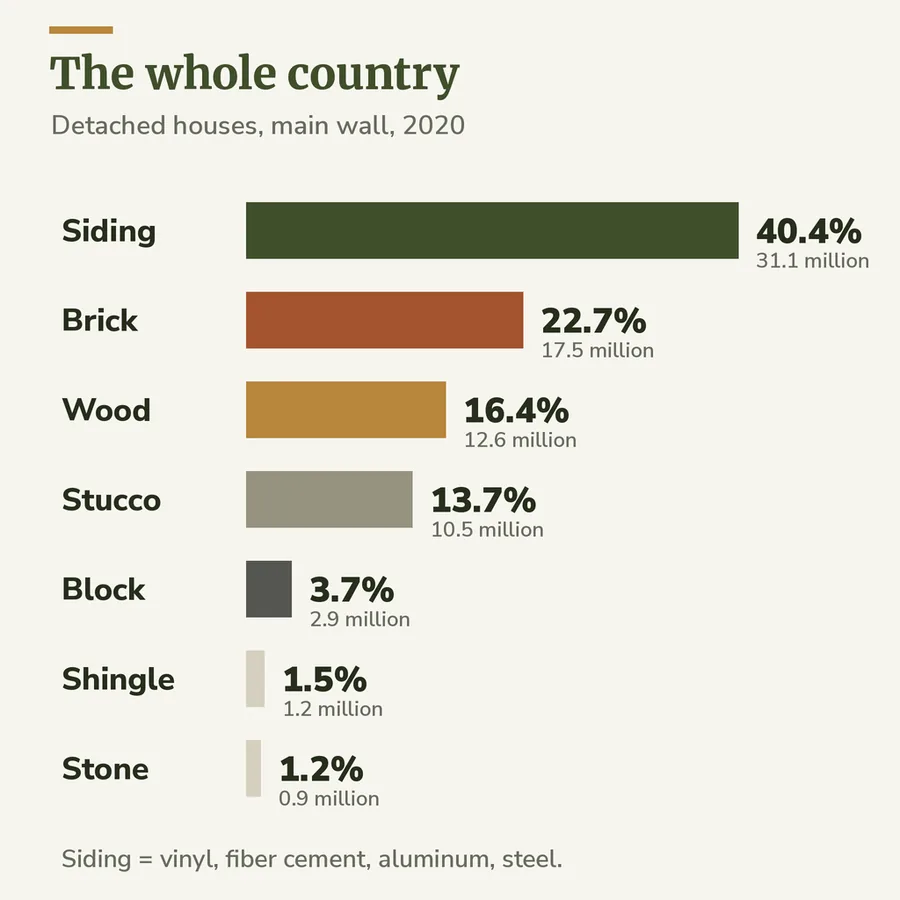
The main types of siding are vinyl, fiber cement, wood, engineered wood, metal, stucco, brick, stone veneer and composite. We counted what the 77.1 million detached houses in the federal energy survey actually wear: siding of the vinyl, fiber cement, aluminum or steel kind is on 40.4 percent, brick on 22.7 percent and wood on 16.4 percent. The answer changes sharply with climate, and that is the most useful thing to know before you choose.
Types of siding, and what most houses already wear
- Siding first, brick second. Across the country, 40.4 percent of detached houses are clad in siding (vinyl, fiber cement, aluminum or steel, which the survey counts together), 22.7 percent in brick, 16.4 percent in wood and 13.7 percent in stucco.
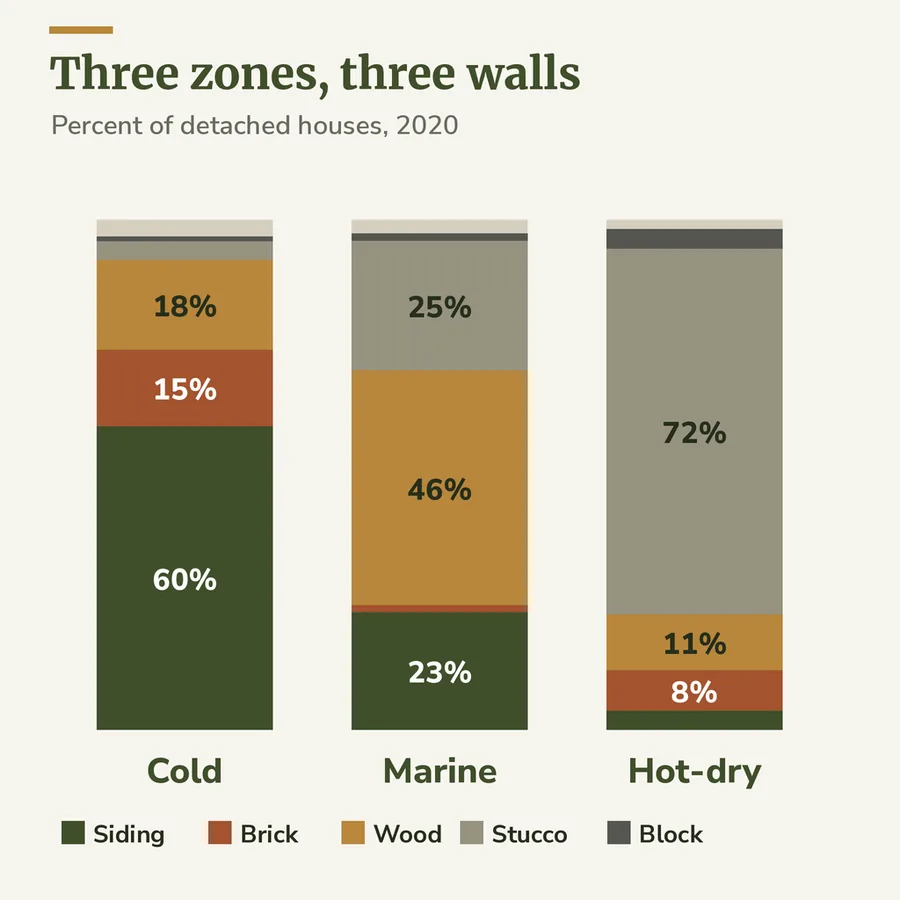
- Climate decides. Siding covers 59.5 percent of houses in the cold zone and 3.7 percent in the hot-dry zone, where stucco is on 71.8 percent. In the marine Northwest, wood leads with 46.0 percent.
- New houses differ from old ones. Wood is on 22.2 percent of houses built before 1950 and 6.1 percent of those built from 2016 to 2020.
- Material and style are separate. Lap, Dutch lap, board and batten and shakes are shapes. Most of them are sold in several materials, so pick the look and the material one at a time.
This page covers the types of house siding and how to choose between them. Each material has a deeper page of its own, linked from its section below. What re-siding costs is on our siding cost page, in its section on the cheapest siding. We publish no price averages, and we sell and install nothing.
Our Count
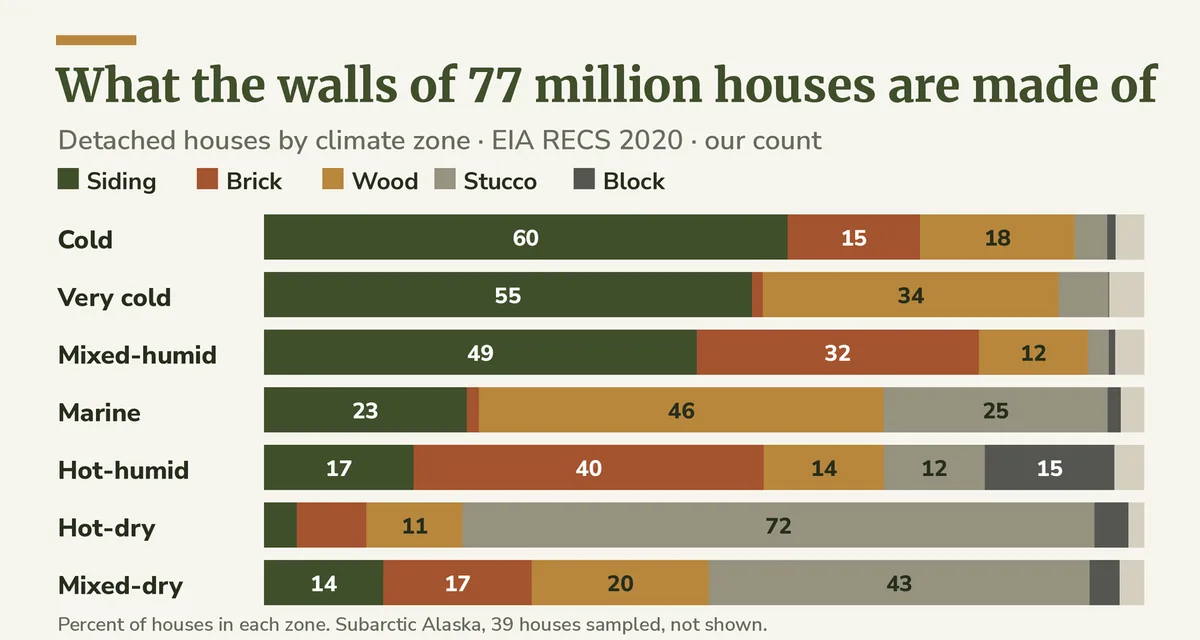
Our count: what 77 million detached houses are clad in, by climate
The Energy Information Administration asks a national sample of households what the outside walls of their home are mostly made of. We took the public microdata for the 12,319 detached single-family houses in the 2020 survey and weighted them to the 77.1 million they stand for, by climate zone.
| Climate zone | Siding | Brick | Wood | Stucco | Concrete block | Houses sampled |
|---|---|---|---|---|---|---|
| Cold | 59.5 | 15.0 | 17.6 | 3.7 | 1.0 | 4,988 |
| Very cold | 55.5 | Q | 33.6 | 5.6* | Q | 354 |
| Mixed-humid | 49.2 | 32.0 | 12.4 | 2.4 | 0.7 | 3,520 |
| Marine | 23.1 | Q | 46.0 | 25.4 | Q | 588 |
| Hot-humid | 17.0 | 39.8 | 13.6 | 11.5 | 14.7 | 1,704 |
| Hot-dry | 3.7 | 7.9 | 10.9 | 71.8 | 3.9 | 1,018 |
| Mixed-dry | 13.6 | 16.9 | 20.2 | 43.2 | Q | 108 |
| Subarctic | 24.5 | – | 75.5 | – | – | 39 |
| All detached houses | 40.4 | 22.7 | 16.4 | 13.7 | 3.7 | 12,319 |
What the table shows
No single material dominates the country. Siding wins in the cold north and the humid middle, brick along the Gulf, stucco in the dry Southwest and wood on the wet Pacific coast. The share of houses in siding is 16 times higher in the cold zone than in the hot-dry one. Read any national ranking of house siding materials with that in mind: it is an average of places that build very differently.
Why existing houses, not sales
Most pages about types of siding describe what is sold this year. A house you buy, or the one you are re-siding, was clad years ago. What is on the houses around you is a record of what local builders and crews have chosen, over and over, in your climate. It is not a test result, but it tells you which materials have a long local track record and which trades are easy to find.
The words “siding” and “wood” in the survey
The survey offers one answer for vinyl, fiber cement, aluminum and steel together, called siding, and a separate answer for wood. A wood clapboard house is counted as wood, not siding. A fiber cement house painted to look like wood is counted as siding. Engineered wood is not named, so owners of it chose whichever answer they thought fit.
How we worked it out
We used the EIA’s 2020 Residential Energy Consumption Survey public file, version 7, and kept the houses it codes as single-family detached. Each house carries a weight that says how many homes it represents; shares are weighted. The survey publishes 60 replicate weights for measuring uncertainty, and we used them with the jackknife formula in the EIA’s own microdata guide. Our national totals match the agency’s published table HC2.1 to the hundredth of a million: 31.14 million detached houses in siding, for example.
Limits of the count
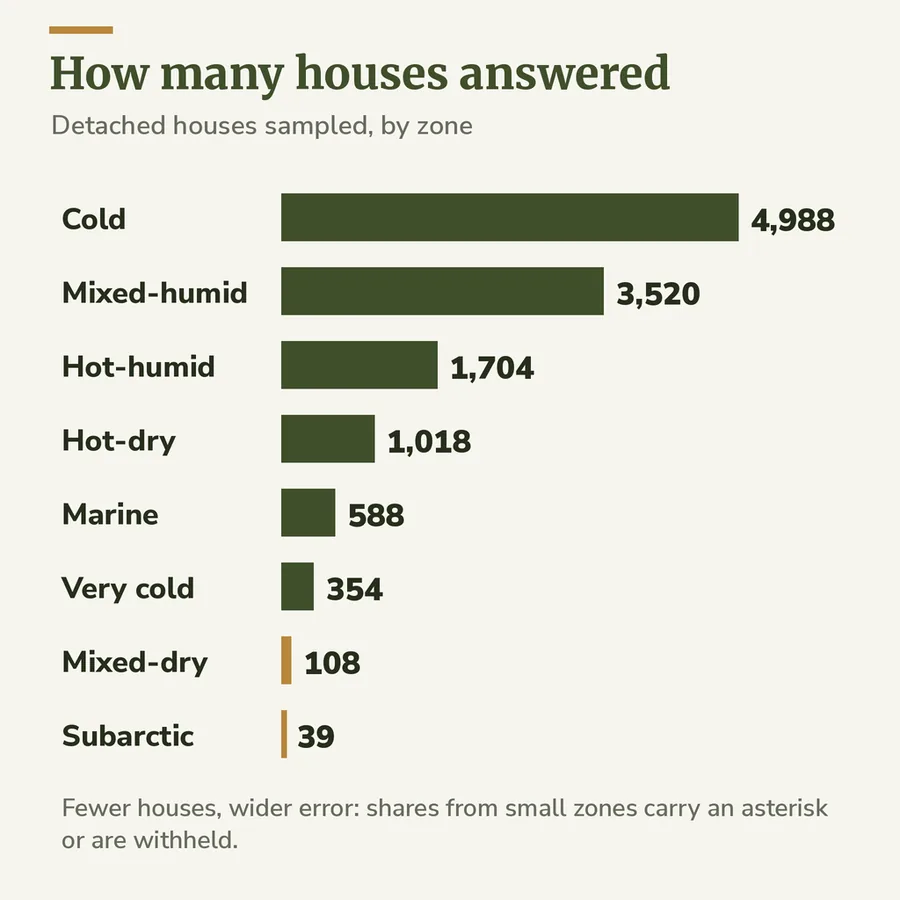
Households described their own walls; nobody inspected them. The year is 2020, so houses re-sided since then still show their old wall. Townhouses, apartments and mobile homes are left out. Where a zone or a state has few houses in the sample, we follow the EIA’s own rule: a share is withheld when its relative standard error passes 50 percent or fewer than ten houses gave that answer, and marked with an asterisk between 30 and 50 percent.
Our Count, by Age
What houses are clad in, by the decade they were built
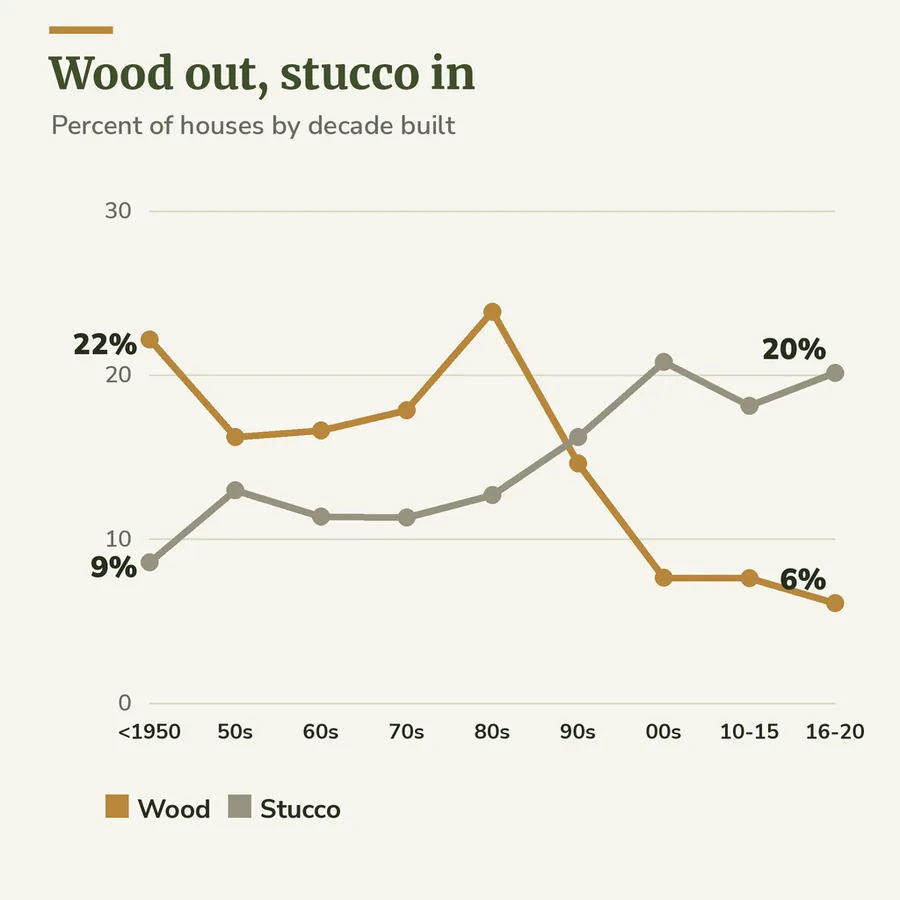
The same count split by when the house was built. It shows wood holding its place until the 1980s and then falling away, the rise of stucco, and it gives you a first guess at what is on an older house before anyone pulls a board.
| Built | Siding | Brick | Wood | Stucco | Concrete block | Houses sampled |
|---|---|---|---|---|---|---|
| Before 1950 | 48.8 | 14.2 | 22.2 | 8.6 | 2.0 | 1,946 |
| 1950s | 38.7 | 24.5 | 16.2 | 13.0 | 4.4 | 1,369 |
| 1960s | 33.1 | 32.1 | 16.6 | 11.4 | 3.6 | 1,312 |
| 1970s | 35.5 | 28.0 | 17.9 | 11.3 | 4.4 | 1,780 |
| 1980s | 33.8 | 24.0 | 23.9 | 12.7 | 4.0 | 1,434 |
| 1990s | 43.8 | 20.4 | 14.6 | 16.2 | 3.6 | 1,601 |
| 2000s | 42.7 | 20.2 | 7.6 | 20.8 | 5.3 | 1,810 |
| 2010 to 2015 | 40.5 | 25.8 | 7.6 | 18.1 | 2.7* | 586 |
| 2016 to 2020 | 45.6 | 21.8 | 6.1 | 20.1 | 3.8* | 481 |
Wood holds, then falls
Wood is the wall of 22.2 percent of houses built before 1950 and still of 23.9 percent of those built in the 1980s. Then it falls: 7.6 percent of houses built in the 2000s. Builders moved to siding and stucco. The oldest houses show the highest share of siding of any decade, 48.8 percent, which most likely reflects re-siding: the wall a family reports today is not always the wall the house was built with.
Stucco and brick follow the Sun Belt
Stucco rises from 8.6 percent of pre-1950 houses to about one in five houses built since 2000. Brick peaks with the houses of the 1960s, at 32.1 percent. Both are Southern and Western walls, so their rise most likely reflects where the country’s houses were being built.
What it tells you about an older house
A house from before 1950 that wears vinyl or aluminum today likely has an earlier wall underneath, often wood. That matters when someone quotes a tear-off: what comes off may be two layers, and on a house built before 1978 the old paint may contain lead. The section on identifying your siding goes further.
Old Streets, New Houses
Standing versus new: what is on houses now and what builders chose in 2025
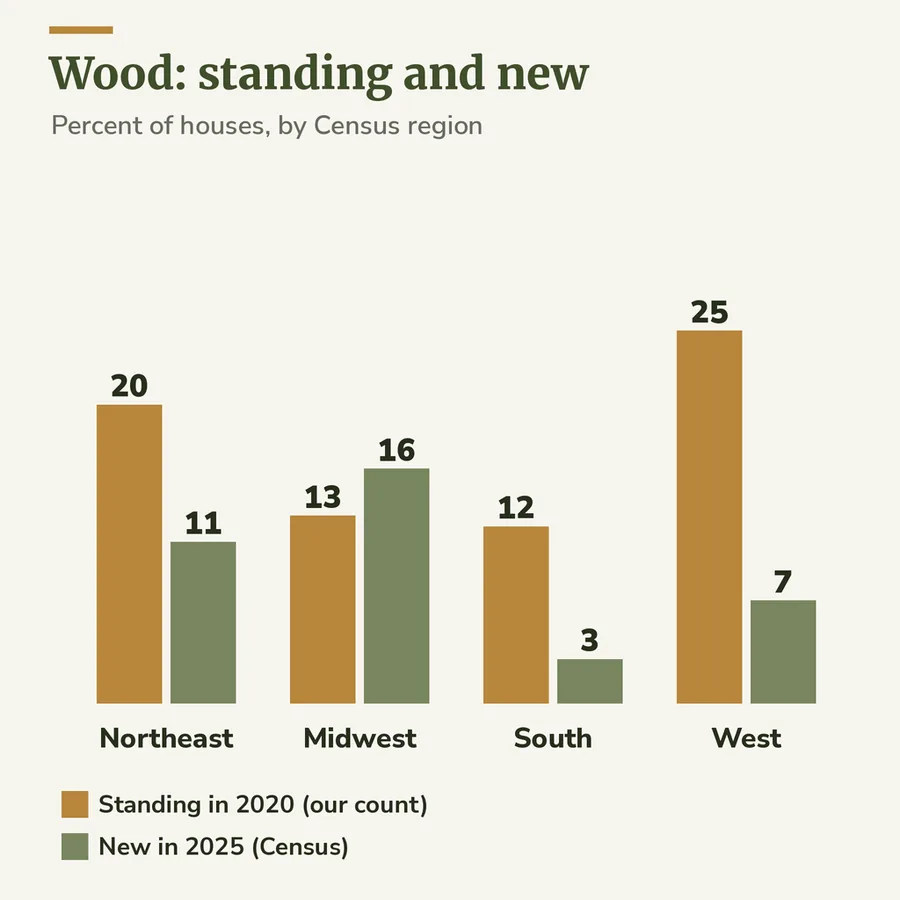
Our count of the houses standing in each Census region, beside the Census Bureau’s figures for the 1,005,000 new single-family houses finished in 2025. The gap shows where taste and building practice are moving.
| Region | Siding, standing | Siding, new | Wood, standing | Wood, new | Brick, standing | Brick, new | Stucco, standing | Stucco, new |
|---|---|---|---|---|---|---|---|---|
| Northeast | 60.5 | 78 | 20.4 | 11 | 10.0 | 8 | 2.5 | 1 |
| Midwest | 62.6 | 76 | 12.8 | 16 | 18.7 | 4 | 2.6 | under 0.5 |
| South | 32.0 | 45 | 12.0 | 3 | 39.5 | 26 | 6.4 | 23 |
| West | 17.9 | 36 | 25.4 | 7 | 5.7 | 1 | 46.2 | 55 |
| United States | 40.4 | 49 | 16.4 | 6 | 22.7 | 16 | 13.7 | 26 |
The West builds fiber cement, not wood
In the West, wood is on 25.4 percent of standing houses and on 7 percent of new ones. Fiber cement alone is on 31 percent of the new houses there, down from 37 percent in 2020. Stucco holds its place, at 46.2 percent of standing houses and 55 percent of new ones.
The South is building less brick
Brick is on 39.5 percent of houses standing in the South and 26 percent of the new ones. Stucco and fiber cement have taken the difference, at 23 percent and 24 percent of new Southern houses.
The North stays with siding
The Northeast and Midwest are siding country on both counts. New houses there are mostly vinyl: 70 percent in the Northeast and 64 percent in the Midwest. Our home page shows what builders chose in each region, year by year.
Two Decisions
Material and style are two separate choices
Most lists of the different types of siding mix materials and shapes in one list, which hides the real choice. A material is what the wall is made of. A style, or profile, is the shape the boards make on the wall.
Clapboard, Dutch lap, board and batten and cedar-look shakes are styles. Vinyl, fiber cement, wood, engineered wood and steel are materials, and most of them are made in several styles. You can have board and batten in vinyl, fiber cement, wood, engineered wood or steel; we cover that combination on our board and batten page. So the useful order is to pick the look you want, then ask which materials offer it, then choose between those on climate, upkeep and budget.
The look comes first for most people
Style is what neighbors, buyers and historic boards notice. It also sets some of the cost, since a vertical or shake pattern takes more trim and more cuts than plain lap. Settle it before you compare quotes, or every quote will price a different house.
The material decides the next thirty years
Material sets the upkeep: painting or not, washing, sealing cut edges. It also sets how the wall handles impact, moisture and fire, and how easy it is to find a crew that installs it well where you live. Those are the questions the sections below take one material at a time.
Material 1
Vinyl siding
Vinyl siding is a rigid PVC panel with the color molded through it, hung loose on nails so it can grow and shrink with the temperature. New houses in the Northeast are 70 percent vinyl, and nationally it is on 26 percent of houses finished in 2025.
Types of vinyl siding
The vinyl siding types you will be offered are mostly profiles: horizontal clapboard, Dutch lap and beaded lap; vertical board and batten; shakes and shingles molded to look like cedar; and accent panels. Lines also differ by thickness, by how deep the panel stands off the wall, and by whether foam is laminated behind it. Two panels that look the same in a photo can be very different products.
Where vinyl works
Vinyl suits owners who do not want to paint. It is a common choice for re-siding in the cold and mixed-humid zones, where siding already covers most houses and crews install it often. Damage is usually repaired one panel at a time.
Where vinyl struggles
Cold makes it stiffer and easier to crack on impact. A grill, or sunlight bounced off a window, can distort it. Long panels move a measurable distance every year, and a panel nailed too tight waves or cracks; our siding repair page works out that movement for 24 cities. Faded panels are hard to match years later.
Best vinyl siding: what to compare
When people search for the best vinyl siding, they usually mean the best line. Compare lines by thickness, panel depth, the color warranty and whether the line makes a dark color designed for heat. We read sixteen lines side by side on our vinyl siding page, with the details a quote rarely names.
Material 1, Variant
Insulated vinyl siding
Insulated vinyl siding is a vinyl panel with rigid foam glued to its back. The foam stiffens the panel and adds some insulation over the studs.
Few re-siding jobs use it. A 2023 presentation by Pacific Northwest National Laboratory for the Department of Energy gives its share of the total market as 3-5% insulated siding
. The same slide shows that thin foam is common: 50% added fan-fold
, meaning the folded foam sheets laid under siding as a backer. Foam an inch thick or more was rare, and the presentation lists the added effort and cost among the barriers.
Best insulated siding: the honest comparison
The best insulated vinyl siding is the one whose stated insulation value you can check on the label, compared with a second option: ordinary siding over a layer of rigid foam board. Ask for both prices. The foam-board route usually adds more insulation, and it works under fiber cement or wood as well as vinyl. More on that in the section on energy.
Material 2
Fiber cement siding
Fiber cement is a board of cement, sand and cellulose fiber, pressed into planks, shingles or panels and either primed for paint or finished at the factory. It grew more than any other wall in new construction over twenty years, from 9 percent of houses finished in 2005 to 23 percent in 2025, and it is on 31 percent in the West.
Fiber cement siding materials and options
Fiber cement siding options include lap planks in smooth or wood-grain texture, vertical panels, shingle panels and trim boards. The difference between makers is real but small next to the difference between a careful installer and a careless one: gaps, flashing and the clearance above the ground decide how the wall ages.
Where fiber cement works
It holds paint well, does not rot and stands up to knocks that would dent aluminum or crack cold vinyl. Where wildfire rules apply, it is often one of the materials local codes accept for exterior walls; check the product’s code report and your building department.
Where it struggles
It is heavy and brittle before it is fastened, so it needs a trained crew. Cutting it makes silica dust, which is regulated on job sites. Painted boards need repainting over the years, and joints need caulk. We compared three makers’ code reports on our fiber cement page, where their specifications sit side by side.
Material 3
Wood siding
Wood siding is sawn boards, shingles or shakes, usually cedar, redwood, pine, spruce or cypress, finished with paint or stain. It is on 16.4 percent of detached houses today and 6 percent of those finished in 2025.
Types of wood siding
The main types of wood siding are bevel or clapboard, shiplap and channel, tongue and groove, board and batten, and shingles and shakes. A 1983 Forest Service bulletin on wood siding called bevel the usual pattern: For houses, bevel siding is perhaps the most widely used.
It is also the look that vinyl, fiber cement and engineered wood copy most. Types of cedar siding include the same patterns plus split shakes and sawn shingles.
Where wood works
Wood is the original, and it can be repaired one board at a time for decades. It suits historic districts, where rules may require it, and the wet Pacific coast, where it covers 46.0 percent of houses in our count.
Where it struggles
It needs a finish on a schedule for life, and end grain left wet will rot. Each species shrinks and swells by a different amount as it dries; our wood siding page tabulates thirteen of them and covers the wood siding options from cedar to modified wood.
Material 4
Engineered wood siding
Engineered wood siding is made of wood strands or fibers bound with resin and wax, pressed into long boards with a printed or embossed grain and sold primed or pre-finished.
It looks like painted wood, weighs less than fiber cement and cuts with ordinary woodworking tools. Long board lengths mean fewer joints on a wall. The survey has no box for it, so it hides in our count under wood or siding, whichever owners felt was closer.
What to watch with engineered wood
Its weak point is water at cut edges and at the bottom course. Makers publish installation rules for sealing cut ends, gaps at trim and clearance above roofs and ground, and their warranties lean on them. Ask the installer which instructions they follow and whether they have installed the product before.
Engineered wood or fiber cement?
The two are the usual choice for a painted lap look without real wood. Engineered wood is lighter and cuts like lumber; fiber cement does not burn and does not rot. Both need paint over time. That comparison belongs on the page for a specific product; here it is enough to know both are mainstream.
Material 5
Metal siding: steel and aluminum
Metal siding is formed steel or aluminum with a baked-on finish. The survey counts it with vinyl and fiber cement as siding, and Census counts it under other materials for new houses, so its share is not measured on its own.
Types of metal siding
The types of metal siding fall into two groups. Residential lap and vertical panels in steel or aluminum copy the shapes of vinyl and wood. Corrugated and standing-seam panels, borrowed from barns and roofs, give the modern farmhouse and industrial look.
Aluminum siding options
Aluminum was common on houses from the middle of the last century and is still on many of them. It does not rust, but it dents in hail and its paint turns chalky in the sun. New aluminum siding options are limited; most homes that have it either keep and repaint it or re-side.
Steel siding
Steel resists dents better than aluminum and comes in heavier gauges. A scratch or cut edge that exposes the steel can rust, so the finish and the trim system matter. One quick way to tell the two apart on an existing house: a magnet sticks to steel and not to aluminum. Gauges, coatings and what eighteen makers’ warranties say near salt water are on our metal siding page.
Material 6
Stucco
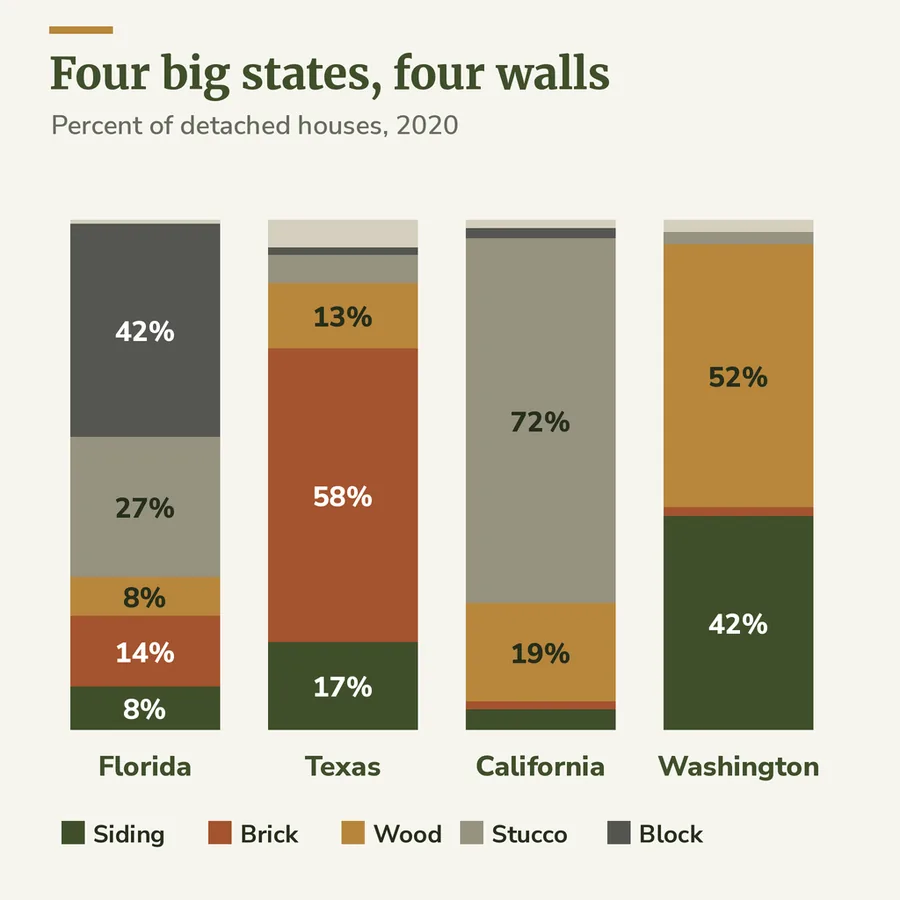
Stucco is a cement plaster troweled over wire lath in coats, finished in a texture and color. It covers 71.8 percent of detached houses in the hot-dry zone and 71.6 percent in California.
Stucco is not siding in the trade sense: plasterers apply it, not siding crews. It is seamless, hard and does not burn, which suits dry, sunny places. Its weak points are cracks and water: a stucco wall depends on the barrier and flashing behind it to send water out. Newer systems add a drainage gap or foam under the plaster.
Siding over stucco, or stucco over siding
Covering stucco with siding is possible over furring strips, and replacing old siding with stucco is possible over new lath. Both change the wall depth at windows and doors. Either one is a bigger job than re-siding like for like, and it is worth asking why before agreeing to it.
Material 7
Brick and brick veneer
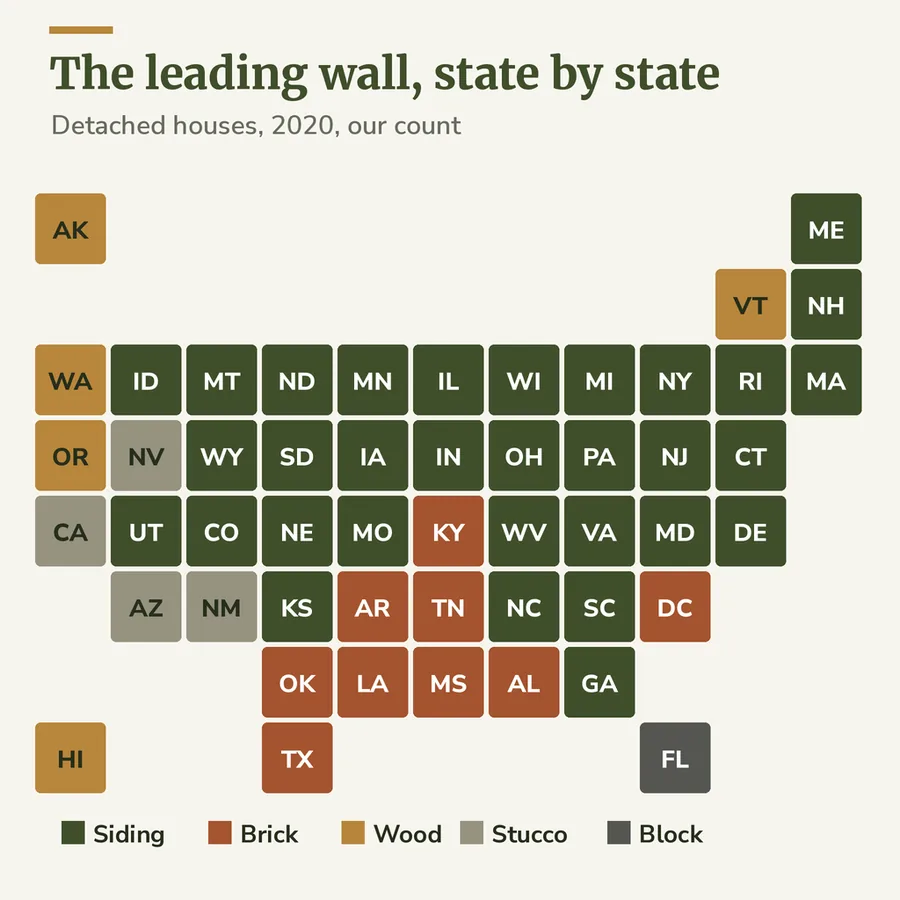
Brick is the second most common wall in the country, on 22.7 percent of detached houses. It is the leading wall in 9 of the 51 places in our count (the 50 states plus the District of Columbia), among them Texas at 57.5 percent and Louisiana at 55.0 percent.
On most houses built in recent decades, brick is a veneer: one layer of brick tied to a framed wall, with an air space and weep holes at the bottom to let water out. Older houses may have solid brick walls. Brick needs little beyond mortar repair, and it is not re-sided; masons repair it.
Siding on brick houses
Brick houses still carry siding: on gables, dormers, second stories and additions. When those are re-sided, the new material has to meet the brick at clean flashed edges. Matching the existing color or texture of those upper walls is often the hard part.
Material 8
Stone and stone veneer
Stone is the main wall of 1.2 percent of detached houses in our count. It is also used as an accent: a base course, a chimney or an entry.
Full natural stone is a masonry trade and a structural decision. Thin natural stone and manufactured stone veneer, a cast concrete product colored to look like fieldstone or ledgestone, are what most homeowners mean by stone siding options. They go on over a framed wall with a water-resistive barrier, lath and mortar.
What decides how it ages
Stone veneer itself lasts; the risk is water behind it. Flashing at the top, a weep screed at the bottom and a drainage layer behind it decide whether the wall behind stays dry. Ask who details those, because the mason and the siding crew may each assume the other did.
Material 9
Composite, polymer and fiberglass siding
Composite is a loose label for siding made of blends: plastic and wood fiber, plastic and stone powder, cellular PVC, or resin and glass fiber. The products differ more from each other than vinyl lines do.
Polymer shakes
Molded polymer shakes copy split cedar in thick, deep panels with varied widths. They are often sold as vinyl or polymer shake siding: the color goes through, there is nothing to stain, and a panel reads as several shingles from the street.
Best composite siding: how to judge it
Because composite covers so many recipes, judge each product on four things: what it is made of, how it is fastened and gapped, what the warranty covers, and whether a crew near you has installed it. A product few people install can be hard to repair in fifteen years.
A Wall, Not a Siding
Concrete block walls, and why Florida is different
Concrete block is the main wall of 3.7 percent of detached houses nationally and of 41.9 percent in Florida. Florida is the one state where it leads; across the hot-humid zone it is on 14.7 percent.
A block house is built of hollow concrete units, usually finished with stucco or paint. Owners who answered “concrete block” and owners who answered “stucco” may have similar-looking houses. Either way, the wall is masonry. It is not re-sided the way a framed wall is, and siding work on such a house is usually limited to gables, porches and additions.
Shapes on the Wall
Siding styles: lap, Dutch lap, shakes, vertical and board and batten
The different types of siding styles are shapes that most materials copy. Here is what each looks like and what it is usually made in.
| Style | What it looks like | Commonly made in |
|---|---|---|
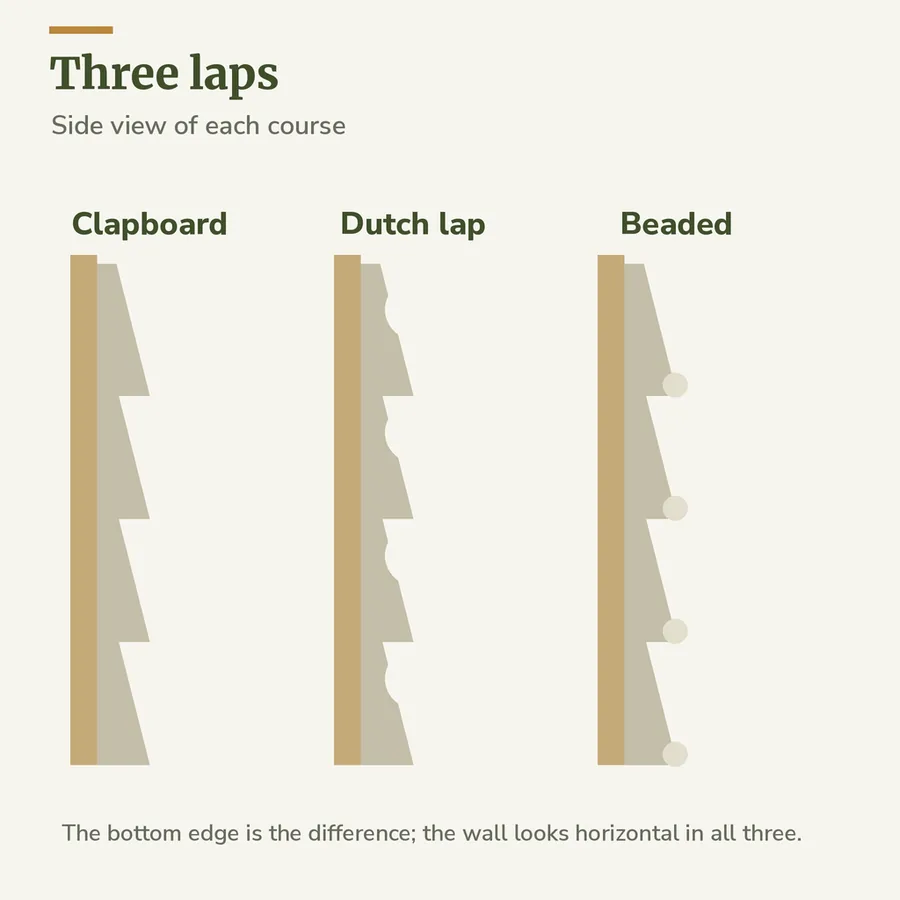
| Lap, clapboard or bevel | Horizontal boards, each lapping the one below, with a shadow line under every course | Vinyl, fiber cement, wood, engineered wood, aluminum, steel |
| Dutch lap | Lap with a concave groove cut under each course, giving a deeper shadow | Vinyl and wood, mostly |
| Beaded lap | Lap with a small rounded bead along the bottom edge of each course | Vinyl, fiber cement, wood |
| Shiplap and channel | Flat boards with rabbeted edges that fit together, leaving a neat gap line | Wood, engineered wood; vinyl and fiber cement versions exist |
| Board and batten | Wide vertical boards with narrow strips covering the joints | Vinyl, fiber cement, wood, engineered wood, steel |
| Vertical V-groove or tongue and groove | Narrow vertical boards with a V or flat seam at each joint | Wood, engineered wood, vinyl, steel |
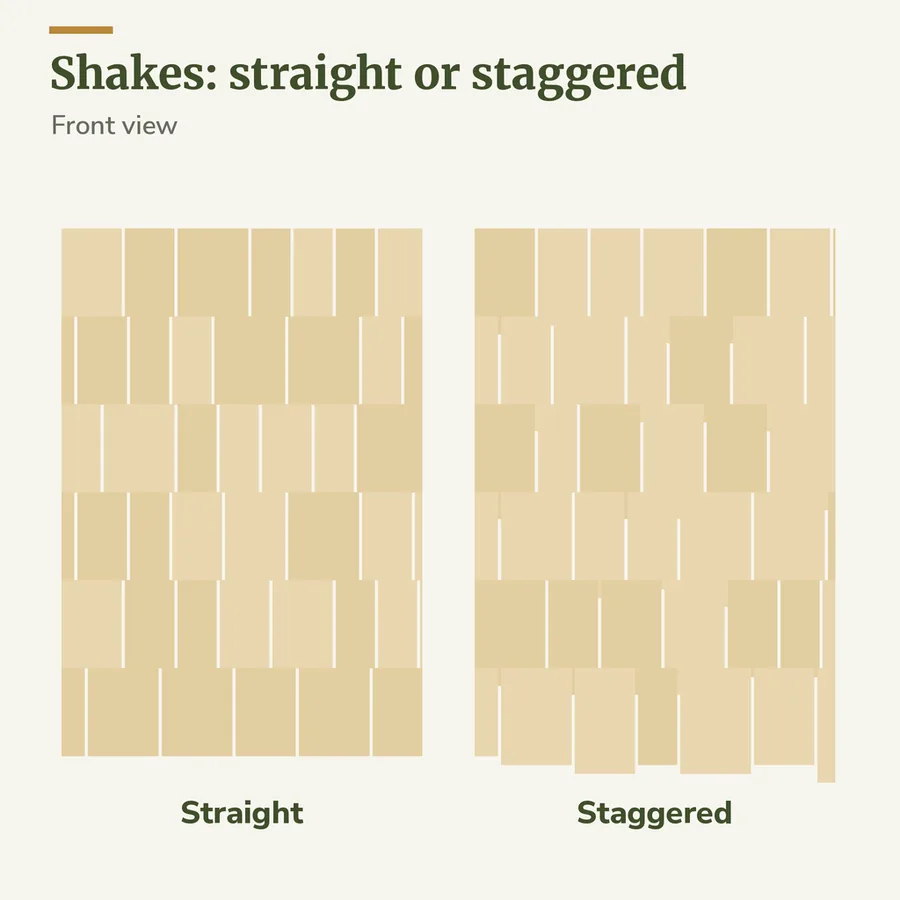
| Shakes and shingles | Short overlapping pieces in rows, straight or staggered at the bottom | Cedar, polymer or vinyl panels, fiber cement |
| Log | Half-round courses that look like stacked logs | Wood, vinyl, steel |
| Panel | Large sheets, sometimes grooved to look like boards | Fiber cement, plywood, engineered wood |
Types of lap siding
Within lap, the choice is mostly exposure, the visible height of each course, and the edge: straight clapboard, Dutch lap or beaded. Narrow exposure reads as older and finer; wide exposure as plainer and more modern. The Forest Service bulletin puts the effect this way: These patterns of siding are applied horizontally and tend to make a house appear lower and longer.
Vertical siding options
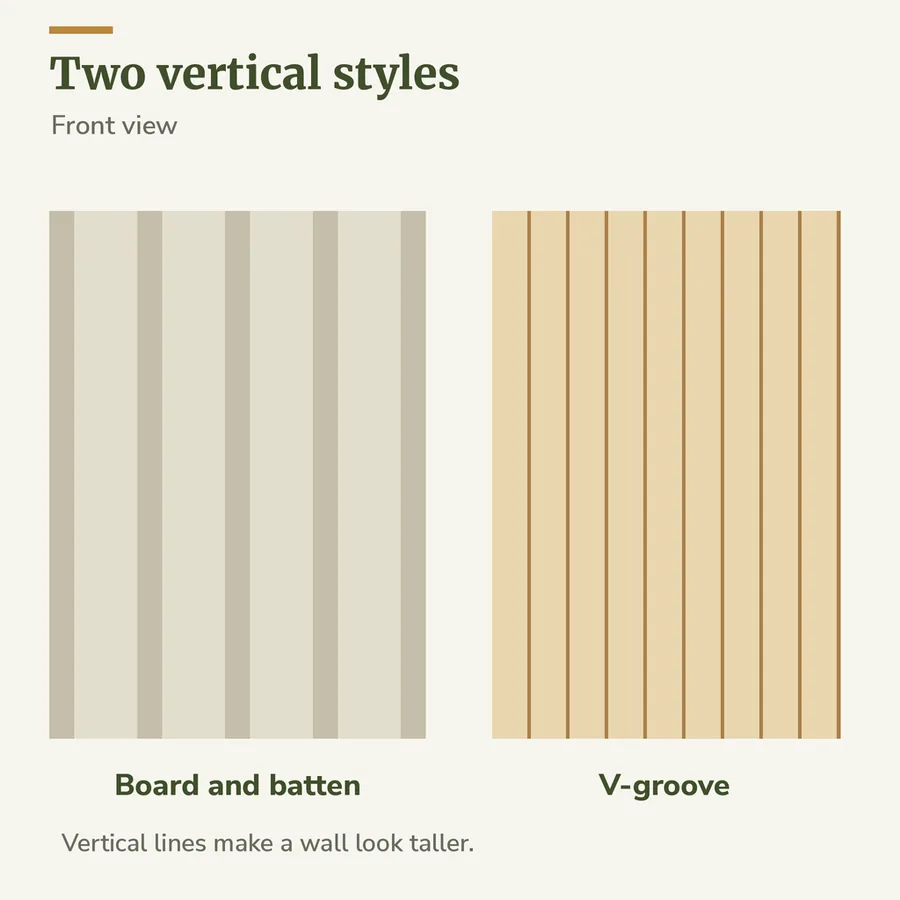
The types of vertical siding are board and batten, reverse board and batten, V-groove and tongue and groove, and vertical metal panels. The same bulletin adds: Vertical siding tends to make a house appear taller.
Vertical patterns need solid backing behind them and careful flashing at every horizontal joint, so ask how the installer handles both. The best vertical siding for a house is the one whose joints shed water, as battens and laps do.
Board and batten in each material
Board and batten is the vertical style with the most searches. Each material’s version, vinyl included, is covered on our board and batten page, with dimensions and spacing.
Side by Side
Nine siding materials side by side
The same nine materials on the questions that decide most choices. No prices: what a material costs depends on the house, and our cost page reads the quote line by line.
| Material | Finish | Usual weak point | Repair | Most common in |
|---|---|---|---|---|
| Vinyl | Color through; no paint | Impact in cold, heat distortion, fading | Unlock and swap a panel | Cold and mixed-humid zones (as siding) |
| Fiber cement | Paint or factory finish | Water at joints and cut edges; repainting | Cut out and replace a board | New houses in the West and South |
| Wood | Paint or stain | Rot where the finish fails | Board by board, for decades | Marine zone (leads); very cold zone (second) |
| Engineered wood | Primed or pre-finished | Swelling at unsealed edges | Replace a board | Counted under wood or siding |
| Steel and aluminum | Baked-on finish | Dents (aluminum), rust at scratches (steel) | Replace a panel or touch up | Counted under siding |
| Stucco | Integral color or paint | Cracks, water behind the plaster | Patch by a plasterer | Hot-dry zone, California, Arizona |
| Brick | None needed | Mortar joints, water at the base | Repointing by a mason | Hot-humid zone, Texas, Louisiana |
| Stone veneer | None needed | Water behind it if flashing is wrong | A mason | Accents more than whole walls |
| Composite and polymer | Color through or painted | Varies by product | Depends on the system | Not counted separately |
What a lab test can and cannot tell you
Consumer testing labs rate siding on impact, wind and color retention, and those tests are useful for comparing lines of one material. They cannot test installation, which is where most siding failures start: a perfect panel nailed tight, or a perfect board butted to a window without flashing, fails anyway. Treat a lab rating as a filter for the product, and the installer’s method as the real test.
The answer is local
There is no best outdoor siding in general, only the best for a climate, a house and an owner. The next two sections take those in turn.
Where You Live
Siding by climate
Our count shows what houses in each zone wear. That is a record of local practice, not a verdict, but it tells you which materials local crews know and which have a long local track record.
Cold and very cold
Siding is on 59.5 percent of houses in the cold zone, which takes in the northern Midwest, the Northeast and the high West; in the very cold zone, wood rises to 33.6 percent. Freeze and thaw punish water left in a wall, so flashing and a good barrier matter more than the cladding. Vinyl turns stiffer in deep cold and cracks more easily if struck, and panels move most where the temperature swing is widest.
Mixed-humid
The broad middle of the country, from the mid-Atlantic through the Ohio and Tennessee valleys, has siding on 49.2 percent of houses and brick on 32.0 percent. Freeze and thaw, summer heat and humidity all reach these walls, so a wall that drains and an installation that keeps courses locked in wind are worth asking about.
Hot-humid and coastal
Along the Gulf and in Florida, brick leads at 39.8 percent and concrete block follows at 14.7 percent; siding is on 17.0 percent. Moisture and hurricanes drive the choice. Ask for the siding’s wind rating and the fastening schedule that goes with it, and for corrosion-resistant fasteners near salt water.
Hot-dry
In the desert Southwest and southern California, stucco is on 71.8 percent of houses and siding on only 3.7 percent. Sun fades finishes and heats dark walls. In wildfire country, some states and counties regulate what exterior walls may be made of; ask your building department before choosing.
Marine
On the cool, wet Pacific coast, wood leads at 46.0 percent and stucco follows at 25.4 percent. Constant moisture rewards walls with a drainage gap behind the siding and a finish that is kept up.
Choosing
What is the best siding for a house?
The best siding for a house suits its climate, its owner’s upkeep and the crews available locally. It also has to come in the style the house calls for. No material wins on all four, which is why ranked lists disagree.
What are the best siding materials for homes?
For most homes the shortlist is vinyl, fiber cement, engineered wood or wood, with stucco or brick where they are already the local wall. Vinyl is the low-upkeep choice where siding is the norm. Fiber cement is the painted, fire-resistant board. Engineered wood is the lighter painted board. Wood is the repairable original for owners who will keep up a finish.
Best siding options by priority
- Least upkeep: vinyl, polymer shakes, factory-finished fiber cement, brick.
- Most resistant to impact: fiber cement, engineered wood, heavy-gauge steel; thicker vinyl lines are less prone to cracking.
- Fire-prone areas: noncombustible walls such as fiber cement, stucco, brick, stone and steel; check local rules.
- Historic look: wood, or a material that matches its profile and exposure.
- Easiest to repair later: the material local crews install most, in a profile that is still made.
Best siding replacement: keep the material or change it?
When re-siding, staying with the same material is the simplest path: trim, depths and details already fit. Changing material is common too, wood to fiber cement or aluminum to vinyl, but it changes the wall thickness at windows and doors and may change the trim. Ask the installer to say in writing which of the two they are quoting.
Mistakes that outlast the material
The common ones are the same for every material: no flashing at windows and roof edges, panels nailed too tight, boards too close to the ground or the roof, and cut edges left unsealed. A good installation of an ordinary material outlasts a poor installation of an excellent one.
Buying and Keeping
Cheap siding options, and the cheapest wall over time
The cheapest siding options on a quote and the cheapest wall to own are often different materials. We publish no prices; this section shows how to read the two.
On the material line alone, thin vinyl is usually the lowest. Over the years, painted materials add repainting, and materials that need specialist crews add labor. Our cost page lists what sets each material’s price to buy and what it asks to keep, line by line, without dollar figures.
House siding options and costs: what moves a quote
For any material, the quote moves with the wall area (not the floor area), the number of openings and corners, what comes off the old wall, the sheathing and barrier underneath, and the trim. The best house siding for the money is the one whose quote is complete on those lines.
Years, Not Months
Lowest-maintenance and longest-lasting siding
Maintenance and life are linked: a material lasts as long as its weak point is looked after. We do not publish lifespans in years, because exposure and installation move them too much.
Brick and stone ask almost nothing until mortar or flashing needs work. Vinyl and polymer need washing and an eye on loose panels. Fiber cement and engineered wood need paint on the finish maker’s schedule and sound caulk. Wood needs a finish for life and a check of the bottom courses. Stucco needs cracks sealed before water finds them.
The wall that lasts longest
The most durable siding is the one installed to its maker’s instructions and kept dry behind. Warranties say the same thing in their small print: almost all of them depend on installation. Ask for the warranty in writing, read what it excludes, and check whether it transfers to the next owner.
Insulation
Siding and energy: what it does and does not do
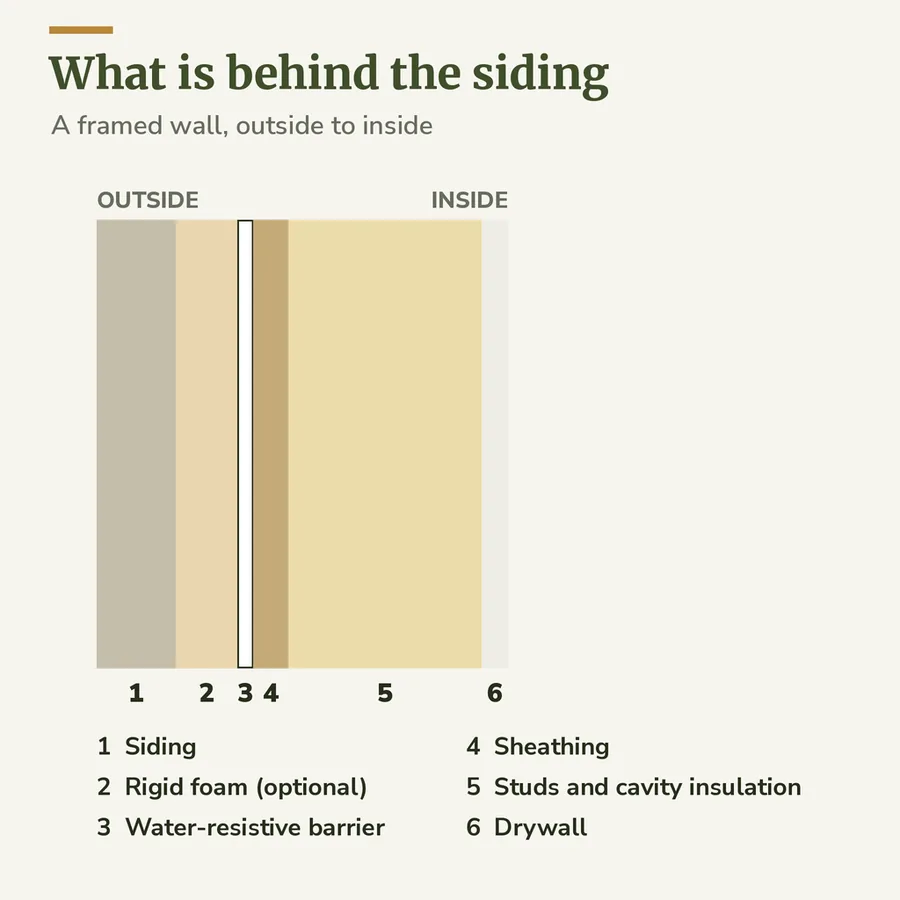
Siding itself adds little insulation. Re-siding is still the cheapest moment to add insulation to a wall, because the outside is open.
Citing a 2021 Guidehouse market study, a 2023 Pacific Northwest National Laboratory presentation for the Department of Energy counts about 3.5 million homeowners who spent money on siding projects that year, and adds: very few projects added 1-in or more of exterior continuous insulation
. A layer of rigid foam under new siding, taped and flashed, adds insulation over the studs, where cavity insulation cannot reach.
Questions to ask about insulation
Ask whether the quote includes a continuous insulation layer, how thick, and how windows and doors will be extended to the new wall depth. Ask the same question whether you choose vinyl, fiber cement or wood: the foam goes under any of them.
How It Looks
Siding colors and modern looks
Siding color options depend on the material: vinyl color is molded in, fiber cement comes primed or factory-finished, wood and engineered wood can be painted any color.
Best siding colors
The best siding colors are the ones that suit the roof, the brick or stone already on the house, and the street. Vinyl siding color options are limited to each line’s palette, and the best vinyl siding colors for a sunny wall are lighter ones or lines made for dark colors. Dark colors on vinyl need a line formulated for heat.
Modern house siding options
Modern siding options lean on vertical boards, wide flat panels, metal, and mixing two materials on one wall. Board and batten in a dark color, standing-seam steel, and smooth fiber cement panels are the usual modern choices. A free siding visualizer from a maker shows its own colors on a sample house; to see your own house, photograph it and ask the installer for color samples on the wall.
Your House
What type of siding does my house have?
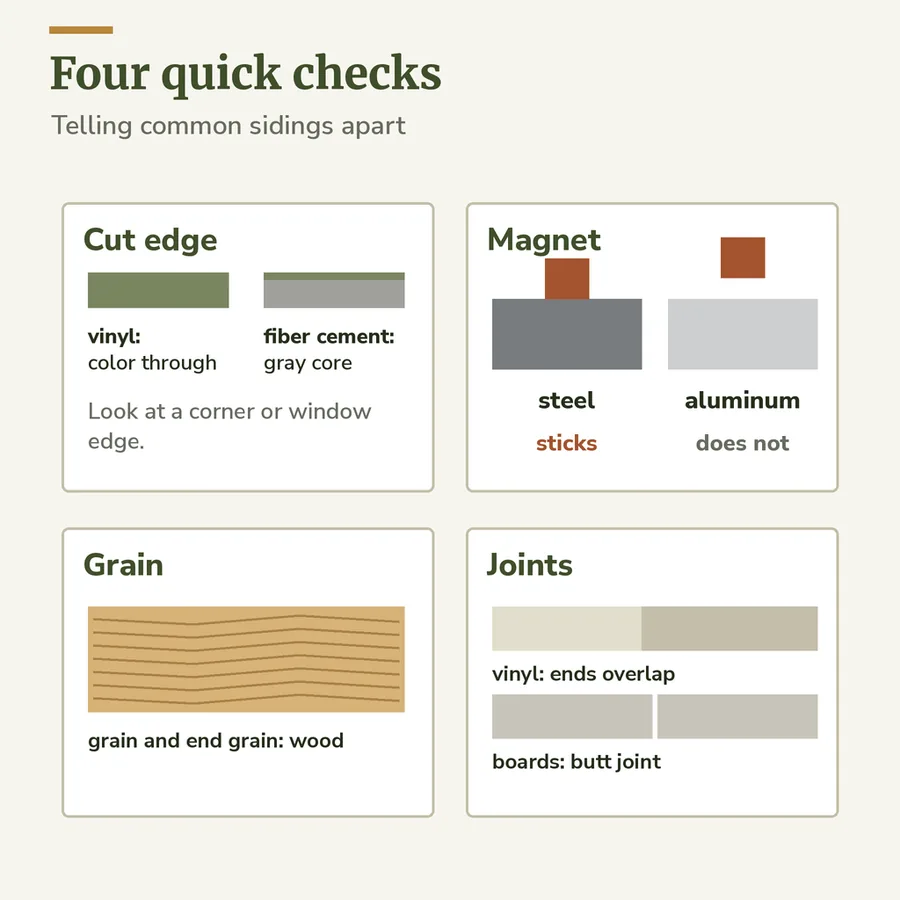
Most siding can be identified from the ground with four checks: the cut edge, a magnet, the grain and the joints. The decade the house was built gives a first guess.
- Look at a cut edge at a corner or a window. Color all the way through means vinyl. A gray core under paint means fiber cement. Wood grain means wood.
- Try a magnet. It sticks to steel siding, not to aluminum.
- Press and tap. Vinyl flexes and sounds hollow; fiber cement is rigid and heavy; aluminum dents easily.
- Look at the joints. Vinyl panels overlap at their ends. Fiber cement and wood boards butt together, often with caulk or flashing behind.
Older houses: what might be underneath
On older houses, the visible siding may cover an earlier wall. Our count shows wood on 22.2 percent of pre-1950 houses today, and many more were built in it. Gray, cement-like shingles on an older house may be asbestos cement. The survey counts shingle walls separately, as composition shingle, on 1.5 percent of detached houses; it does not say what the shingles are made of. The Environmental Protection Agency warns: Generally, you can't tell whether a material contains asbestos simply by looking at it, unless it is labeled.
It also advises: Material that is in good condition and will not be disturbed (by remodeling, for example) should be left alone.
Lead paint before 1978
The EPA’s estimate for older houses: Approximately three-quarters of the homes in the United States built before 1978 still contain some lead-based paint.
Paid work that disturbs painted surfaces on those houses must be done by a lead-safe certified firm. That applies when old painted siding is removed or cut, not only when it is painted. Our siding repair page explains the exemption for small repairs.
Your State
Find what houses near you are clad in
Choose your state and the decade your house was built. The figures come from our count of the 2020 federal survey and the Census Bureau’s 2025 figures for new houses. It runs in your browser and names no price.
A picture of the houses around you, not advice for one wall. The wall itself, and the installer, settle the choice.
Every state in one table
| State | Siding | Brick | Wood | Stucco | Concrete block | Main zone | Houses sampled |
|---|---|---|---|---|---|---|---|
| Alabama | 29.2 | 49.0 | 17.5 | Q | – | Mixed-humid | 167 |
| Alaska | 29.6 | – | 68.1 | – | Q | Very cold | 195 |
| Arizona | 3.4 | 11.8 | 11.7 | 59.6 | 11.4 | Hot-dry | 352 |
| Arkansas | 34.7 | 43.1 | 17.9 | Q | Q | Mixed-humid | 207 |
| California | 4.0 | 1.6* | 19.3 | 71.6 | 2.0 | Hot-dry | 701 |
| Colorado | 39.8 | 18.5 | 23.8 | 12.0 | Q | Cold | 243 |
| Connecticut | 60.5 | Q | 28.2 | Q | Q | Cold | 201 |
| Delaware | 78.6 | Q | Q | Q | – | Mixed-humid | 95 |
| District of Columbia | Q | 71.4 | Q | – | – | Mixed-humid | 21 |
| Florida | 8.5 | 13.9 | 7.6 | 27.4 | 41.9 | Hot-humid | 408 |
| Georgia | 45.6 | 31.4 | 15.0 | 4.8 | Q | Mixed-humid | 300 |
| Hawaii | 18.7 | Q | 65.2 | 7.5 | Q | Hot-humid | 175 |
| Idaho | 52.0 | 8.7 | 29.4 | 7.2 | Q | Cold | 211 |
| Illinois | 59.8 | 26.9 | 9.6 | Q | Q | Cold | 326 |
| Indiana | 63.3 | 23.4 | 8.7 | Q | Q | Cold | 314 |
| Iowa | 71.3 | 9.1 | 15.1 | Q | Q | Cold | 231 |
| Kansas | 49.8 | 11.9 | 26.8 | 6.7 | Q | Mixed-humid | 156 |
| Kentucky | 40.2 | 49.2 | 7.1 | Q | Q | Mixed-humid | 306 |
| Louisiana | 25.4 | 55.0 | 15.2 | Q | Q | Hot-humid | 218 |
| Maine | 55.0 | Q | 39.6 | – | – | Cold | 155 |
| Maryland | 64.0 | 27.7 | 5.6 | Q | – | Mixed-humid | 200 |
| Massachusetts | 51.6 | Q | 37.8 | Q | Q | Cold | 327 |
| Michigan | 60.4 | 25.8 | 10.2 | Q | Q | Cold | 277 |
| Minnesota | 62.2 | Q | 21.0 | 11.1 | – | Cold | 240 |
| Mississippi | 14.2 | 61.6 | 18.1 | Q | – | Hot-humid | 116 |
| Missouri | 56.3 | 19.4 | 15.1 | Q | Q | Mixed-humid | 221 |
| Montana | 54.9 | Q | 36.0 | Q | Q | Cold | 122 |
| Nebraska | 65.3 | 10.8 | 19.1 | Q | Q | Cold | 142 |
| Nevada | 9.8 | Q | 19.7 | 65.0 | Q | Hot-dry | 147 |
| New Hampshire | 61.0 | – | 36.5 | Q | – | Cold | 115 |
| New Jersey | 67.9 | 4.3* | 16.8 | Q | Q | Mixed-humid | 277 |
| New Mexico | Q | 11.5 | Q | 72.4 | Q | Mixed-dry | 122 |
| New York | 65.7 | 8.0 | 18.6 | 2.7* | Q | Cold | 461 |
| North Carolina | 48.1 | 35.8 | 13.0 | Q | Q | Mixed-humid | 333 |
| North Dakota | 76.3 | Q | 14.6 | 6.1* | – | Very cold | 199 |
| Ohio | 65.8 | 22.7 | 7.2 | Q | Q | Cold | 248 |
| Oklahoma | 23.6 | 60.3 | 9.7 | – | Q | Mixed-humid | 176 |
| Oregon | 37.4 | Q | 54.5 | Q | Q | Marine | 218 |
| Pennsylvania | 57.3 | 24.1 | 7.6 | 3.7 | Q | Cold | 393 |
| Rhode Island | 49.0 | Q | 35.0 | Q | – | Cold | 133 |
| South Carolina | 51.5 | 31.8 | 12.3 | Q | – | Mixed-humid | 225 |
| South Dakota | 65.7 | Q | 27.8 | Q | Q | Cold | 136 |
| Tennessee | 38.5 | 42.4 | 13.4 | Q | Q | Mixed-humid | 364 |
| Texas | 17.2 | 57.5 | 12.9 | 5.5 | Q | Hot-humid | 719 |
| Utah | 34.4 | 25.0 | Q | 30.5 | – | Cold | 146 |
| Vermont | 47.5 | Q | 48.2 | – | – | Cold | 165 |
| Virginia | 56.9 | 28.4 | 11.6 | Q | Q | Mixed-humid | 291 |
| Washington | 41.9 | Q | 51.5 | Q | – | Marine | 296 |
| West Virginia | 58.5 | 19.6 | 12.7 | Q | Q | Mixed-humid | 137 |
| Wisconsin | 69.5 | 9.3 | 16.3 | Q | Q | Cold | 253 |
| Wyoming | 52.1 | 14.2 | 20.8 | Q | Q | Cold | 138 |
Before Choosing
Before you pick: questions to settle first
Six questions that narrow the types of siding to the two or three worth quoting.
| Question | Why it matters | Where to look |
|---|---|---|
| Does an HOA or historic district have rules? | Some limit materials, colors or profiles | The covenants, or the local preservation office |
| What is on the wall now, and under it? | Decides tear-off or overlay, and lead or asbestos rules | A look at a cut edge and the year built |
| What does your climate throw at walls? | Hail, wind, fire and moisture favor different materials | The climate section above, and your insurer |
| How much upkeep will you really do? | Painted materials need it on schedule | Your own track record with the trim |
| Who installs it near you? | Installation decides how any material ages | Ask each installer how many of these walls they did last year |
| Is insulation going on with it? | The wall is only open once | Ask for a second price with rigid foam |
Once the shortlist is two or three materials, get written quotes for each on the same scope. Our contact page says when our own introduction line opens; the questions above work with any installer you find.
Who Wrote This
Who wrote this, and how we are paid
Siding Pros USA is a referral service: we do not make, sell or install siding of any kind, so no material on this page earns us more than another. Our model is a fixed fee for introducing a homeowner to an independent local contractor, and that line is not open yet. The count on this page is ours, from public federal data; how we check facts is set out in our editorial standards and our about page.
Straight Answers
Types of siding questions, answered
What are the main types of siding?
Vinyl, fiber cement, wood, engineered wood, metal (steel and aluminum), stucco, brick, stone veneer and composite or polymer. In our count of detached houses, siding of the vinyl, fiber cement, aluminum or steel kind is on 40.4 percent, brick on 22.7 percent, wood on 16.4 percent and stucco on 13.7 percent.
What is the most common siding on houses?
Siding in the survey’s sense, vinyl, fiber cement, aluminum or steel, is the most common wall nationally and leads in 32 of the 51 places in our count, the 50 states plus the District of Columbia. Among new houses finished in 2025, vinyl and stucco tied at 26 percent each, with fiber cement at 23 percent.
What is the best siding for a house?
The one that suits the climate, the upkeep the owner will do and the crews available locally, in the right style for the house. Vinyl leads where siding is the norm and nobody wants to paint; fiber cement where fire or dents matter; wood where a historic look and repairs board by board matter. The section above ranks them by priority.
What is the cheapest type of siding?
On the material line of a quote, thin vinyl is usually the lowest. Over the life of the wall, painting, repairs and labor can change the order, so compare what a material costs to buy and to keep. Our cost page lists what sets each one; we publish no price averages.
What siding lasts the longest?
Brick, stone and well-kept fiber cement have the reputation, and wood that is painted on schedule can last for generations. In practice, installation and water management behind the wall decide life more than the material. We do not publish lifespans in years because exposure and installation move them too much.
What is the difference between siding material and siding style?
Material is what the wall is made of: vinyl, fiber cement, wood and so on. Style is the shape the boards make: lap, Dutch lap, board and batten, shakes or vertical. Most styles are made in several materials, so it helps to choose the look first and then compare the materials that offer it.
What are the types of vinyl siding?
Mostly profiles: clapboard, Dutch lap and beaded lap, board and batten, shakes and shingles, and accent panels, plus insulated versions with foam on the back. Lines also differ by thickness and panel depth, which a photograph does not show. Our vinyl siding page reads sixteen lines side by side.
How can I tell what siding my house has?
Check a cut edge for color through (vinyl) or a gray core (fiber cement), try a magnet (it sticks to steel, not aluminum), press the wall (vinyl flexes) and look at the joints (vinyl overlaps, boards butt). On older houses, do not cut or sand gray cement-like shingles; the EPA says asbestos cannot be identified by looking.
Which siding is best for a cold climate?
In our count, siding is on 59.5 percent of houses in the cold zone and wood rises to 33.6 percent in the very cold zone. Any of the common materials works there if the wall is flashed and drained; vinyl becomes stiffer in deep cold, so thicker lines and careful nailing matter more.
Which siding is best for a hot, humid climate?
Houses in the hot-humid zone are most often brick, at 39.8 percent, with concrete block and stucco common too. For framed walls, moisture management and wind ratings decide more than the cladding: ask for the product’s wind rating, its fastening schedule and corrosion-resistant fasteners near the coast.
Is insulated siding worth it?
It stiffens vinyl and adds some insulation, and very few jobs use it. Compare it with ordinary siding over a layer of rigid foam board, which usually adds more insulation and works under any material. Re-siding is the cheapest time to insulate a wall from outside, so ask for both prices.
Do you sell or install siding?
No. Siding Pros USA is a referral service and does no sales or installation. Our model is a fixed fee for introducing homeowners to independent local contractors, the same whichever material you choose, and that line is not open yet. The research on this page is ours; the wall is the contractor’s.
Where This Comes From
Sources and method
- Our count of wall materials: U.S. Energy Information Administration, 2020 Residential Energy Consumption Survey, public microdata (version 7), with the method in the agency’s guide to computing estimates and standard errors. The shares by climate zone, decade and state are our calculation.
- National check: EIA, RECS 2020 housing characteristics tables, table HC2.1, single-family detached column.
- New houses in 2025: U.S. Census Bureau, Survey of Construction, characteristics of new housing, primary exterior wall material of new single-family houses completed.
- Asbestos in old siding: EPA, Protect Your Family from Exposures to Asbestos.
- Lead paint in houses built before 1978: EPA, Lead Renovation, Repair and Painting Program.
- Wood siding patterns: USDA Forest Service, Forest Products Laboratory, Wood Siding: Installing, Finishing, Maintaining (Home and Garden Bulletin 203, revised 1983).
- Insulation when re-siding: Pacific Northwest National Laboratory for the U.S. Department of Energy, Adding Insulation when Re-Siding, 2023 peer review.
Our editorial standards explain how facts on this page were sourced and checked. Quotations are copied word for word from the linked source, and the page carries no price averages. Last updated .
Before you call anyone
The flat-fee match — we are paid for the introduction, not for the size of your job
Most siding advice is written by the company that wants to do the work or the company that makes the product. That is not a failing of the people who read it; it is a defect in who is talking: the measurement, the estimate and the invoice come from one party, and no amount of care on your side fixes that.
We are built the other way round. We do not install, repair or sell anything, so the payment reaches us when you are connected to a licensed, insured siding contractor — the same amount whether you need one panel replaced or four walls re-clad. Nobody here has a reason to talk you into the larger number. You can check that rather than take it on trust: how we make money is written down, and this site keeps telling readers when one wall is enough. Why does not everyone work this way? Because a flat fee leaves money on the table every time the job turns out to be big.
Waiting is the one thing that actually costs money. A wall that is open to the weather does not get better and does not wait for a convenient week; the water that gets behind the siding finds the sheathing, the framing and the drywall inside. A cracked panel over a window lets the next storm in. And if it turns out to be one panel and a quarter-hour, say so when you ask. We will tell you, and that answer earns us nothing.
Not for you if: you want a price over the phone — nobody honest gives one without measuring the house; you need a guarantee of arrival within the hour — we cannot promise that for a company we do not run; the building is commercial; or you would rather do it yourself, in which case the pages on this site are written so that you can.