Metal Siding
Metal siding: steel and aluminum, and what their warranties actually say
Reviewed by the Siding Pros USA editorial team · · 39 min read
Metal siding is steel or aluminum formed into lap boards or vertical panels and coated at the factory. We read eighteen warranties and seven installation guides and specifications published by fourteen manufacturers. Every warranty in the count limits its coverage near salt water, and fourteen of the eighteen say exactly how far.
Metal siding in short: steel, aluminum and what the documents say
- Two metals, one idea. Steel siding is heavier, magnetic and harder to dent, and it can rust where a cut or scratch reaches the steel. Aluminum is lighter, never shows red rust and dents easily; much of it is on houses built decades ago.
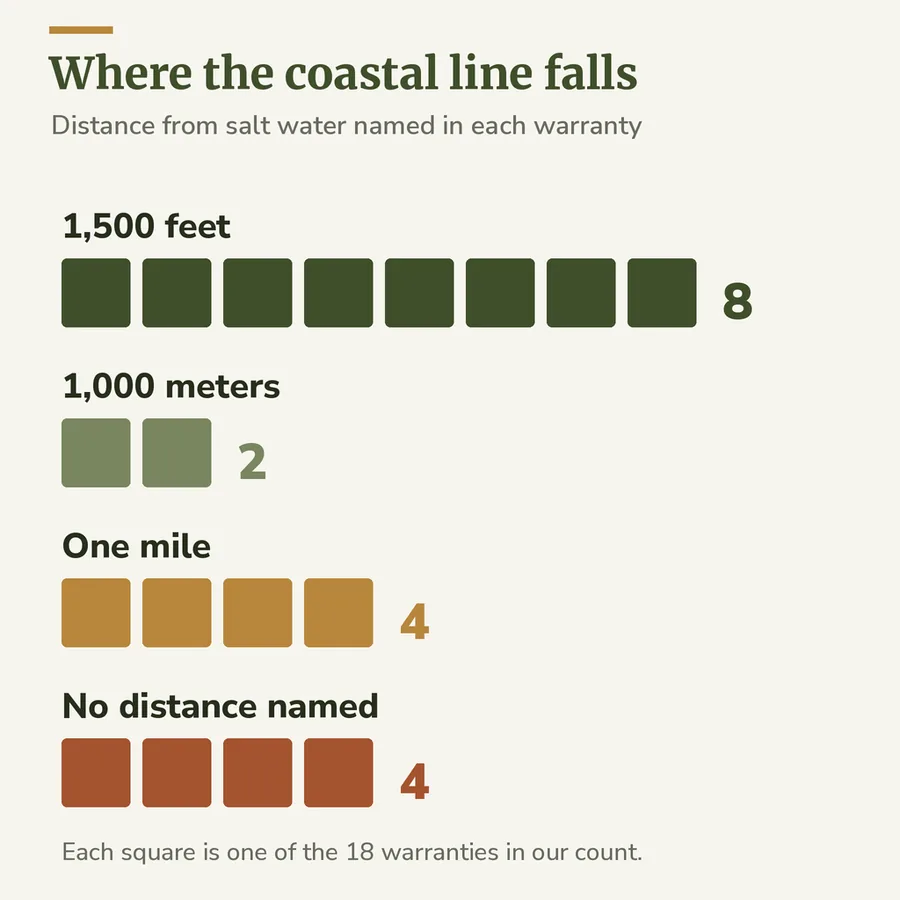
- Salt water changes the deal. All 18 warranties we read limit coverage near the coast. 8 draw the line at 1,500 feet, 4 at one mile and 2 at 1,000 meters; 4 exclude salt air without naming a distance.
- The paint has numbers. Fourteen of the eighteen warranties cap chalking on the wall and thirteen of the eighteen cap fading, most at a chalk rating of 8 and 5 units of color change. Only two of the six warranties written for house siding name a chalk limit.
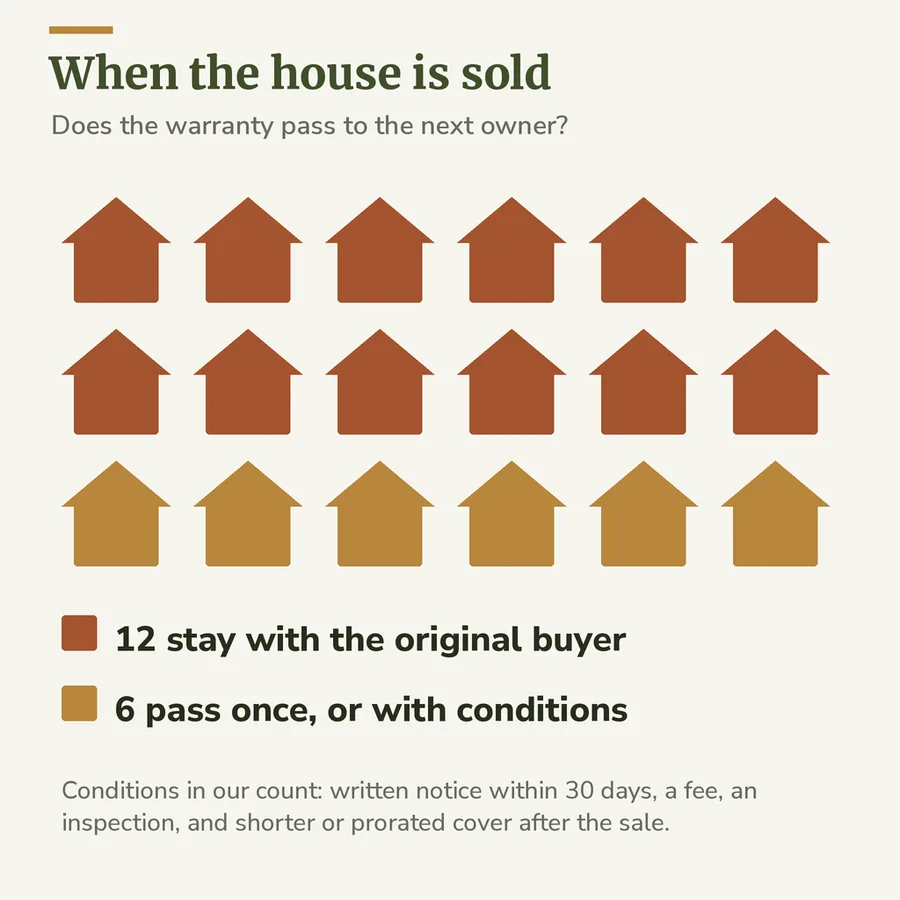
- Most of them stay with the buyer. Twelve of the eighteen cannot pass to the next owner of the house at all; the other six pass once or with conditions.
This page goes deep on steel and aluminum. Metal next to the other eight materials is on our guide to the types of siding, and the board and batten shape in every material has a page of its own. What re-siding costs is on our cost page. We publish no price averages, and we make, sell and install nothing.
Our Count
Our count: what 18 metal siding warranties and 7 installation guides say
Every maker publishes its own warranty and nobody lines them up. On October 18, 2026 we saved 25 documents for steel and aluminum siding and metal wall panels sold in the United States (one Gentek guide is its Canadian edition) and read each one for the same few clauses.
| Maker and line | Metal | Finish term | Chalk and fade on walls | Salt water | Passes to next owner |
|---|---|---|---|---|---|
| EDCO, Steel siding, Entex finish | Steel | Lifetime | Fade 5 for 30 years | Rust and corrosion not covered within 1 mile | Limited |
| EDCO, Steel siding, RealGrain wood-look finish | Steel | Lifetime | None stated | Rust and corrosion not covered within 1 mile | Limited |
| Rollex, Navigator steel siding | Steel | Lifetime | Chalk 8, fade 5 for 35 years | No coverage within 1 mile | Limited |
| Rollex, Aluminum siding, soffit, rainware | Aluminum | Lifetime | Chalk 6, fade 7 for 25 years | Salt air excluded, no distance given | Limited |
| Ply Gem, Performance Metals aluminum siding | Aluminum | Lifetime | Chalk and fade excluded | Salt air excluded, no distance given | Limited |
| Kaycan, Aluminum siding and accessories | Aluminum | 25 years | None stated | Salt air excluded, no distance given | No |
| Metal Sales, PVDF painted panels and trim | Steel or aluminum | 45 years | Chalk 8, fade 5 for 35 years | Paint not covered within 1,500 ft | No |
| Sheffield Metals, 40-year PVDF paint | Steel or aluminum | 40 years | Chalk 8, fade 5 for 30 years | No coverage within 1,500 ft | Limited |
| Fabral, WeatherXL panels on AZ50, incl. board and batten | Steel | Lifetime | Chalk 8, fade 5 for 30 years | No coverage within 1,500 ft | No |
| Sherwin-Williams for Allsteel, WeatherXL SMP coil coating | Steel or aluminum | 40 years | Chalk 8, fade 5 for 30 years | No coverage within 1,500 ft | No |
| McElroy Metal, Fluropon PVDF panels | Steel | 40 years | Chalk 8, fade 5 for 30 years | No coverage within 1,500 ft | No |
| Petersen PAC-CLAD, Print Coat wood-look system | Steel | 40 years | Chalk 8 for 30 years | No coverage within 1,500 ft | No |
| Steelscape, Riverstone on ZINCALUME | Steel | 20 years | Chalk 8 for 20 years | Paint: no coverage within 1 mile. Steel: 20 years from 1,000 ft to 1 mile, none closer | No |
| Western States Metal Roofing, Cool Tech 500 PVDF | Steel or aluminum | 40 years | Chalk 8, fade 5 for 40 years | Within 1,500 ft only with conditions | No |
| Petersen PAC-CLAD, 35-year PVDF, Hawaii edition | Steel or aluminum | 35 years | Chalk 8, fade 5 for 35 years | Steel: no coverage within 1,500 ft. Aluminum: 25 years instead of 35, rinsed twice a year | No |
| Union Corrugating, 40-year paint | Steel | 40 years | Chalk 8, fade 5 for 30 years | Within 1,000 m only with conditions | No |
| Union Corrugating, AZ50/AZ55 substrate and paint | Steel | 45 years | Chalk 8, fade 5 for 30 years | Within 1,000 m only with conditions | No |
| Western States Metal Roofing, Cool Tech SMP | Steel or aluminum | 40 years | Chalk 8, fade 5 for 40 years | Salt air excluded, no distance given | No |
What the table shows
The clause that changes most from one document to the next is the one about the coast. Eight warranties draw their line at 1,500 feet from salt water, two Union Corrugating warranties at 1,000 meters, and Rollex, EDCO and Steelscape at a mile. The chalk and fade limits, by contrast, are nearly the same everywhere they appear: a rating of 8 and 5 units of color change on thirteen and twelve warranties. What differs is whether a limit is there at all.
House siding warranties and panel warranties
Six of the documents are written for siding on a home, by EDCO, Rollex, Ply Gem and Kaycan. The other twelve cover painted panels, coil or coatings in general, the kind of warranty behind much of the board and batten, ribbed and corrugated metal on houses, which is rolled by panel makers rather than siding brands. The panel warranties are the stricter documents: twelve of twelve set a chalk limit, against two of six house siding warranties, most of which promise a “lifetime” instead.
Lifetime and the years after it
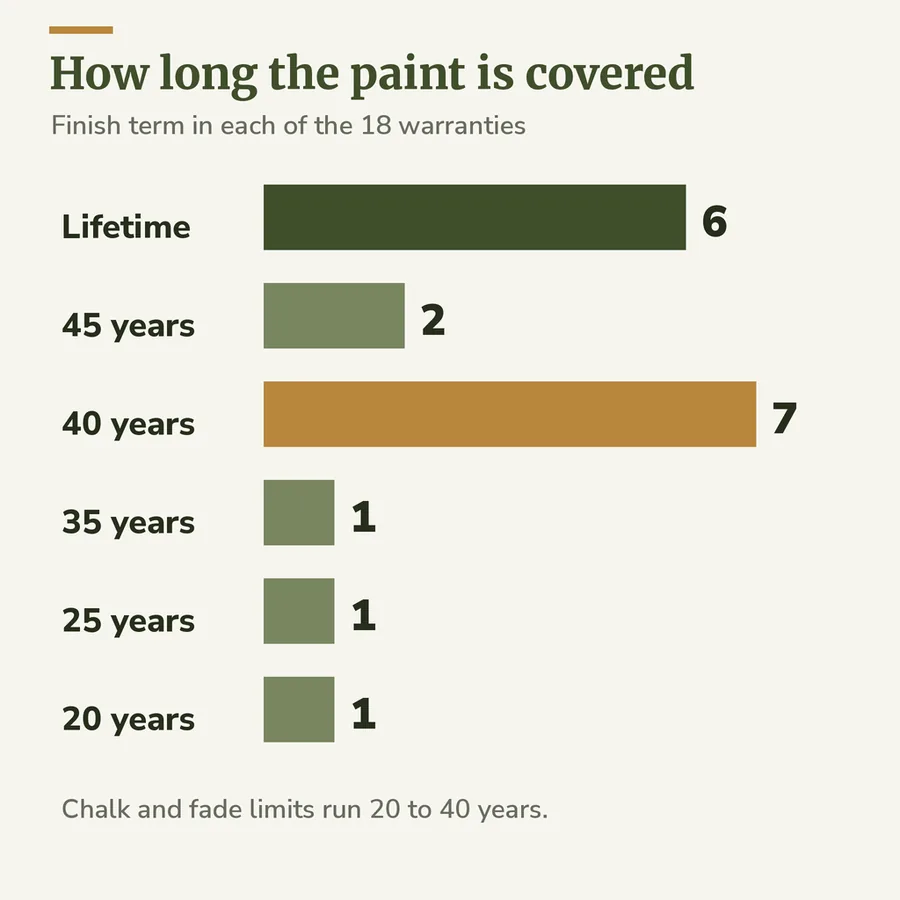
Six of the warranties call themselves lifetime; the rest run 20 years to 45 years on the finish. A lifetime warranty in this count is usually full only for the first owner, and then shrinks: Rollex limits the second owner to 50 years from installation with a sliding share of the cost, and EDCO covers labor for 20 years and then materials only, depreciating 10 percent a year. The chalk and fade limits run 20 years to 40 years: shorter than the finish term in most of the warranties that set both, and equal to it in the rest.
How we worked it out
We looked for every warranty and installation guide for steel or aluminum siding, and for painted metal wall panels, that a maker publishes on its own site or a dealer mirrors. Each file was saved as downloaded, with the date and address. For every document we copied the clause behind each answer word for word, then checked by script that each of the 529 quotations appears in the saved copy. The coding into the columns above is ours; the counts come from that coding, so a reader with the same files gets the same numbers.
Limits of the count
This is what makers chose to publish and what we could download in October 2026, not the whole market. Two residential lines, Longboard aluminum and Quality Edge steel, are missing because their documents would not load. Eight of the panel warranties are blank sample forms; the certificate issued for a real house can differ. Editions range from 2006 to 2026, and the Petersen warranty is its Hawaii edition because the general one was offline. We read legal text as carefully as we can, but the warranty that decides a claim is the one issued for your purchase.
Two Metals
Steel siding or aluminum siding
Aluminum siding vs steel siding comes down to dents against rust. Steel resists knocks and hail better; aluminum cannot rust red and is lighter to hang.
| Property | Steel siding | Aluminum siding |
|---|---|---|
| Magnet | Sticks | Does not stick |
| Dents | Resists better, more so in heavier gauges | Dents from hail, ladders and balls |
| Corrosion | Zinc or aluminum-zinc coating under the paint; red rust where it is cut or scratched through | No red rust; the paint chalks and the metal can pit near salt |
| How thickness is sold | By gauge: a lower number is thicker | In thousandths of an inch, such as .019 or .024 |
| Residential lines in our count | EDCO, Rollex Navigator | Rollex, Ply Gem, Kaycan |
| Same maker, two metals | Rollex Navigator steel: chalk rating 8, fade 5 units, for 35 years | Rollex aluminum: chalk rating 6, fade 7 units, for 25 years |
| Salt water in our count | Rollex: no coverage within one mile. EDCO: rust not covered within one mile | Rollex, Ply Gem and Kaycan exclude salt air with no distance named |
| Where it is used | New lap siding, board and batten, ribbed and corrugated panels | Older houses, mobile homes, soffit and trim; some new lap lines |
The difference the warranties show
The clearest comparison in our count comes from one maker. Rollex publishes a steel siding warranty and an aluminum one, and the aluminum warranty allows more chalk (a rating of 6, against 8) and more fading (7 units of color change, against 5), for 25 years against 35. Petersen’s Hawaii edition goes the other way at the shore: within 1,500 feet of a seacoast its paint warranty requires an aluminum panel, saying “Installations less than 1500’ from a seacoast require aluminum substrate material” and warrants them for 25 years.
Is metal siding magnetic?
Steel siding is; aluminum siding is not. A fridge magnet held to the wall is the quickest way to tell which one a house has, and it matters before ordering a replacement piece or a touch-up paint. Both ring when tapped, which is how most people tell either of them from vinyl.
Which one for which house
Where hail, ladders or a busy yard put the wall at risk, steel in a heavier gauge is the sturdier choice. Where the house is within sight of salt water, read the coastal clause of the actual product before choosing either; in our count it decides more than the metal does. On an older aluminum house, matching or painting the existing siding is often simpler than mixing in steel.
Thickness
Gauge and thickness, in plain numbers
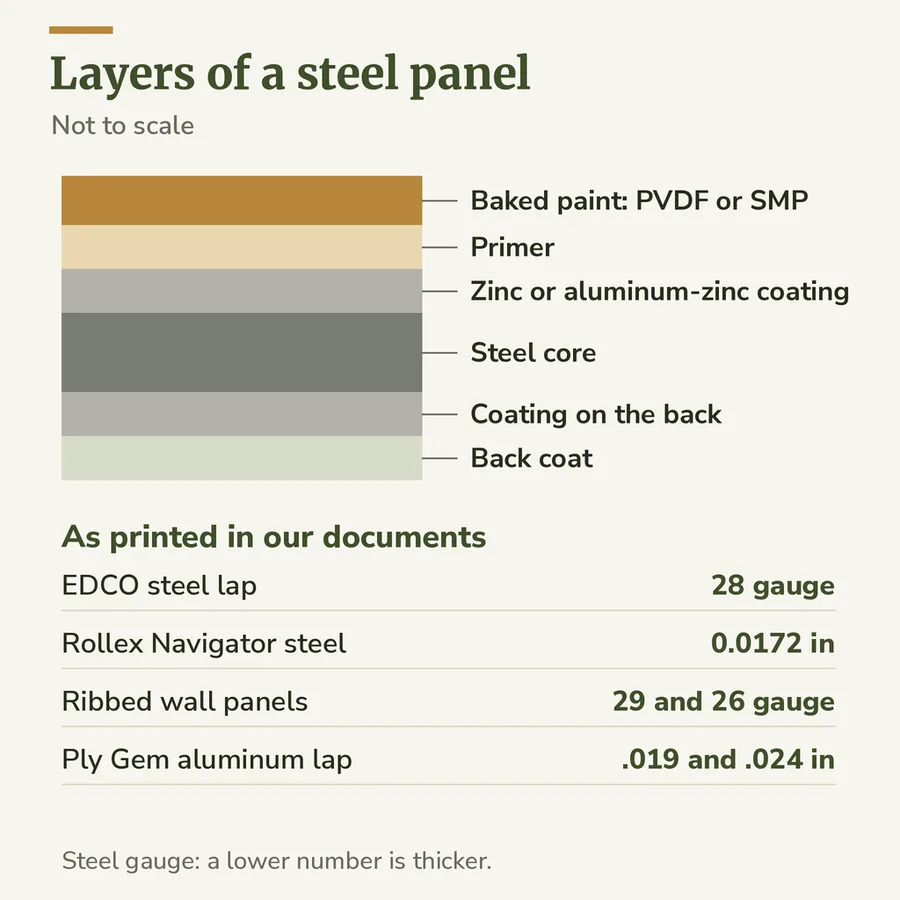
Metal siding gauge is the thickness of the steel; a lower gauge number means thicker metal. Aluminum siding skips gauges and states thickness in thousandths of an inch.
| Product | Metal | As printed | Document |
|---|---|---|---|
| EDCO steel siding, Entex finish | Steel | 28 gauge | EDCO installation guide, September 2022 |
| Rollex Navigator steel siding | Steel | 0.0172 inch nominal, hot-dipped galvanized | Rollex product specification |
| Metal Sales Classic Rib panel | Steel | 29 and 26 gauge standard | Metal Sales installation manual, 2025 |
| Fabral Grandrib 3 panel | Steel | 26 gauge | Fabral warranty F-229, 2024 |
| Ply Gem Endurance aluminum lap | Aluminum | .019 inch nominal | Ply Gem specification guide, 2026 |
| Ply Gem Envoy aluminum lap | Aluminum | .024 inch nominal | Ply Gem specification guide, 2026 |
Which gauge for a house
House lap siding in steel is thin: the two residential lines in our count print 28 gauge and 0.0172 inch. For ribbed wall panels of the kind used on barns and barndominiums, Metal Sales prints 29 and 26 gauge as standard, and 26 is the heavier of the two. A heavier gauge resists dents and the slight waviness of wide flat panels, called oil canning, and the same worry is behind searches for 24 gauge metal board and batten siding, where the flat faces between battens are wide.
Aluminum siding thickness
Ply Gem prints .019 inch for its Endurance line and .024 inch for Envoy, a quarter thicker. Older aluminum houses were clad in a range of thicknesses, and the thinnest dent from a thrown ball. When matching an old wall, take a cut piece to the supplier: thickness changes how a new piece locks into the old course.
Gauge is not the whole story
Two panels of the same gauge can behave differently: the profile stiffens the sheet, a foam backer supports it, and the coating decides how long it looks new. A quote should state the gauge or thickness, the coating and the finish system, all three in writing.
Coatings
Coatings and paint finishes: galvanized, Galvalume, PVDF and SMP
A steel panel carries two layers of protection: a metal coating against rust, then a baked paint that gives the color. The warranties cover the two separately.
The metal coating: galvanized or Galvalume
Galvanized steel is coated in zinc, sold by weight as G60 or G90. Galvalume, also sold as ZINCALUME, is coated in an aluminum-zinc alloy, graded AZ50 for painted sheet and AZ55 for bare. The panel warranties in our count name these grades: Metal Sales covers rust-through only on “AZ50 Galvalume-coated steel,” and Union Corrugating covers its Galvalume sheet against perforation for 20 years and 6 months from the mill, 25 years and 6 months for bare AZ55.
The paint: PVDF, SMP and printed finishes
PVDF paints, made with resins sold as Kynar 500 or Hylar 5000, are the premium finish; SMP, silicone-modified polyester, is the common one. In our count both carry long terms: McElroy’s PVDF and Sherwin-Williams’ WeatherXL SMP run 40 years against peeling. Wood-grain and other printed finishes are a separate layer and sometimes a separate warranty; Petersen’s Print Coat warranty promises only that the print stays “intact and distinguishable” rather than naming a color change.
| Term in the warranty | What it measures | Usual limit on walls | How many name it |
|---|---|---|---|
| Chalk rating, ASTM D4214 | White powder from the paint, rated against photo standards; 10 means none, lower means more | No worse than 8 | fourteen of the eighteen |
| Color change, ASTM D2244 | Fading, measured in Hunter or NBS units with a meter against a kept sample | No more than 5 units | thirteen of the eighteen |
| Film integrity | Peeling, cracking, flaking, blistering | Lifetime or 20 years to 45 years | All eighteen |
| Perforation | Rust or corrosion right through the steel | Lifetime on steel house siding; 20 to 40 years on panels | seven; paint-only warranties exclude it |
Walls are held to stricter limits than roofs
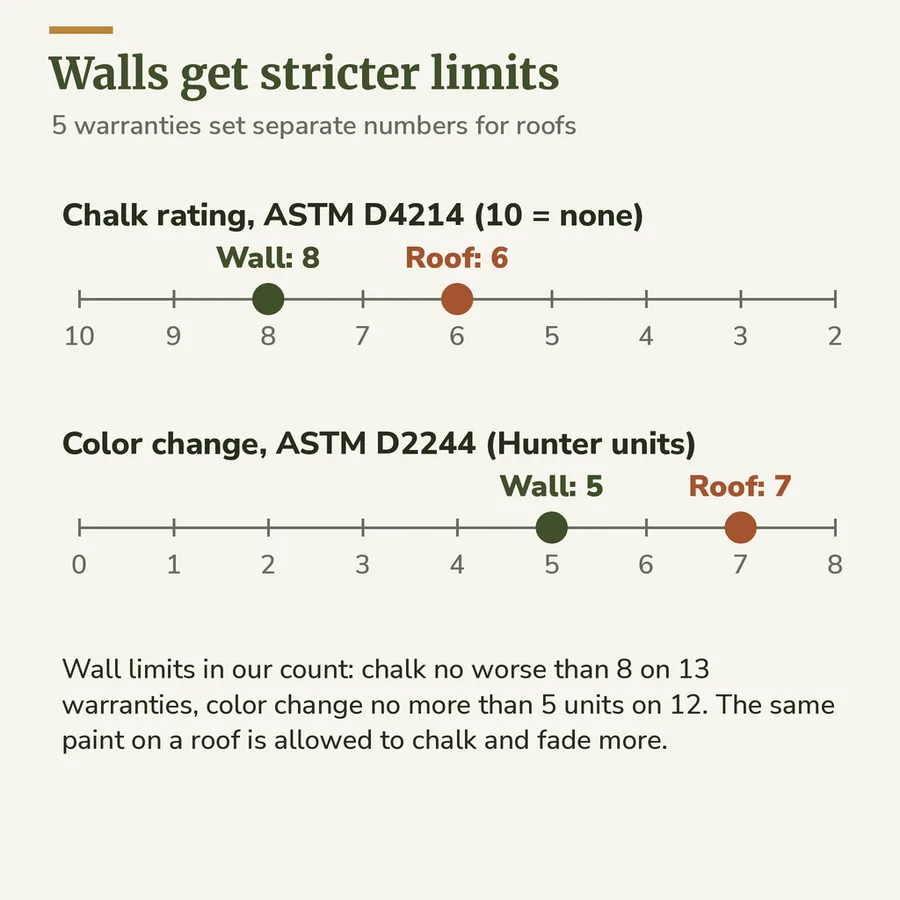
Five warranties in our count set two sets of numbers: a chalk rating of 8 and 5 color units for vertical wall panels, but 6 and 7 for roofs. Fabral’s puts it in one line: “Chalk in excess of a numerical rating of eight (8) for vertical siding panels.” The warranties do not say why; a wall does take the sun at a steeper angle than a roof. Some colors get softer terms: McElroy gives orange and bright red 10 years on chalk and fade instead of 30, and Sheffield gives matte black 10 years.
Oxidation and chalk on old aluminum
The white powder that rubs off old aluminum siding is chalk from the paint, not the metal; the cleaning and painting sections below cover what to do about it. On steel, rust at a cut edge or deep scratch is a coating problem that touch-up paint from the maker slows down, if the warranty allows touch-up: Sherwin-Williams and Petersen Print Coat exclude damage from touch-up painting.
Coast
Near salt water: where metal siding warranties stop
Does metal siding rust? Steel can, at cut edges and scratches. Near the ocean every warranty in our count changes its terms, and the distance is printed in the document.
| Inside the distance | Warranties | Distances named |
|---|---|---|
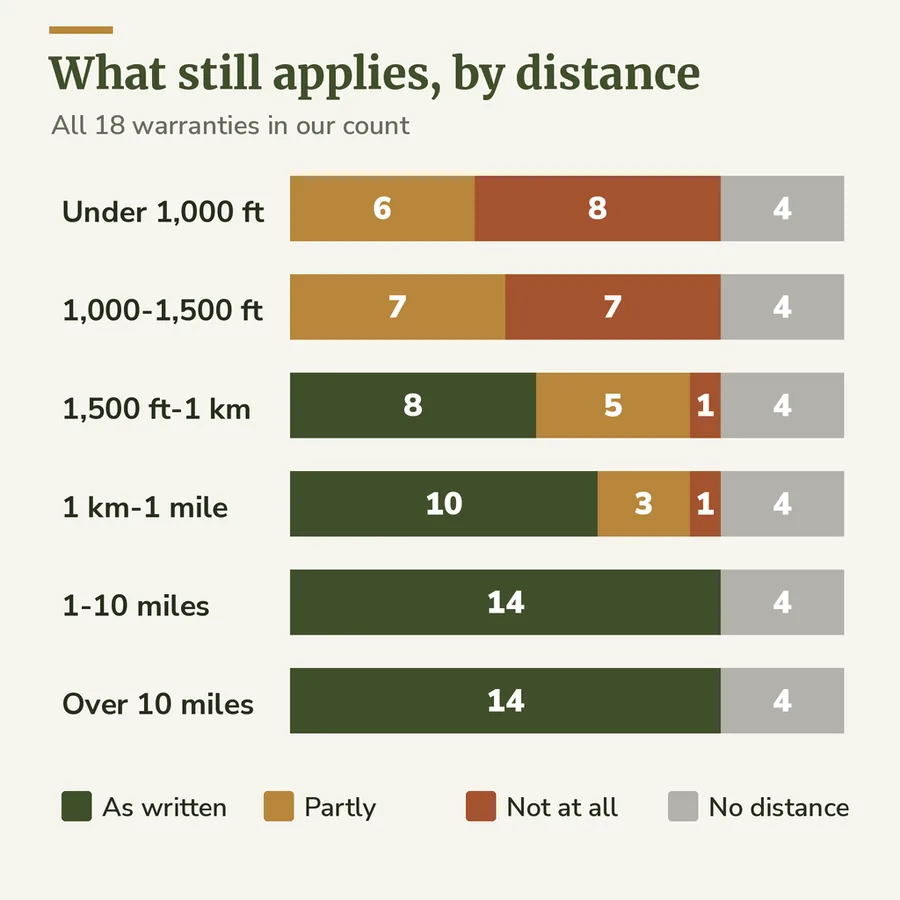
| No coverage | seven | 1,500 feet (6), one mile (1) |
| Part of the coverage lost, the rest stays | three | One mile: EDCO drops rust and corrosion; Steelscape drops the paint, and the steel keeps 20 years beyond 1,000 feet |
| Covered only with conditions | four | 1,500 feet (2), 1,000 meters (2) |
| Salt air excluded, no distance named | four | None |
What the conditions are
The four conditional warranties ask for something extra. Union Corrugating keeps its chalk and color coverage within 1,000 meters only if the owner washes the panels with fresh water every year and keeps records. Western States voids its PVDF warranty within 1,500 feet unless a high-build primer and topcoat system is used and the panels are washed every year, with records. Petersen’s Hawaii edition keeps 25 years instead of 35 for aluminum panels rinsed twice a year and none for steel. Ask for the condition in writing before the order: a high-build primer or an aluminum panel has to be chosen before the panels are made, and the yearly rinse records have to start on day one.
Why the line sits where it does
FEMA’s bulletin on corrosion in coastal areas describes the gradient behind such lines: “The amount of salt spray in the air is greatest near breaking waves and declines rapidly in the first 300 to 3,000 feet landward of the shoreline.” It adds a warning for anyone a few miles in: “studies have shown accelerated corrosion rates as far inland as 5 to 10 miles.” FEMA’s coastal construction guide recommends stainless steel fasteners for buildings within 3,000 feet of the ocean and says to “Avoid using dissimilar metals together.”
Measuring the distance
Measure on a map from the wall to the nearest salt or brackish water, not only the open ocean: Fabral writes “salt water or brackish water environment” and Sheffield names salt or brackish water too, which takes in bays, sounds and tidal rivers. Write the measured distance on the contract. If the house is inside a stated line, ask the maker in writing whether the product is covered at that address, and keep the answer with the warranty.
Shapes
Metal siding profiles, from lap to standing seam
The types of metal siding are mostly shapes. The same coil of steel can be rolled into lap boards that pass for painted wood or into tall ribs that look like a barn, and the shape decides how it is fastened.
Lap and Dutch lap
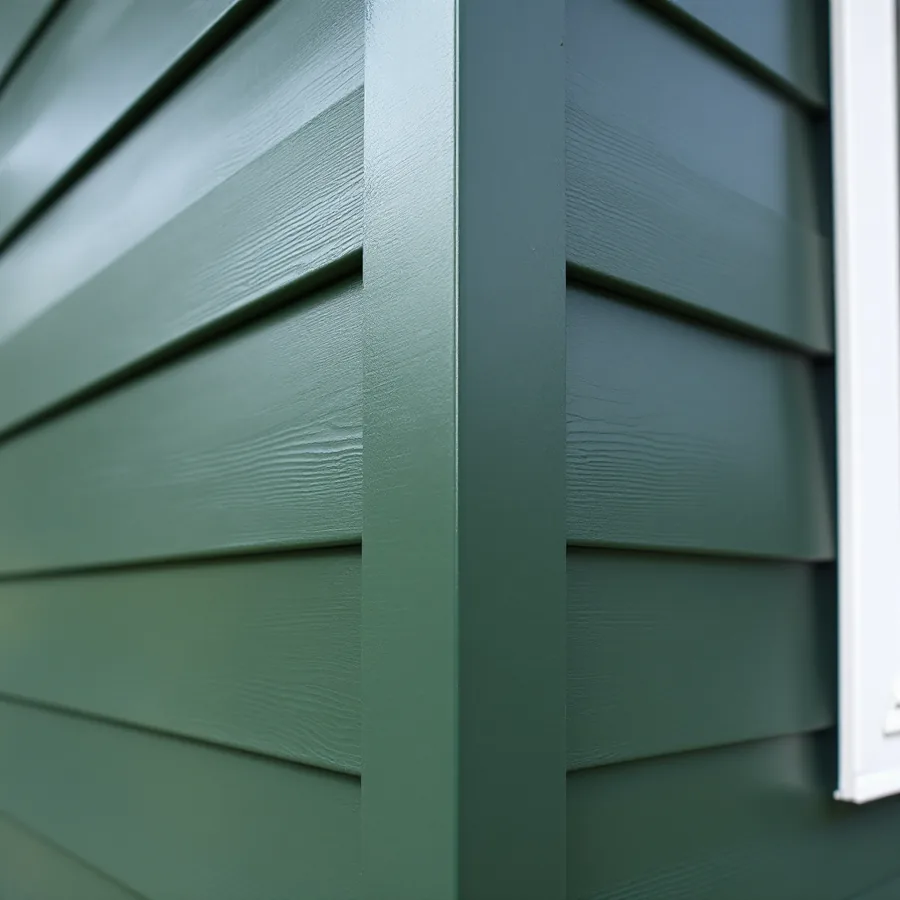
Horizontal steel or aluminum boards that copy clapboard, usually with an embossed grain and a hidden nailing hem. This is the residential profile: it hangs on the same starter strip, corner posts and J-channel as vinyl, and it is usually what a re-siding quote for a whole house means by “steel siding.” Aluminum lap came in 8-inch and double 4-inch widths, and those two are still the patterns people try to match on older houses.
Metal board and batten
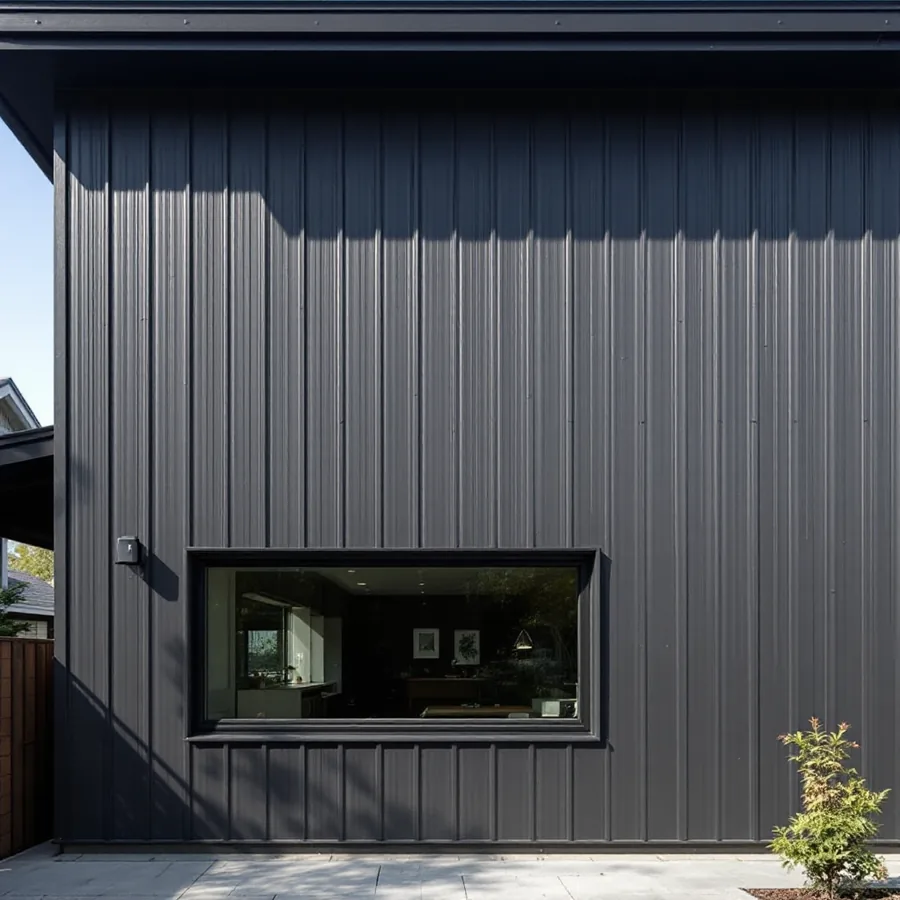
Board and batten metal siding is a vertical panel with a raised batten every foot or so, rolled from one sheet. It is the look of the modern farmhouse, and the reason searches for steel board and batten siding outnumber searches for most other metal profiles. The profile itself, in vinyl, fiber cement and wood as well, has its own page: board and batten siding, in every material. Gauge matters more here than on lap boards, because a wide flat face between battens shows every wave in the steel.
Corrugated metal siding
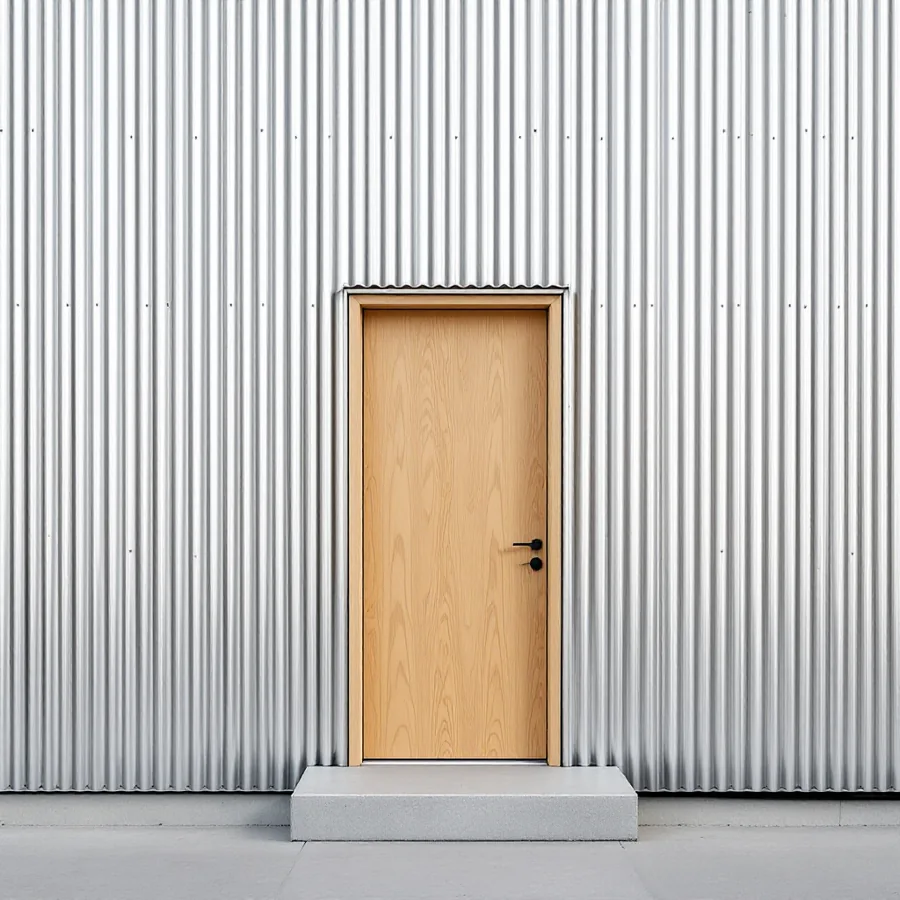
Rounded waves, galvanized or painted, borrowed from barns and grain bins. On a house it reads as industrial or rustic, and it usually runs vertically so water drains down the valleys. Corrugated panels are fastened through the face with screws, so the screw rows are part of the look.
Ribbed panels: classic rib, R-panel and deep groove
Trapezoid ribs at regular spacing, the profile sold for post-frame buildings and barndominiums. Classic rib metal siding panels and similar exposed-fastener panels go up fast over girts or furring and show their screws. Deep groove panels push the ribs farther apart and deeper for a stronger shadow.
Standing seam and other concealed-fastener panels
Standing seam metal siding and flush “seamless” wall panels hide their fasteners under the next panel’s seam. Most architectural metal siding on modern houses is of this kind. The faces stay clean and there are no screw heads to work loose, but the panels need flat, true walls and a crew used to them. Steel seamless siding sold for homes is usually a long-length lap or flush panel cut to the wall on site.
Steel log siding and metal shakes
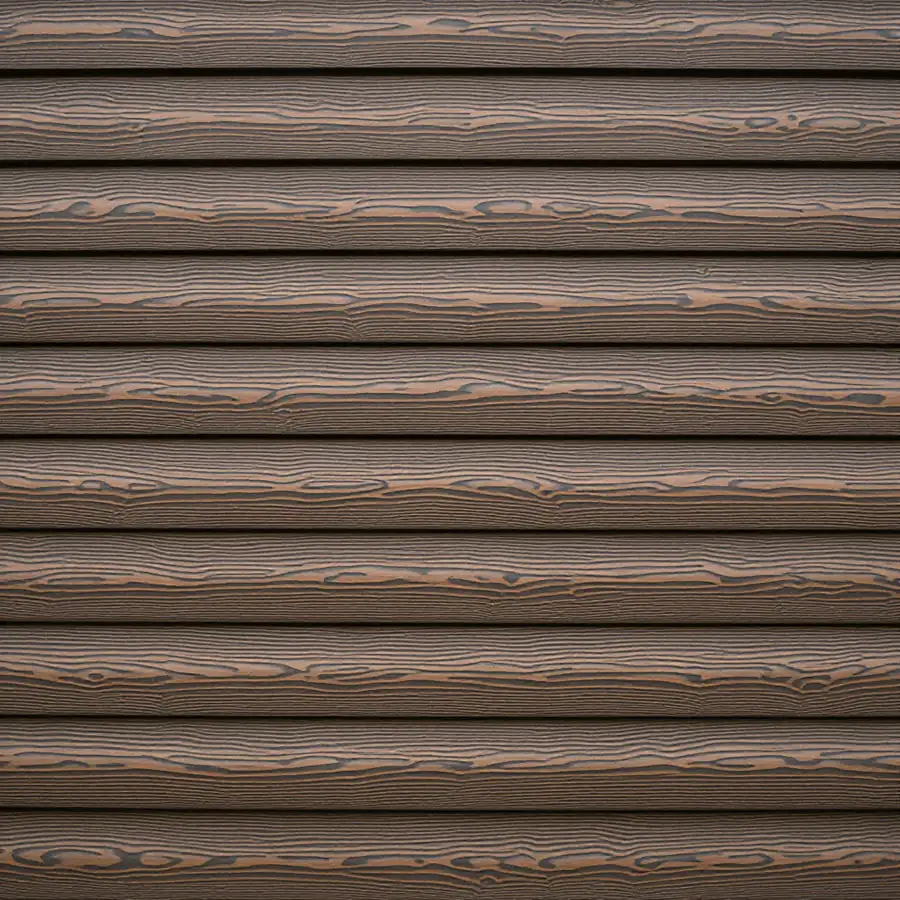
Steel log siding is pressed into half-round courses and printed with a wood grain, for cabins and lake houses that want the log look without staining logs. Metal shakes and shingles are stamped panels for gables and accents. Both are niche shapes; check that trim and corners are sold in the same pattern before choosing one.
Aluminum exterior cladding
Aluminum exterior cladding sold today is mostly flat or plank panels for modern facades and soffits, often with a wood-grain print, rather than the 8-inch lap boards of older houses. Treat it as a separate product from aluminum siding: ask what substructure it needs and whether the maker lists it for houses or for commercial walls.
Colors and Looks
Wood-look, black, white and other metal siding colors
Color on metal siding is a printed or baked coating, not the metal. That is why a wood-look panel and a plain white one can carry very different warranties from the same maker.
Metal siding that looks like wood
Wood grain metal siding, barnwood and cedar-tone steel are printed: a photograph of grain is laid onto the painted coil and sealed under a clear layer. Up close the pattern repeats along the panel, and at ten feet it reads as stained boards; wood look aluminum siding is made the same way. Ask for the warranty that covers the printed finish by name. In our count Petersen’s Print Coat warranty promises only that the print stays “intact and distinguishable” for 20 years, against 30 for chalk and 40 for peeling, and EDCO’s RealGrain warranty names no fade limit at all.
Black, charcoal and other dark colors
Black metal siding and charcoal panels are the modern-farmhouse choice. Dark surfaces run hotter in sun. Check the color list in the warranty: Sheffield covers Matte Black and Antique Black for 10 years instead of 30 and gives metallic colors no fade rating at all, and McElroy and Petersen set shorter terms for some reds, oranges and one blue. Matte finishes hide oil canning, the slight waviness of wide flat steel, better than gloss.
White and light colors
White metal siding and white aluminum siding are the plainest match for trim and soffit. White is also the color most old aluminum houses wear, which matters when you need to match a replacement piece.
Rustic, camo and weathering steel
Camo metal siding is a printed pattern on the same painted steel. Corten steel siding is different: weathering steel is meant to rust on the surface into a stable brown layer, which also runs off onto concrete and stone below it for years. It is a finish for a designed facade, not a substitute for painted siding on an ordinary house.
Matching siding to a metal roof
Metal roof and siding color combinations usually pair a darker roof with a lighter wall, or match roof and trim. Roof and wall from one paint system start out matched, but they do not weather alike: five warranties in our count allow a roof 7 units of color change where a wall gets 5, and Fabral’s notes that fading “may not be in uniform if the surfaces are not equally exposed to the sun” and the elements.
Fit
Where metal siding fits a house, and where it struggles
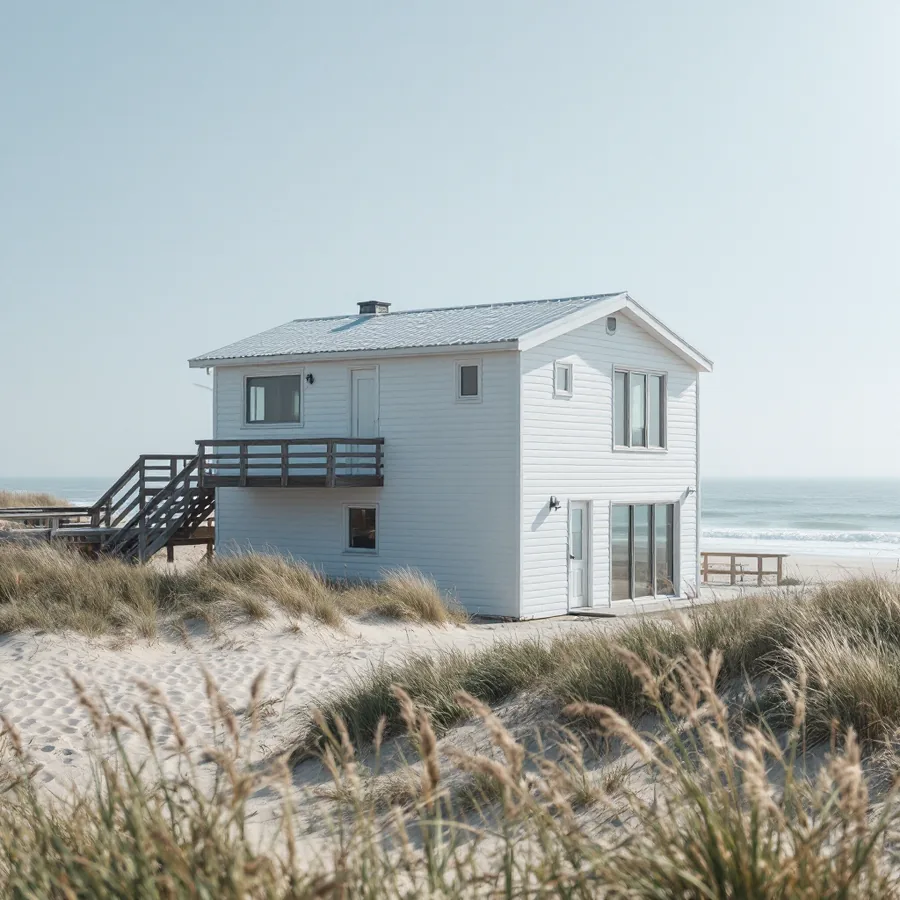
Is metal siding worth it? It is on houses where fire, insects or rot are the worry and nobody minds a few dents. It is a harder sell on a beach, under frequent hail, or where the crews near you have never hung it.
Where it fits
- Wildfire country. FEMA’s fact sheet on exterior walls in wildfire zones, in the 2008 draft we could obtain, lists “Concrete, fiber-cement panels or siding, exterior fire-retardant-treated wood siding or panels, stucco, masonry, and metal” as recommended coverings, and in the same paragraph puts “metal siding susceptible to warping” among those it does not recommend. It also asks for the whole wall assembly to carry a fire-resistance rating, so the panel is one layer of the answer, with vents, eaves and windows the rest.
- Rot and insects. Metal gives termites and woodpeckers nothing to eat and does not rot. What it hangs on still can, so the water-resistive barrier behind it matters as much as on any wall.
- Low upkeep, in the middle of the country. A factory finish on steel or aluminum needs washing, not painting, for years. How many years depends on the finish and the exposure, which is what the warranty limits above put into numbers.
- Modern and farmhouse designs. Board and batten, standing seam and corrugated profiles give looks that vinyl does not do convincingly.
Where it struggles
- Hail and knocks. Thin aluminum dents from hail, ladders and baseballs; steel resists better in heavier gauges but dents too. A dent in metal stays; our siding repair page covers documenting hail damage.
- Salt air. The coastal section above is the short version: most warranties we read either stop or change near salt water.
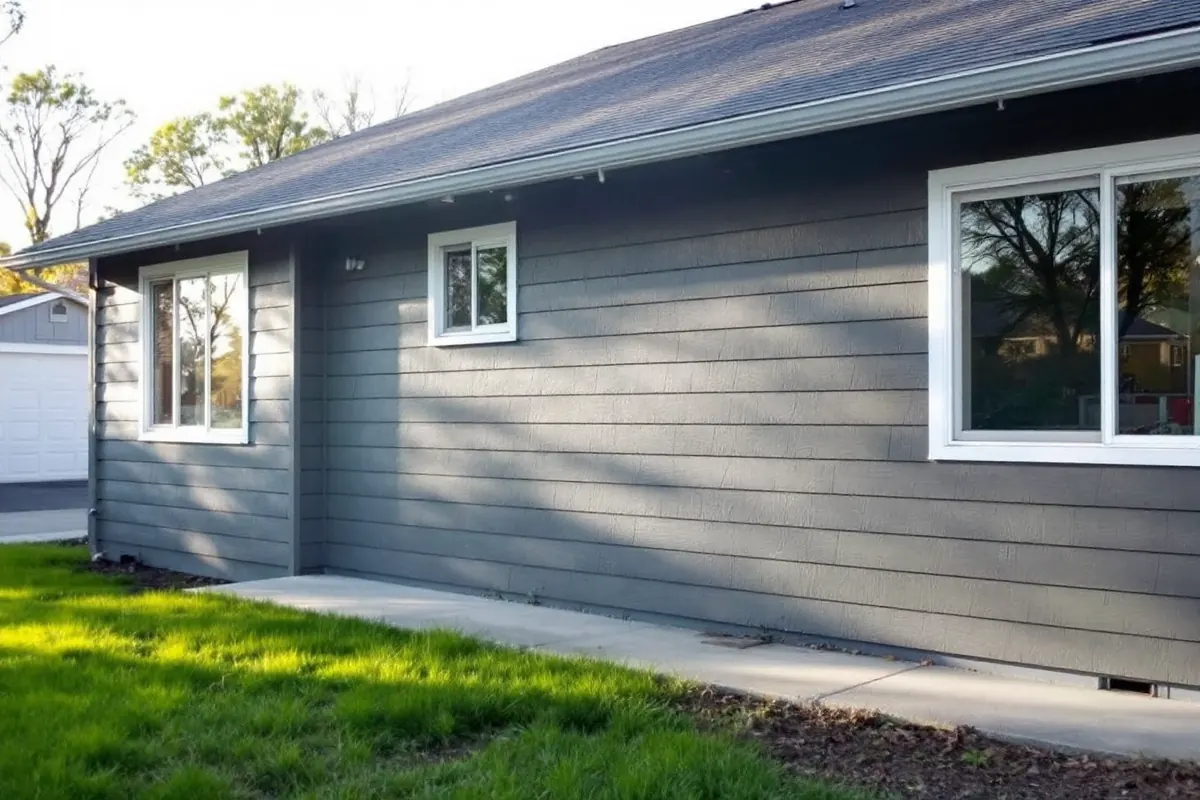
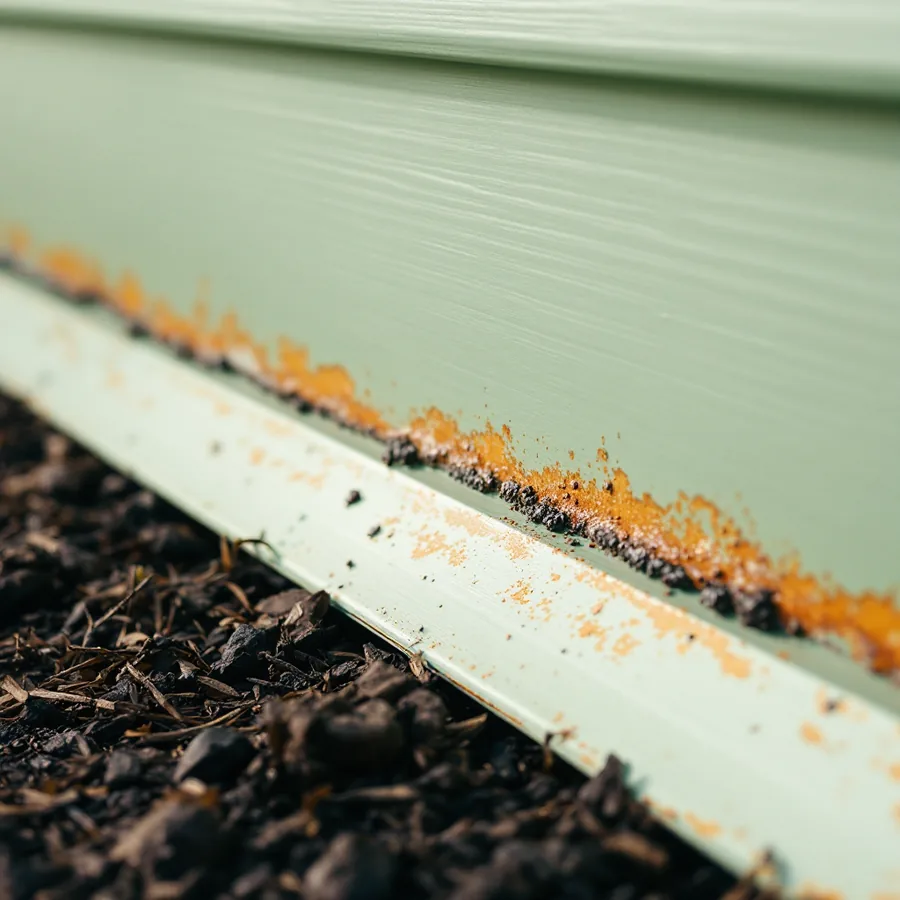
- Scratches and cut edges on steel. Galvanized and Galvalume coatings protect a scratch for a while, but a deep one or a sawn edge left raw can show rust, as in the picture below.
- Crews. Lap steel goes up much like vinyl, but panels with exposed or hidden fasteners, flashings and bent trim are their own trade. Ask each installer how many metal walls they did last year.
Insulated metal siding
Insulated metal siding and insulated aluminum siding carry a foam backer under the panel. The backer stiffens the face against dents and adds a little insulation; the larger gain comes from a continuous layer of rigid foam over the whole wall, under any siding. The aluminum versus vinyl siding insulation question has the same answer for both: the material of the face adds almost nothing, the foam behind it does.
Mobile and manufactured homes
Metal siding for mobile homes, mostly aluminum lap or vertical panels, is common on older units. Replacement panels in matching profiles are sold by parts suppliers for manufactured housing; match the profile and the width before ordering, because hems often differ between makers.
Common Worries
Questions people ask about living behind a metal wall
Five worries come up again and again in searches about metal siding. Federal sources answer most of them.
Does metal siding attract lightning?
No. The National Weather Service lists it as a myth and says: “The presence of metal makes absolutely no difference on where lightning strikes.” Height, shape and isolation decide where a bolt lands. The same page adds that metal “does conduct it,” which is why whether metal siding needs to be grounded is a question for the electrician and the local code, not for the siding seller.
Does metal siding make a house hotter?
The panel surface gets hot in sun, dark colors more than light ones, but a vented or furred wall with insulation behind it keeps most of that outside. The EPA’s cool-roof guidance, written for roofs, names the property that matters: “A high solar reflectance, or albedo, is the most important characteristic” for how much sun a surface turns away. Light, reflective finishes on a south or west wall help; the color of a shaded north wall barely matters.
Does metal siding block wi-fi and phone signal?
It can weaken signals coming through the wall. A continuous metal skin reflects radio waves; when the National Institute of Standards and Technology measured signal loss through building materials, it used “a metal RF isolation barrier” precisely to stop signals going around its samples. Wi-fi inside the house is mostly unaffected because the router is inside too. Cell reception in a room against a metal wall can drop; windows let signal through, and a phone’s wi-fi calling setting is the usual workaround.
Is metal siding noisy in rain?
A wall takes rain at a slant, not head-on like a roof, and lap panels lie on sheathing. None of the installation guides in our count mentions noise; what they warn about is movement. Panels nailed tight have no room to expand, and Gentek’s aluminum guide warns, in capitals, “TO AVOID DISTORTION, DO NOT DRIVE NAILS TIGHT” in either siding or corner caps. The installation section below covers it.
Can I hang things on metal siding?
Magnets with a rubber face can hold a light sign on steel without a hole. Aluminum siding hooks clip under the lap of a course and come off again, the way holiday lights usually go up. Any screw through metal siding is a hole in the weather skin, and a screw of a different metal can start corrosion around it.
Installation
Installation details that decide a metal wall
How to install metal siding is set out in each maker’s guide, and the guides agree on more than they differ. These are the lines from the installation guides in our count that decide whether a wall lasts, whoever does the work.
Can metal siding touch the ground?
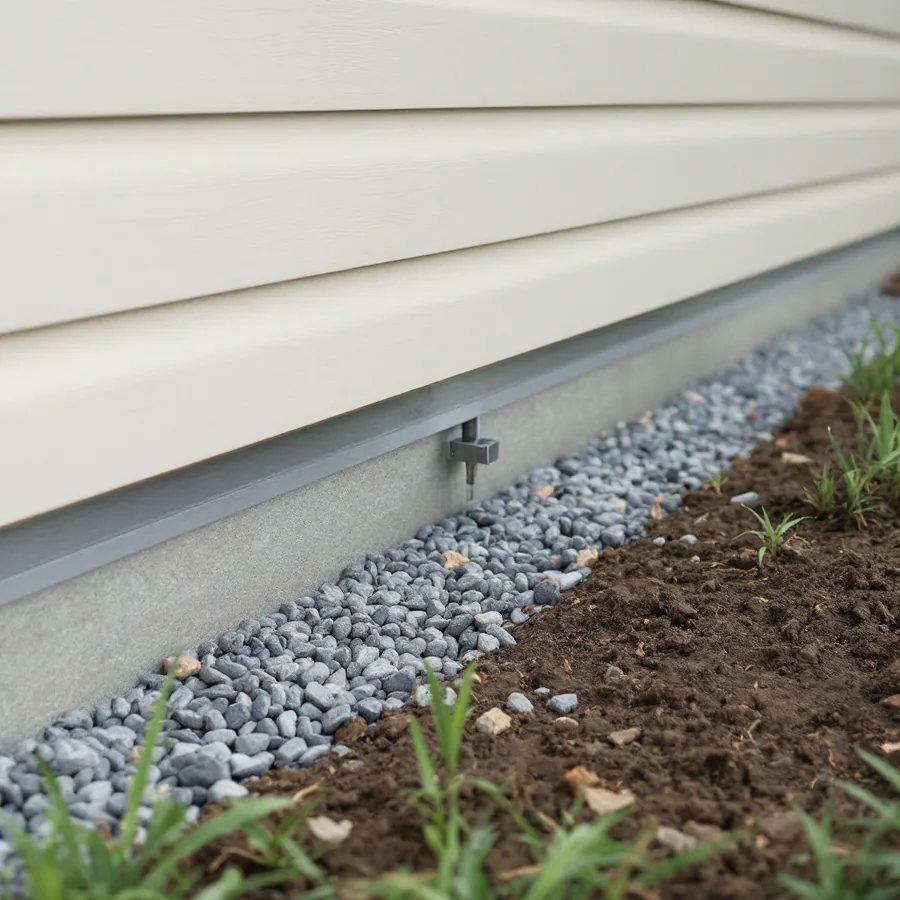
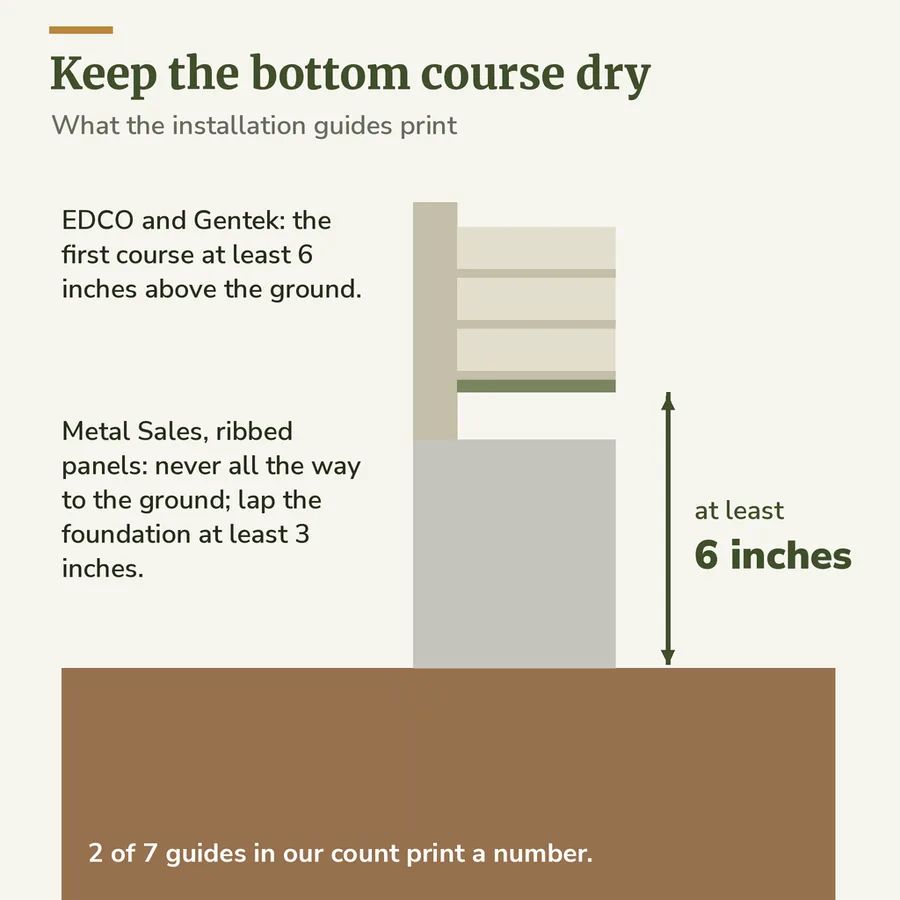
No. Gentek’s metal siding manual says “The first course should be installed a minimum of 6" from the ground.” EDCO’s guide asks for the same: “Make sure that the bottom edge of the first panel is a minimum 6" above ground level at all points.” Those are the only two of the seven guides in our count that print a number; Metal Sales, for its ribbed panels, says they “should not be installed all the way to the ground” and should lap the foundation by at least three inches. Soil, mulch and splash keep the bottom edge wet, and a wet cut edge is where steel rusts first.
Nails and screws: match the metal
The fastener has to suit the panel. Gentek’s aluminum guide: “Use only aluminum nails when nailing siding or aluminum accessories, to avoid rust streaks on the siding.” Rollex, for steel: “Always use galvanized nails.” Aluminum siding nails driven into steel trim, or plain steel screws in aluminum, set up the dissimilar-metal corrosion the manuals warn about. Gentek’s metal manual lists what to keep panels away from: “dissimilar metals, concrete, stucco, asbestos siding, pressure-treated/pre-treated lumber, masonry or corrosive non-metallic materials that might become repeatedly wet.”
Does metal siding need sheathing and a water barrier?
Metal siding sheds most rain but is not a waterproof wall; water gets behind every siding at laps and trim. EDCO’s guide notes that “A housewrap, or water-resistive barrier, is required to be installed underneath the siding by many municipalities,” and lap profiles are nailed to solid sheathing or through it into studs. Ribbed and corrugated panels can span furring strips or girts instead, which is how barndominiums go up.
Leave room to move
Steel and aluminum grow and shrink with temperature, and a panel pinned tight has nowhere to go but out of plane. Gentek’s aluminum guide asks for nails in the middle of the slotted holes “to allow for expansion and contraction,” and, in capitals, “DO NOT DRIVE NAILS TIGHT.” Rollex says the same for steel: “Do not Overdrive Nails.”
Cutting without ruining the finish
The guides list tin snips, power shears and hacksaws, and allow a circular saw with conditions: for steel, Rollex says “Only use a ferrous saw blade - other blades can destroy protective coatings and damage siding,” and only for cuts that end inside J-channel or corner posts, adding that “Metal chips, dust, and burrs should be removed from the edges of cuts made by a saw.” For aluminum, Gentek asks for a blade made for aluminum and saw cuts made “so that the saw burr is toward the back of the siding.”
Trim, J-channel and corners
Metal siding trim comes in the same finish as the panels: starter strip, J-channel around windows and doors, outside and inside corner posts, undersill trim, and flashing at the base and above openings. Metal flashing for siding goes over window heads and at roof-to-wall joints before the siding. Aluminum siding corners on older houses are often individual corner caps, one per course, and Gentek’s guide warns against driving their nails tight as well. A quote that lists panels but not trim is incomplete.
Older Houses
Aluminum siding on an older house: keep it, paint it or take it off
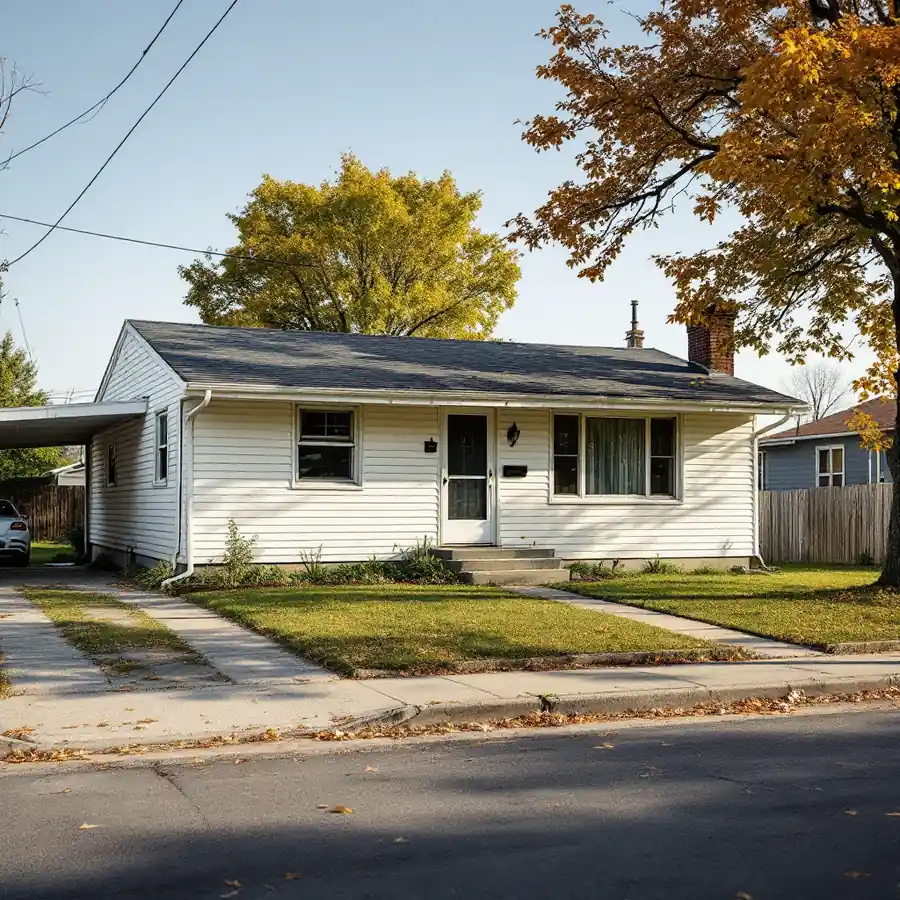
Most aluminum siding in the country went up decades ago, often over the house’s first wood siding. What is under it, and how old the house is, decide more than the aluminum itself.
Do they still make aluminum siding?
Yes, though aluminum siding styles and options are narrower than they were: mostly lap and Dutch lap in a few widths, vertical panels and soffit. Our sample includes aluminum siding warranties from Rollex, Ply Gem and Kaycan, nominal thicknesses of .019 and .024 inch printed in Ply Gem’s 2026 specification guide, and installation guides for aluminum lap from Gentek. The makers sell it through siding distributors and dealers rather than off the shelf. Can you still buy aluminum siding to match one damaged board? Often, if the profile and color are still in a catalog; if not, a piece taken from a hidden wall is the usual answer.
What is under aluminum siding
On a house built before 1978 the answer is often painted wood clapboard, and the paint may contain lead. The EPA says “approximately three-quarters of the homes in the United States built before 1978 still contain some lead-based paint,” and its Renovation, Repair and Painting rule “requires that anyone paid to perform work that disturbs painted surfaces” in those homes be certified. Tearing aluminum off disturbs the paint behind it. The other old layer to expect is cement shingles: the EPA’s list of asbestos products includes “Roofing and siding shingles,” and it adds that material “in good condition and will not be disturbed” is best left alone.
How to remove aluminum siding
Work from the top down: corner caps and trim first, then each course is unhooked from the one below and the nails pulled. On a pre-1978 house, hire a lead-safe certified firm or follow the EPA’s do-it-yourself lead-safe practices, and do not cut or break any gray cement shingles that turn up underneath. Re-siding over the old layer instead is sometimes allowed; ask the installer whether the new product’s instructions permit it.
Is aluminum siding worth anything as scrap?
It is recyclable, and scrap yards buy it by the pound; prices move with the metal market, so call two yards. The U.S. Geological Survey counts how much comes back: “In 2025, aluminum recovered from purchased scrap in the United States was about 3.6 million tons.” Separate the aluminum from steel nails and foam backer before weighing it in, because mixed loads are often graded lower.
Repainting
Can you paint aluminum siding? And steel siding?
Yes to both, and the work is mostly cleaning. Factory finishes chalk as they age; paint applied over chalk peels.
Why old aluminum siding needs paint at all
A paint maker’s technical bulletin on painting aluminum siding puts it plainly: “the coating that is/was on aluminum siding is not indestructible. It does erode, chalk, and fade.” Is painting aluminum siding worth it? On a sound wall it brings back color without re-siding. On a dented, loose or leaking wall it only colors the problem.
How to paint aluminum siding, step by step
- Test for chalk. The same bulletin: “Test for chalk by rubbing your hand on the siding, checking for a transfer of chalk onto your hand. Chalk must be completely removed prior to painting.”
- Wash it off. Warm soapy water or a pressure washer, then rinse well; the next section has more on cleaning.
- Prime where needed. Where cleaning exposes bare aluminum, the bulletin calls for an acrylic maintenance primer first. Where heavy chalk will not wash off, the maker’s metal siding bulletin recommends a solvent-thinned primer instead.
- Two coats of exterior acrylic latex. The paint for aluminum siding in both bulletins is acrylic latex, two coats. A flat sheen, the bulletin notes, reduces “the magnification of any surface imperfections such as dents.”
- Try a patch first on factory-painted steel. The metal siding bulletin says “it is not possible to judge the ability of a coating to adhere to a surface by observation,” so a test patch comes before the whole wall.
Painting steel siding
Can you paint steel siding? Yes, the same way, with one extra step: rust. The metal siding bulletin says to remove loose coating and rust, dull glossy areas with sandpaper and spot prime bare steel with a rust-inhibitive primer. Painting can also end a factory finish warranty: Metal Sales’ excludes panels that have been “field painted,” and several others exclude products that have been altered or modified, so check yours before the first coat.
Lead paint and the paint job
Painting the aluminum itself does not disturb old lead paint. Scraping trim, sills and wood elements on a pre-1978 house does, and a paid painter doing that work falls under the EPA rule above.
What sets the price of painting aluminum siding
Wall area, height and access, how much chalk and loose paint has to come off, how much bare metal needs primer, and how many colors. We publish no price averages; ask painters to quote the same scope, including how they will remove chalk.
Cleaning
Cleaning chalky or oxidized metal siding
How to clean aluminum siding: wash from the bottom up, rinse from the top down, and stop when your hand comes away clean.
The white powder on old aluminum siding is chalk, the paint binder breaking down in sunlight; true oxidation of the metal shows only where the paint has worn through. A household detergent or a pre-paint cleaner in warm water, a soft brush and a thorough rinse remove most of it; the metal siding bulletin adds “not allowing detergent to dry on the surface.” For mildew on shaded walls the same bulletin gives a mix of three parts water to one part bleach, left ten minutes and rinsed off. On siding still under a factory finish warranty, read its cleaning clause first: the Fabral, McElroy, Sherwin-Williams and Petersen Print Coat warranties in our count exclude damage from bleach cleaners, and Steelscape’s excludes damage from pressure washing. Water driven up under the laps also ends up behind the siding.
Cleaning alone brings back some color but not the gloss, and chalk returns. If a wall needs scrubbing every year to look right, it is ready for paint.
Repairs
Dents and damaged pieces
A dent in metal siding does not pop back. Repair means filling it or replacing the piece, and replacing works only if the profile and color can still be found.
How to repair aluminum siding with small dents
Small dents can be filled with an exterior filler made for metal, sanded flush and touched up; on a wall that will be repainted anyway, this is the usual route. A flat finish hides what remains.
Replacing a damaged piece
Aluminum siding replacement pieces are cut from a new panel or salvaged from a garage or back wall. The damaged course is cut out above the nail hem, the new piece is set into the lock of the course below and fastened through its top under the course above, usually with a sealant at the overlap. Steel lap panels are replaced the same way. Ask for touch-up paint from the maker of the siding, because spray paint from a store rarely matches a baked finish.
Hail on a metal wall
After hail, photograph every wall before anything is repaired, and ask your insurer what it needs to see. EDCO’s Entex and Rollex’s Navigator steel siding warranties both send the homeowner to insurance first, before the maker. Our siding repair page covers documenting storm damage.
Money
What a metal siding quote should list
How much is metal siding? We publish no price averages, because a number from another town and another wall says little about yours. What we can show is what a fair quote is made of.
| Line on the quote | What to check |
|---|---|
| Panels, in squares | Material (steel or aluminum), gauge or thickness, profile, finish system and color by name |
| Trim and accessories | Starter strip, J-channel, corner posts, window and door trim, flashings, all in the same finish |
| Tear-off and disposal | What comes off, and how lead paint or cement shingles under it will be handled |
| Wall preparation | Sheathing repairs, water-resistive barrier, furring or girts for panels |
| Insulation | Foam backer or a continuous foam layer, and its thickness |
| Fasteners | Type and coating, as the maker’s guide requires |
| Labor and access | Height, staging or lifts, number of stories |
| Warranty paperwork | Who registers the finish warranty, and the workmanship warranty in writing |
What makes the panel line move: steel against aluminum, gauge, a PVDF finish or a printed wood grain against plain SMP, and concealed-fastener panels against lap or exposed-fastener ones. Counting the wall area comes first; our squares calculator turns house measurements into the squares a quote should show, and the rest of that page explains what moves the cost of re-siding.
Side by Side
Metal siding against vinyl, fiber cement and wood
Does aluminum beat vinyl, or steel beat fiber cement? Each material wins on something different, so the table below is by property, not by score.
| Property | Steel | Aluminum | Vinyl | Fiber cement | Wood |
|---|---|---|---|---|---|
| Burns? | No | No | Melts in high heat; FEMA does not recommend it in wildfire zones | No | Yes |
| Dents? | Resists in heavier gauges | Easily | Cracks in cold, rarely dents | Chips, does not dent | Dents, can be filled |
| Rusts or rots? | Rust at cut edges and scratches | No rust; chalks | Neither | Neither if sealed | Rots where finish fails |
| Finish | Baked paint or print | Baked paint | Color through | Paint or factory finish | Paint or stain |
| Magnetic | Yes | No | No | No | No |
| Near salt water | Warranties often limited | Warranties often limited | No metal face to corrode; fasteners still can | No metal face to corrode; fasteners still can | No metal face to corrode; fasteners still can |
| Deeper page | This page | This page | Vinyl siding | Fiber cement | Wood siding |
Aluminum vs vinyl siding
Vinyl largely took aluminum’s place on new houses: it does not dent, chalk or need paint; aluminum does not burn, crack in cold or sag in heat. How to tell them apart on a house: a magnet does not stick to either, but aluminum is cold and rigid to the touch, rings when tapped and shows bare metal at a scratch, while vinyl flexes and is the same color all the way through. Is metal siding cheaper than vinyl? That depends on the product and the wall, so ask for both prices on the same scope.
Steel siding vs vinyl, and metal vs Hardie board
Steel takes knocks better than vinyl and does not burn; vinyl is lighter, more forgiving to install and has no metal face for salt to attack. Against fiber cement such as Hardie board, both are noncombustible: fiber cement is heavier, needs paint over time and does not dent, while steel is lighter, factory-finished and dents. More on that material is on our fiber cement siding page.
How long does aluminum siding last?
Many houses still wear aluminum put up fifty or sixty years ago, repainted along the way. We do not publish lifespans in years, because exposure and installation move them too much; the finish warranties in our count say how long the makers stand behind the paint, which is a different and shorter number than how long the metal hangs on the wall.
Your House
Check a metal siding warranty against your house
Pick how far the house is from salt or brackish water and which kind of warranty you are looking at. The tool counts how the eighteen warranties in our sample treat that distance. Nothing you pick leaves this page, and no price appears.
“Partly” covers two cases from the table at the top of the page: EDCO keeps its warranty near the coast but drops rust and corrosion, Steelscape keeps 20 years on the steel from 1,000 feet out, and four panel warranties keep coverage only if their conditions are met. The Petersen 35-year warranty in our count is its Hawaii edition and applies only there. Counting the squares of wall comes next; our squares calculator does that for any material.
Before Signing
Before you sign: seven things to get in writing
Most of what goes wrong with a metal wall is settled on paper before the first panel goes up.
| Ask for | Why |
|---|---|
| The finish warranty itself, not the brochure | Chalk and fade limits, colors excluded and the coastal clause are in the document only |
| Who registers it, and by when | Several warranties in our sample require registration or a claim within a set time |
| Distance to salt water, on the contract | So nobody argues later about which exposure the house is in |
| Fasteners named by type and coating | The wrong metal against the panel corrodes, and the guides name what to use |
| Ground clearance and gutters | The bottom course and splash zone are where steel rusts first |
| Touch-up paint from the maker | Scratches and cut edges need the matching finish |
| Workmanship warranty, separately | The maker’s warranty excludes installation; the installer’s covers it |
The Federal Trade Commission’s advice on home improvement contractors applies here as on any job: get several written estimates, check license and insurance, and do not choose on the lowest bid alone. Our contact page says when our own introduction line opens; the list above works with any installer you find.
About This Page
Who read these warranties, and how we are paid
Siding Pros USA introduces homeowners to contractors and is not one. We do not make, sell or install siding, and no maker in the count paid for a mention or a place in the tables. The documents were read by our editorial team; every number in the count rests on a word-for-word quotation from a copy of the maker’s own document that we saved on October 18, 2026; four of them are linked in the sources below, and the rest are named in the table. Our model is a fixed fee for introducing a homeowner to an independent local contractor, the same whichever material the wall gets, and that line is not open yet. How we check facts is set out in our editorial standards.
Straight Answers
Metal siding questions, answered
What is metal siding made of?
Steel or aluminum sheet, formed into lap boards or vertical panels. Steel carries a zinc or aluminum-zinc coating against rust under a baked paint; aluminum carries the paint alone. Wood-grain looks are printed onto the paint and sealed.
Is steel siding better than aluminum siding?
For dents and hail, usually yes, especially in heavier gauges. Aluminum is lighter. Near salt water the clause matters more than the metal: Petersen’s Hawaii warranty requires aluminum within 1,500 feet of a seacoast, but the three aluminum house-siding warranties in our count all exclude salt air. Rollex, which makes both, gives its steel siding stricter chalk and fade limits than its aluminum.
Does metal siding rust?
Steel can rust where a cut edge, scratch or fastener hole reaches the steel, and faster near salt water or wet soil. Aluminum does not rust red but can corrode near the coast. All 18 warranties in our count limit coverage near salt water, and fourteen of the eighteen name a distance.
How long does metal siding last?
The metal can hang on a wall for many decades; the paint is what ages. In our count the finish is warranted for life in six of the documents and for 20 years to 45 years by the rest, while chalk and fade limits run 20 years to 40 years. We publish no lifespans in years, because exposure and installation move them too much.
Is metal siding cheaper than vinyl?
It depends on the product more than the metal: steel lap, aluminum lap and ribbed wall panels are priced differently and need different trim, framing and crews. We publish no price averages; ask for both materials on the same scope and compare the lines a quote should list.
Can metal siding touch the ground?
No. The EDCO and Gentek guides in our count both set a minimum of 6 inches between the first course and the ground, and Metal Sales says panels “should not be installed all the way to the ground.” Soil and mulch keep the bottom edge wet.
Does metal siding attract lightning?
No. The National Weather Service calls that a myth: metal makes no difference to where lightning strikes, though it conducts electricity once struck. Grounding questions go to an electrician and the local code.
Does metal siding block wi-fi or cell signal?
Wi-fi inside the house is little affected, because the router is inside too. Cell reception in rooms behind a continuous metal wall can drop; windows let signal through, and wi-fi calling on the phone is the usual workaround.
Can you paint aluminum siding?
Yes. Wash off all the chalk, prime any bare metal and apply two coats of exterior acrylic latex. Painting can end the factory finish warranty, so read it first. The painting section has the steps from a paint maker’s bulletin.
Do they still make aluminum siding?
Yes; aluminum siding is still available, in fewer patterns. Our count includes current aluminum siding warranties from Rollex, Ply Gem and Kaycan, and Ply Gem’s 2026 specification guide prints thicknesses of .019 and .024 inch.
How can I tell if my siding is steel or aluminum?
Hold a magnet to it. A magnet sticks to steel siding and not to aluminum. Both ring when tapped and show bare metal at a deep scratch, which tells either of them apart from vinyl.
What gauge of metal siding is best for a house?
The residential steel lap lines in our count print 28 gauge and 0.0172 inch; Metal Sales prints 29 and 26 gauge for its ribbed panels, and a lower number is thicker. Heavier gauge resists dents and waviness. Ask for the gauge in writing next to the finish system.
Is a metal siding warranty transferable?
Often not. Twelve of the eighteen warranties in our count stay with the original buyer; the other six pass once or with conditions, such as written notice within 30 days or a fee, and usually with shorter or prorated coverage after the sale.
Do you sell or install metal siding?
No. We are a referral service, with no sales arm and no crews. Our model is a fixed fee for introducing homeowners to independent local contractors, the same whichever material the wall gets, and that line is not open yet. The warranty count on this page is our own research.
Where This Comes From
Sources and method
Every document behind our count was saved on the day we read it; the main ones are linked here.
- Our count of warranties and installation guides: 25 documents published by the makers, saved October 18, 2026, among them the EDCO Entex siding limited lifetime warranty, the Gentek metal siding installation manual (2022), the Fabral WeatherXL warranty F-229 and the Steelscape Riverstone ZINCALUME sample warranty. The coding and counts are ours.
- Salt spray and corrosion near the coast: FEMA, NFIP Technical Bulletin 8, Corrosion Protection for Metal Connectors and Fasteners in Coastal Areas (June 2019), and FEMA P-499, Home Builder’s Guide to Coastal Construction (December 2010).
- Wildfire and wall coverings: FEMA, Home Builder’s Guide to Construction in Wildfire Zones, technical fact sheets (September 2008 draft as published by the State of Alaska).
- Lightning: National Weather Service, Lightning Myths.
- Radio signals through building materials: NIST, NISTIR 6055, Electromagnetic Signal Attenuation in Construction Materials (October 1997).
- Reflective walls and heat: EPA, Using Cool Roofs to Reduce Heat Islands.
- Lead paint under old siding: EPA, Lead Renovation, Repair and Painting Program.
- Asbestos in old siding: EPA, Learn About Asbestos and Protect Your Family from Exposures to Asbestos.
- Aluminum recycling: U.S. Geological Survey, Mineral Commodity Summaries 2026: Aluminum.
- Painting metal and aluminum siding: Diamond Vogel technical bulletins Painting Aluminum Siding and Painting Metal Siding.
- Hiring a contractor: Federal Trade Commission, Consumer Advice: How To Avoid a Home Improvement Scam.
How each fact here was found and checked is set out in our editorial standards. Quotations are copied word for word from saved copies of the linked documents, and the page carries no price averages. Last updated .
Before you call anyone
The flat-fee match — we are paid for the introduction, not for the size of your job
Most siding advice is written by the company that wants to do the work or the company that makes the product. That is not a failing of the people who read it; it is a defect in who is talking: the measurement, the estimate and the invoice come from one party, and no amount of care on your side fixes that.
We are built the other way round. We do not install, repair or sell anything, so the payment reaches us when you are connected to a licensed, insured siding contractor — the same amount whether you need one panel replaced or four walls re-clad. Nobody here has a reason to talk you into the larger number. You can check that rather than take it on trust: how we make money is written down, and this site keeps telling readers when one wall is enough. Why does not everyone work this way? Because a flat fee leaves money on the table every time the job turns out to be big.
Waiting is the one thing that actually costs money. A wall that is open to the weather does not get better and does not wait for a convenient week; the water that gets behind the siding finds the sheathing, the framing and the drywall inside. A cracked panel over a window lets the next storm in. And if it turns out to be one panel and a quarter-hour, say so when you ask. We will tell you, and that answer earns us nothing.
Not for you if: you want a price over the phone — nobody honest gives one without measuring the house; you need a guarantee of arrival within the hour — we cannot promise that for a company we do not run; the building is commercial; or you would rather do it yourself, in which case the pages on this site are written so that you can.