Siding Repair
Siding repair: read the damage first, then fix the piece it points to
Reviewed by the Siding Pros USA editorial team · · 22 min read
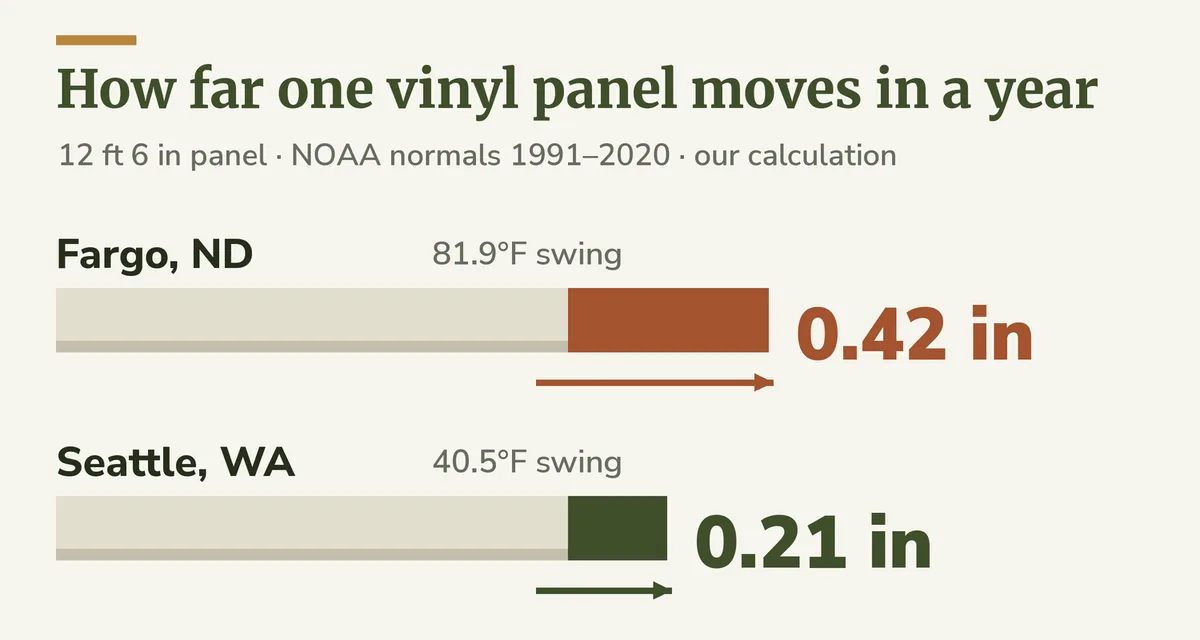
Siding repair is replacing or fixing the damaged pieces of a wall without re-siding it. A hole, a crack or a loose panel usually involves one panel or one course, and the shape of the damage tells you what caused it. By our calculation from federal climate records, a vinyl panel in Fargo, ND travels twice as far each year as one in Seattle, WA. A panel nailed too tight to make that trip waves, cracks or pops loose, so some of what looks like damage is an installation fault.
Siding repair starts with the piece, once you know what broke it
- Size first. A hole, a crack or a loose panel is usually one piece or one run of panels. A wall is only the job when the damage repeats across it or the wall behind is wet.
- Movement. A 12-foot-6-inch vinyl panel grows and shrinks between 0.21 inch and 0.42 inch a year on air temperature alone, depending on the city. Panels that cannot slide on their nails crack, wave and pop loose.
- Old paint. On a house built before 1978, the federal lead rule exempts paid minor exterior repairs that disturb “20 square feet or less of painted surface for exterior activities”, with conditions. Paid work beyond that needs a certified firm.
- Matching. The hard part of a one-piece repair is rarely the repair. It is finding a panel that matches a wall the sun has been working on for years.
This page is about what siding damage means and how each kind is fixed. What a repair costs is on our siding cost page, in its section on one panel and one wall. We publish no price averages, and we install and repair nothing ourselves.
Our Calculation
Our calculation: how far a vinyl panel travels in 24 cities
Vinyl siding is hung loose on purpose, because it changes length with temperature. We worked out how far one standard panel travels in a year in twenty-four cities, using NOAA's thirty-year climate normals and a manufacturer's published expansion figure.
| City (NOAA station) | Coldest month, normal low | Warmest month, normal high | Swing | Panel moves |
|---|---|---|---|---|
| Fargo, ND | 0.2°F (January) | 82.1°F (July) | 81.9°F | 0.42 in. |
| Minneapolis, MN | 8.8°F (January) | 83.4°F (July) | 74.6°F | 0.38 in. |
| Omaha, NE | 15.2°F (January) | 88.1°F (July) | 72.9°F | 0.37 in. |
| Denver, CO | 18.4°F (December) | 89.9°F (July) | 71.5°F | 0.36 in. |
| Salt Lake City, UT | 24.2°F (January) | 94.0°F (July) | 69.8°F | 0.36 in. |
| Kansas City, MO | 19.5°F (January) | 88.3°F (July) | 68.8°F | 0.35 in. |
| St. Louis, MO | 23.8°F (January) | 89.6°F (July) | 65.8°F | 0.34 in. |
| Chicago, IL | 18.8°F (January) | 84.5°F (July) | 65.7°F | 0.34 in. |
| Detroit, MI | 19.2°F (January) | 83.7°F (July) | 64.5°F | 0.33 in. |
| Indianapolis, IN | 20.9°F (January) | 85.2°F (July) | 64.3°F | 0.33 in. |
| Columbus, OH | 22.0°F (January) | 85.4°F (July) | 63.4°F | 0.32 in. |
| Philadelphia, PA | 26.0°F (January) | 87.8°F (July) | 61.8°F | 0.32 in. |
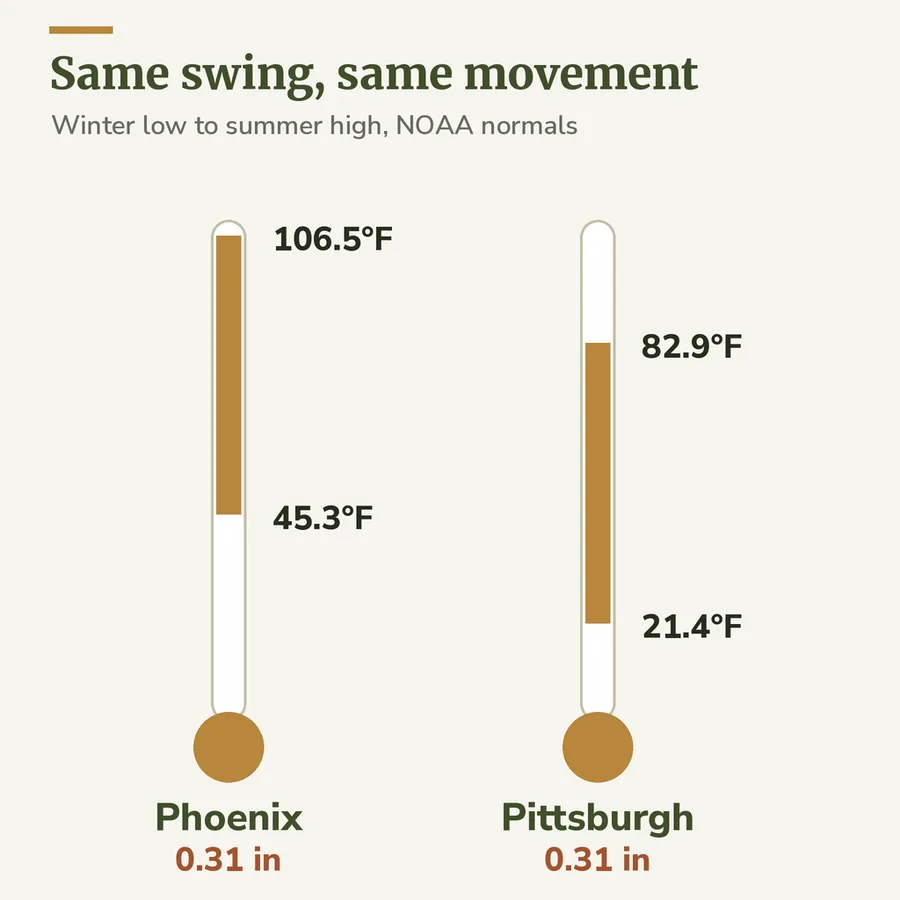
| Pittsburgh, PA | 21.4°F (January) | 82.9°F (July) | 61.5°F | 0.31 in. |
| Phoenix, AZ | 45.3°F (December) | 106.5°F (July) | 61.2°F | 0.31 in. |
| Buffalo, NY | 19.0°F (January) | 80.2°F (July) | 61.2°F | 0.31 in. |
| Nashville, TN | 30.1°F (January) | 90.9°F (July) | 60.8°F | 0.31 in. |
| Dallas-Fort Worth, TX | 36.1°F (January) | 95.8°F (August) | 59.7°F | 0.30 in. |
| Boston, MA | 23.1°F (January) | 82.1°F (July) | 59.0°F | 0.30 in. |
| Charlotte, NC | 31.8°F (January) | 90.3°F (July) | 58.5°F | 0.30 in. |
| New York, NY | 27.9°F (January) | 84.9°F (July) | 57.0°F | 0.29 in. |
| Atlanta, GA | 35.6°F (January) | 90.1°F (July) | 54.5°F | 0.28 in. |
| Houston, TX | 43.7°F (January) | 94.9°F (August) | 51.2°F | 0.26 in. |
| Portland, OR | 36.2°F (January) | 82.3°F (August) | 46.1°F | 0.24 in. |
| Seattle, WA | 37.1°F (December) | 77.6°F (August) | 40.5°F | 0.21 in. |
What the table shows
The panel on a house in Fargo, ND grows and shrinks by 0.42 inch over a normal year; the same panel in Seattle, WA moves 0.21 inch. The middle of the list sits at 0.31 inch. Chicago comes out at 0.34 inch, Denver at 0.36 inch and New York at 0.29 inch. Phoenix, for all its heat, moves no more than Pittsburgh, because what matters is the gap between its winter nights and summer afternoons, not the summer alone.
Why a quarter inch matters
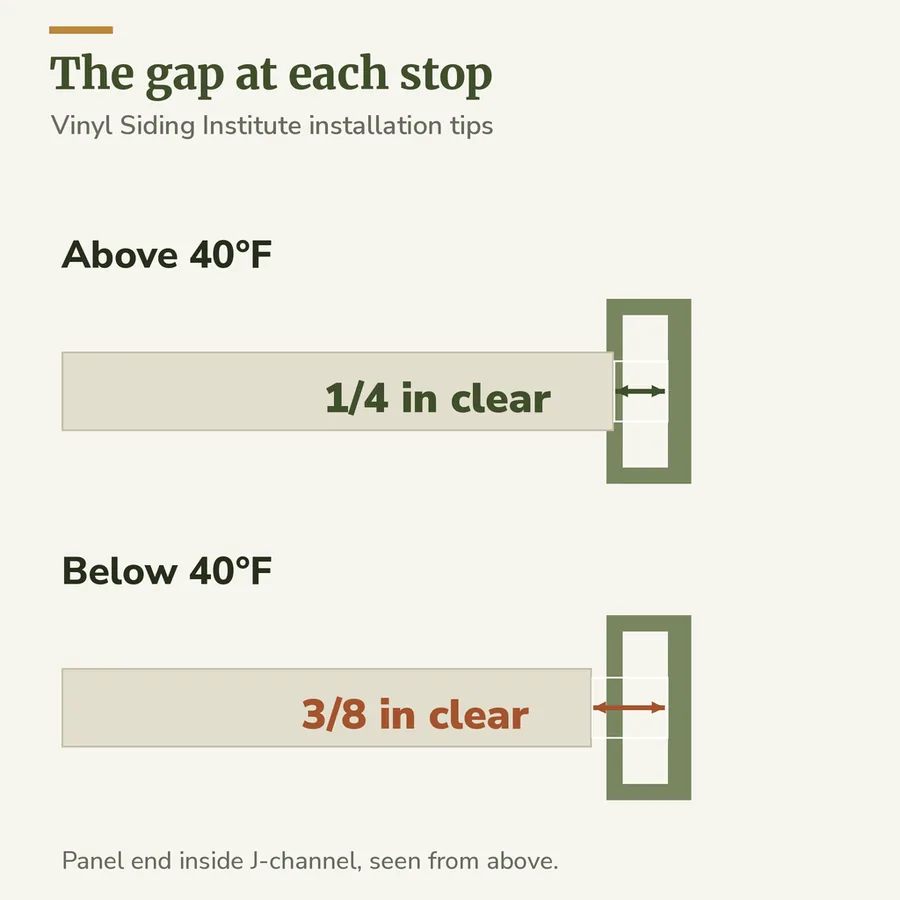
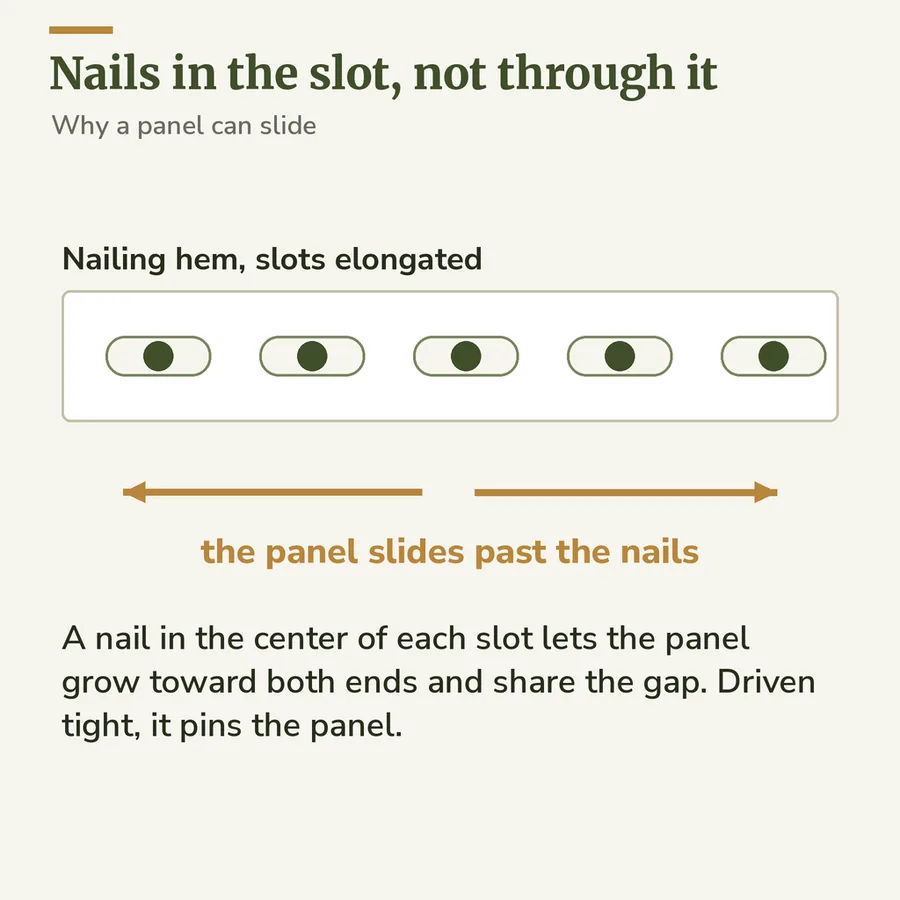
The Vinyl Siding Institute's installation tips say to “Leave 1/4" clearance inside all receiving channels at all openings and stops for expansion and contraction.” With a quarter inch at each end, a panel has half an inch of room in all, enough for every city in the table, but only if it can slide on its nails and share its growth between both ends. In twenty-two of the twenty-four cities, air temperature alone moves a panel more than a quarter inch over the year. Pinned at one end by tight nails, a panel has to find all of that at the other end, where the gap is a quarter inch, and it bows.
Why this is the floor, not the ceiling
These are air temperatures in the shade. A panel in the sun runs hotter, and a dark one hotter still. The siding makers' association writes that “vinyl siding can expand and contract 1/2” (12.7mm) or more over a 12’6″ (3.81m) length.” At the same expansion figure, half an inch takes a swing of about 98 degrees, more than any city in our table sees in the air. The likeliest difference is sunlight on the face of the panel.
Cold-weather repairs
The same tips add: “Increase to 3/8" (9.5mm) when installing in temperatures below 40° F.” In twenty-two of the twenty-four cities, the normal low of the coldest month is below forty degrees. A panel cut to fit on a January morning there is cut at its shortest, and a repair that ignores the larger gap is a repair that comes back in July as a bulge.
How we worked it out
The expansion figure, 0.000034 inch per inch per degree Fahrenheit, is the coefficient of expansion listed in a vinyl siding maker's three-part specification, which names ASTM D696 among its test references. The length, 12 ft 6 in, is the one the siding association uses for its own estimate. For each city we took the 1991–2020 normal high of its warmest month and normal low of its coldest from the NOAA National Centers for Environmental Information, and multiplied the swing by the length and the coefficient. Neither the specification nor the climate normals publish movement by city. That is our arithmetic, done on October 18, 2026.
Limits of the calculation
It covers vinyl only, and one formula of it. Insulated vinyl with a foam backer, wood, fiber cement and aluminum behave differently and are not in it. Thirty-year normals smooth out the hard winters and hot summers, and a station at an airport, or in Central Park for New York, can run a few degrees off a suburb. We give no surface temperatures, because we have no primary source for them.
Diagnosis
Read the damage first
Each kind of siding damage has a usual cause, and the cause decides how big the job is. This table is the short version; each row has its own section below.
| What you see | Usual cause | Size of the fix |
|---|---|---|
| A hole | Something hit it, or a fastener was pulled out of it | One piece |
| A crack or a broken corner | An impact in cold weather, or a panel that could not slide | One piece, unless cracks repeat |
| A loose or missing panel | Wind under a bottom edge, or nails that missed the framing | One run of panels |
| Waves or bulges | Nails driven tight, or ends jammed with no gap | The wall, often the house |
| A distorted, glossy patch | Heat from a grill or a reflecting window | The distorted pieces |
| Dents, chips, cracks on one side | Hail, on the side that faced the storm | One or two walls |
| Stains, a soft wall, peeling paint inside | Water behind the siding | Unknown until opened |
| Round holes in a line | Woodpeckers, often after insects | The holed pieces, plus the cause |
| Faded, chalky color | Sun | Nothing broken; a matching problem |
Is it the siding at all?
Some siding damage starts somewhere else. A stain running down from a roof edge is a roof or gutter problem first. A bulge under a window can be water coming in at the window. A crack beside a downspout can be ice. Before anyone replaces a panel, it is worth asking what was above it and what was behind it.
What to do on the day you find it
Photograph the damage and the whole wall, with the date. If a panel is hanging, push it back into its lock or tape it flat so the wind cannot tear the course above. If the wall behind is open to rain, cover it. None of that is the repair; it buys time for a proper one.
Holes
Holes in vinyl siding
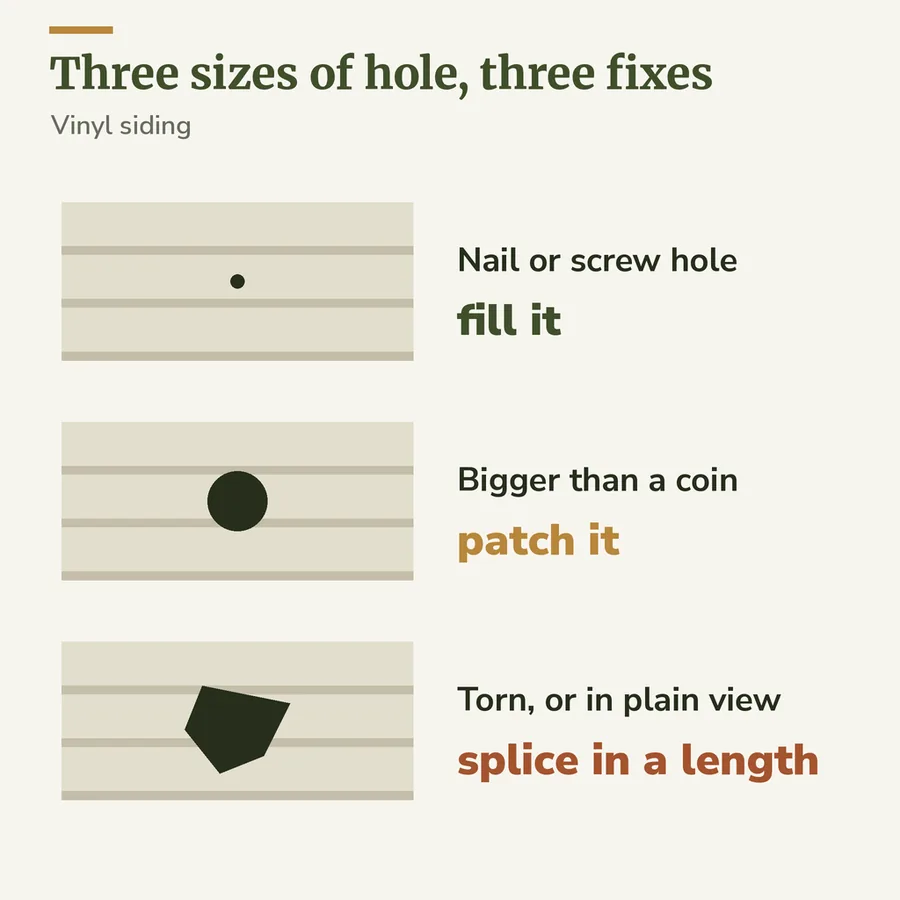
A hole in vinyl siding can be filled or cut out. Filling is quicker; cutting out and splicing in a matching piece is the repair that disappears.
How to repair a small hole in vinyl siding
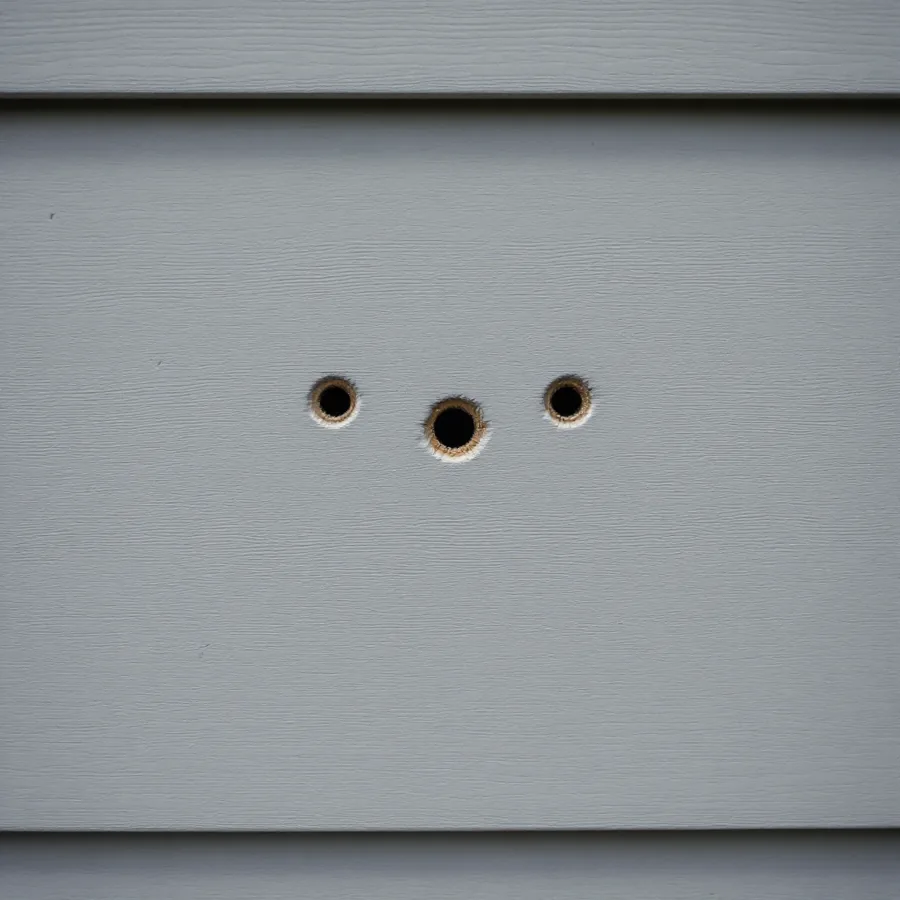
For a hole the size of a nail or a screw, the usual fix is an exterior sealant or patching compound made for vinyl, in a color close to the wall. Clean the area, fill the hole slightly proud, let it cure and trim it flush. Holes left by old satellite dish or light fixture screws are a frequent case. A filled hole keeps water out, but it stays visible from a few feet away, because no filler weathers the way the panel around it has.
How to patch a larger hole in vinyl siding
Once a hole is bigger than a coin, filler alone sags and cracks out. The patch method cuts a piece from matching scrap a couple of inches larger than the hole, trims off its nailing hem, and glues it over the damage with an adhesive made for vinyl. It is a patch, and it looks like one: a raised rectangle on a flat face. On the back of the house that may be fine. On the front, splicing in a new length is the better repair.
Patch or replace?
Patch when the hole is small, out of sight and the wall is due for replacement anyway. Replace the length when it is in plain view, when the hole is torn rather than punched, or when the panel around it is cracked. Replacing one piece of vinyl siding takes a zip tool, a matching panel and an hour, and the next section walks through it.
What to keep out of a hole
Avoid household caulk that is not rated for exterior vinyl, spray foam, and anything that will not move with the panel. Avoid screws through the face of the panel. The installation tips say flatly: “Do not face-nail through siding, except for the one nail needed to finish at top of a gable.” A screw through the face pins the panel, and the next hot afternoon cracks it around the screw.
Cracks
Cracked and broken panels
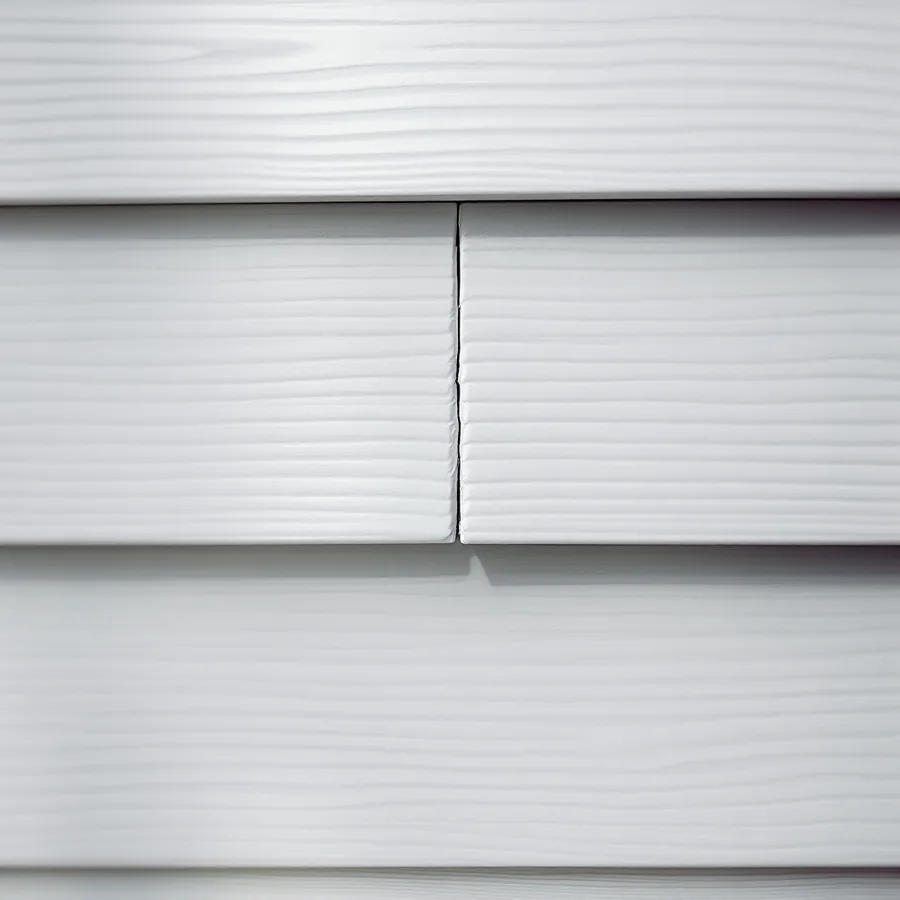
Repair a cracked vinyl siding panel by replacing the cracked length; a crack keeps running once the panel starts moving again.
Why vinyl cracks
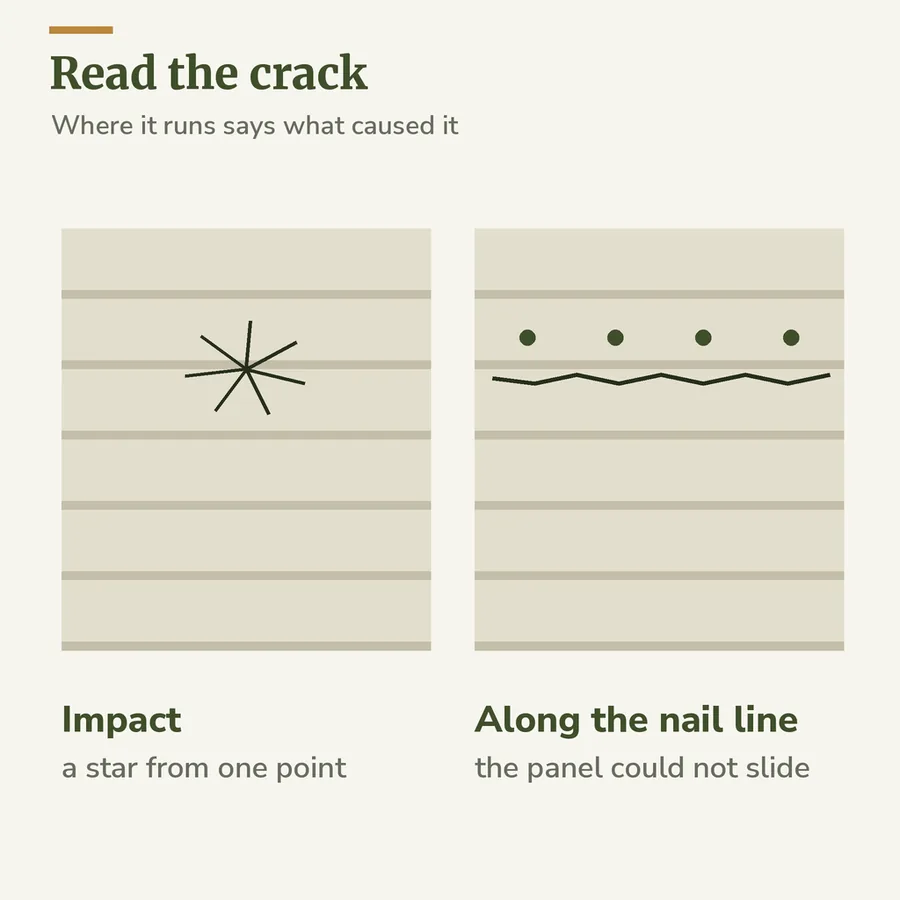
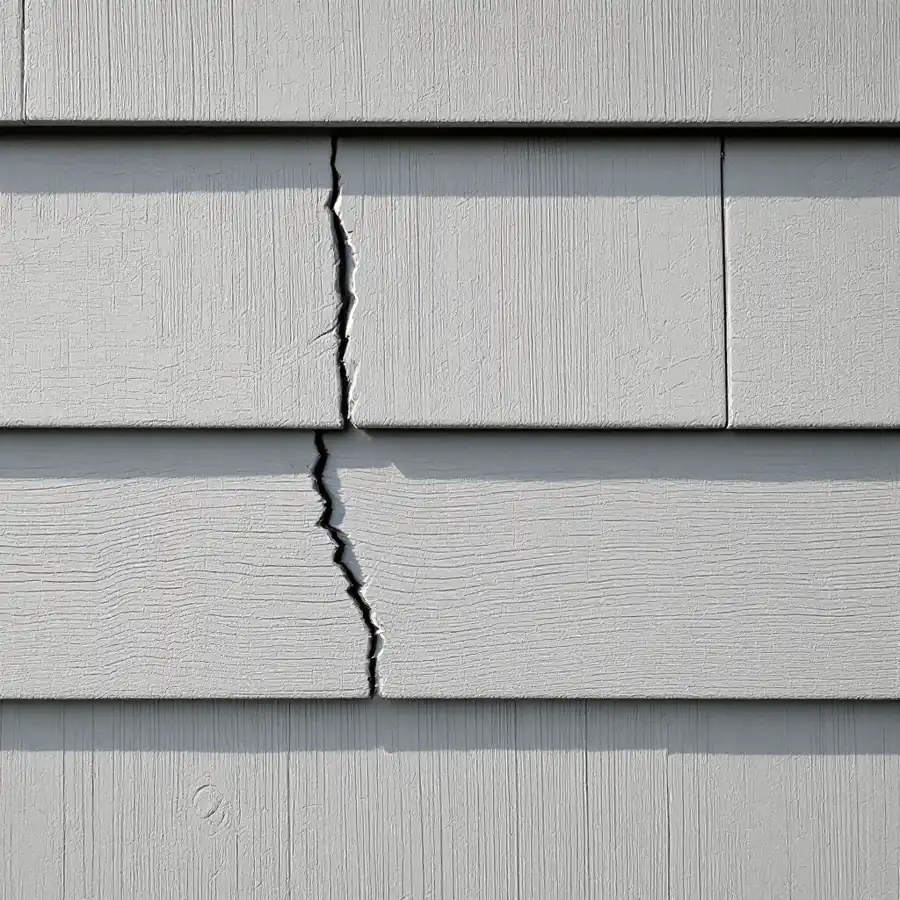
Vinyl is flexible in summer and stiff in winter. One maker's specification gives its impact strength as 2.20 ft-lbs per inch at 73 degrees F and 1.30 ft-lbs per inch at 32 degrees F. A ball or a ladder that a panel would shrug off in July can split it in January. A crack that runs from a nail hole, or several cracks along the same course, has a different cause: the panel could not slide, and it split instead.
How to repair cracked vinyl siding
Cut out the cracked section and splice in a matching piece, following the steps below. Sealant pushed into a crack holds for a season at best, because the panel moves at the crack every day. Some homeowners run a bead of clear sealant on a hairline crack as a stopgap until a matching panel turns up, which is reasonable as long as it is treated as temporary.
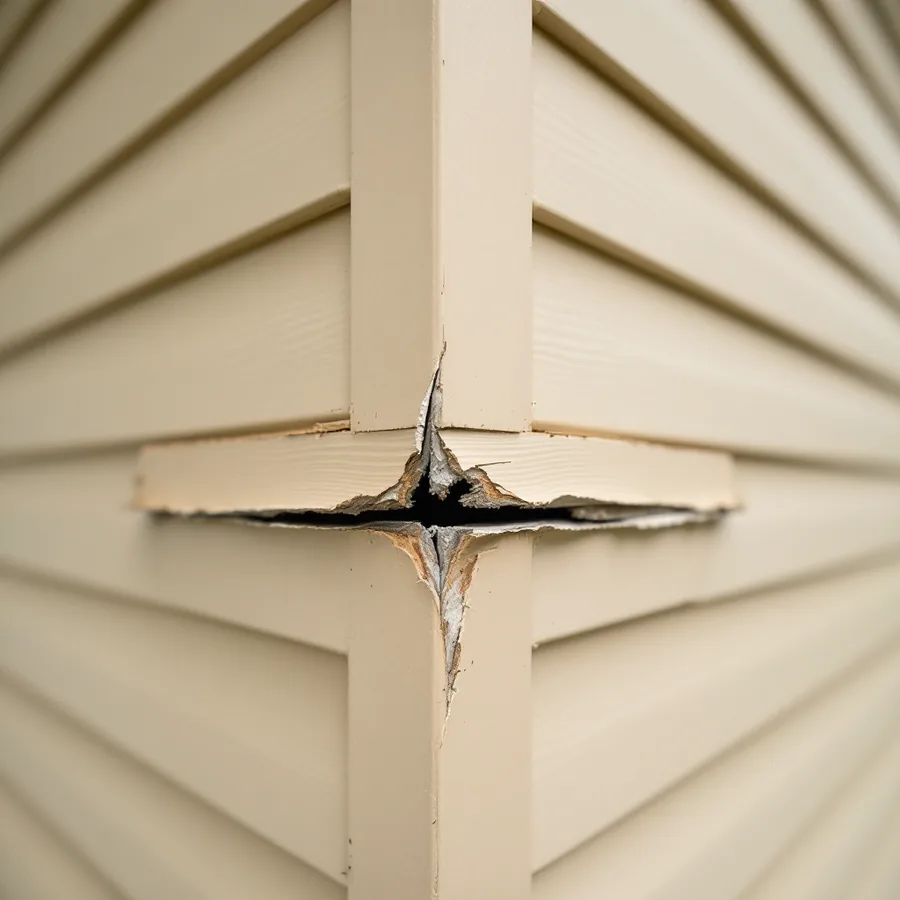
Broken corners and trim
Corner posts and J-channel also break, from ladders and mowers. They are separate pieces and are replaced on their own: the panels that run into them are unlocked and eased out, the trim piece is swapped, and the panels go back with their gaps.
When cracks repeat
If cracks repeat along a wall at the same height, the wall is telling you about its installation. The nails along that course are probably driven tight. Replacing the cracked pieces without loosening the nails on the rest of the course replaces the symptom.
Step By Step
Replacing a piece of vinyl siding, step by step
How to replace a piece of vinyl siding: unlock the course above, swap the damaged length, nail the new one loose with its gaps, and relock.
Step 1: Find a matching piece
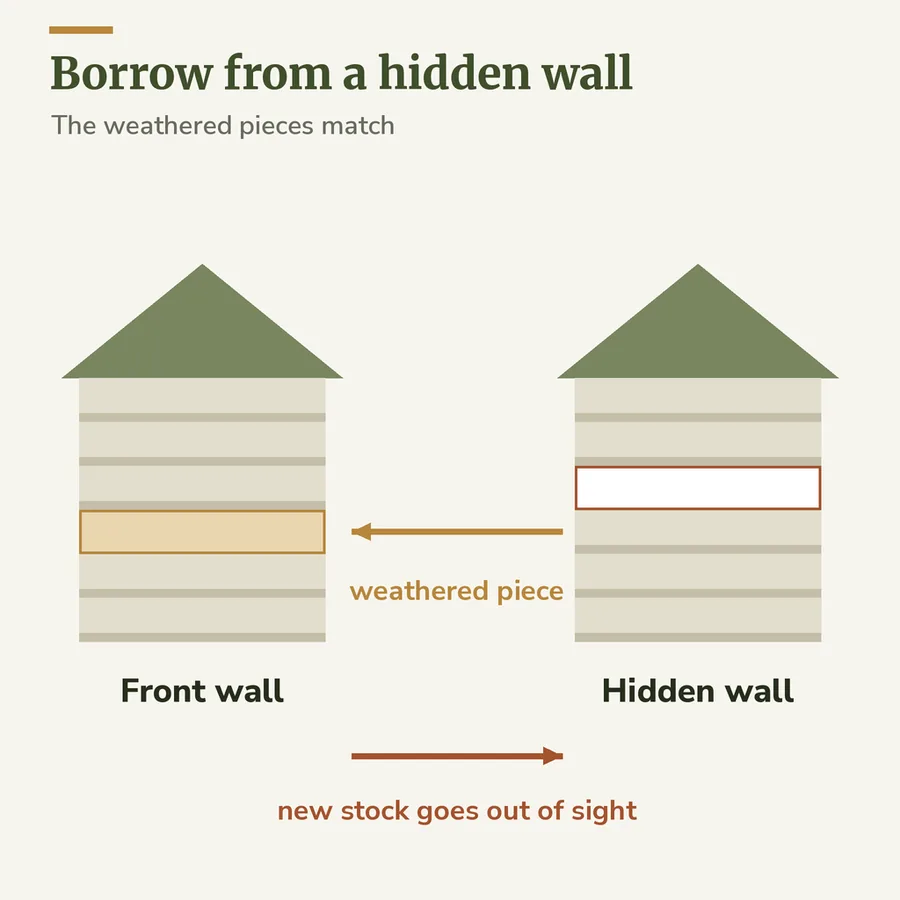
Match the profile first: the width of each course, single or double, smooth or grained. Then the color. Old leftover panels in the garage are the best source. If there are none, a siding supplier can often identify the line from a sample. A third route is to take a panel from a hidden wall, such as behind a deck, and put the new stock there.
Step 2: Unlock the course above
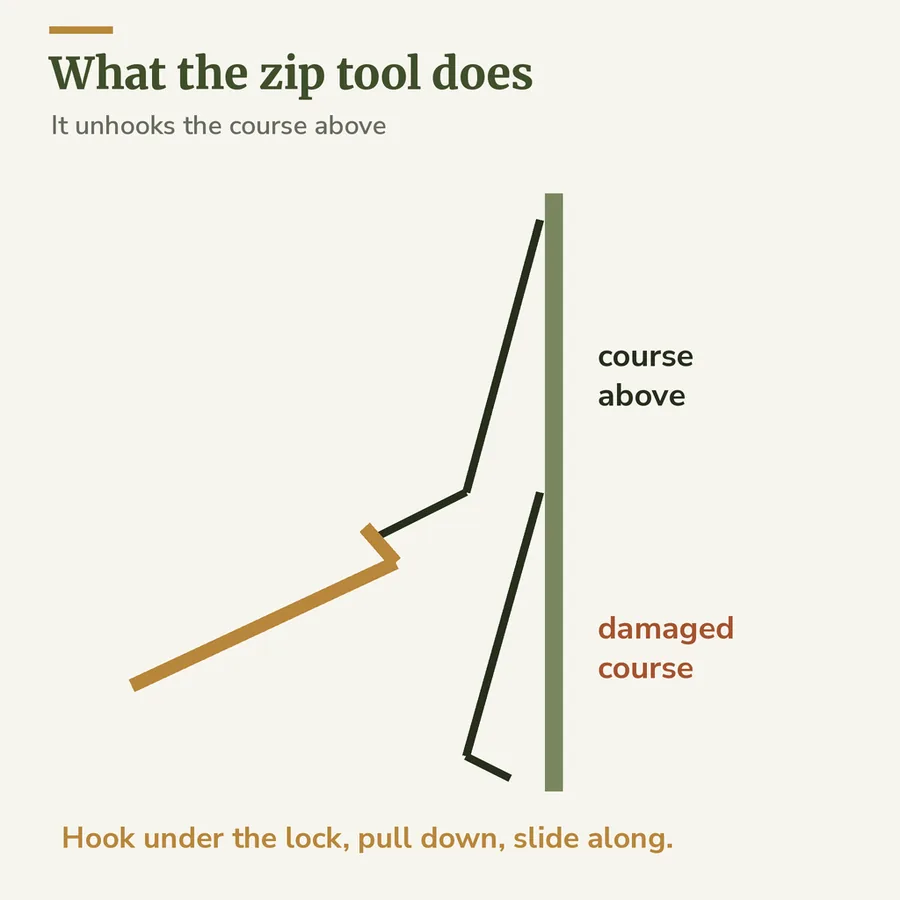
Hook a zip tool into the bottom lip of the panel above the damaged one, near a seam, and pull it down and out while sliding along. The lock pops open as you go. Prop the freed panel out with a scrap block so you can see the nail hem of the damaged panel underneath.
Step 3: Take out the damaged panel
Pull the nails along the top of the damaged panel with a flat bar, taking care not to bend the panel above. If only part of the panel is damaged, you can cut out that length with snips and splice in a replacement, so long as each new end overlaps the old by an inch.
Step 4: Cut the new piece with its gaps
Cut the new piece to length, leaving room at any end that runs into a corner post or J-channel. The tips call for a quarter inch at each such stop, three-eighths when it is below forty degrees. Where two panels overlap, the tips say: “When panels overlap, make sure they overlap by 1" on the face of the panel.” Lap the new piece so the joint faces away from the street and the door, because the tips also advise to “Overlap panels away from entrances and away from the point of greatest traffic.”
Step 5: Nail it loose, in the center of the slots
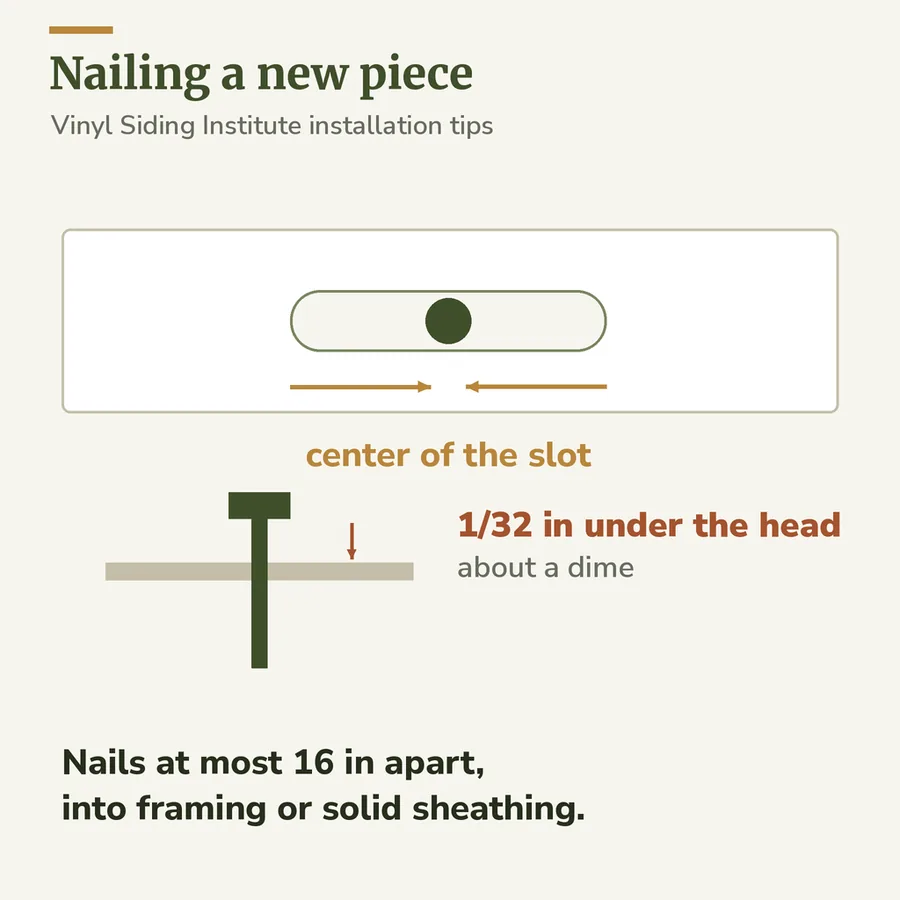
Lock the bottom of the new piece into the course below, then nail through the center of the slots in its nailing hem, into framing or solid sheathing, no more than 16 inches apart. Do not drive the nails home. The tips put it exactly: “Leave approximately 1/32" clearance (about the thickness of a dime) between the fastener head and the nail hem.” Then slide the panel by hand; the tips say to “Make sure that the panels and accessories move freely when fastened.”
Step 6: Lock the course back
Start at one end of the panel above and run the zip tool back along it, pressing the lock over the new panel's top edge until it snaps. Check that both panels still slide. If the panel above cannot be locked without stretching, it was cut too tight, and that is the moment to fix it.
How to repair vinyl siding without replacing a panel
Several repairs need no new panel: relocking an unhooked course, filling a small hole, patching a larger one with scrap, loosening tight nails on a wavy course, and holding a loose top course with utility trim. Cracks, torn holes and distorted pieces are fixed by replacing the length.
Loose Panels
Loose, unhooked and blown-off siding
To fix loose vinyl siding, relock the course with a zip tool and renail anything that pulled out; a torn panel is replaced, a whole one can go back.
Unhooked bottom edges
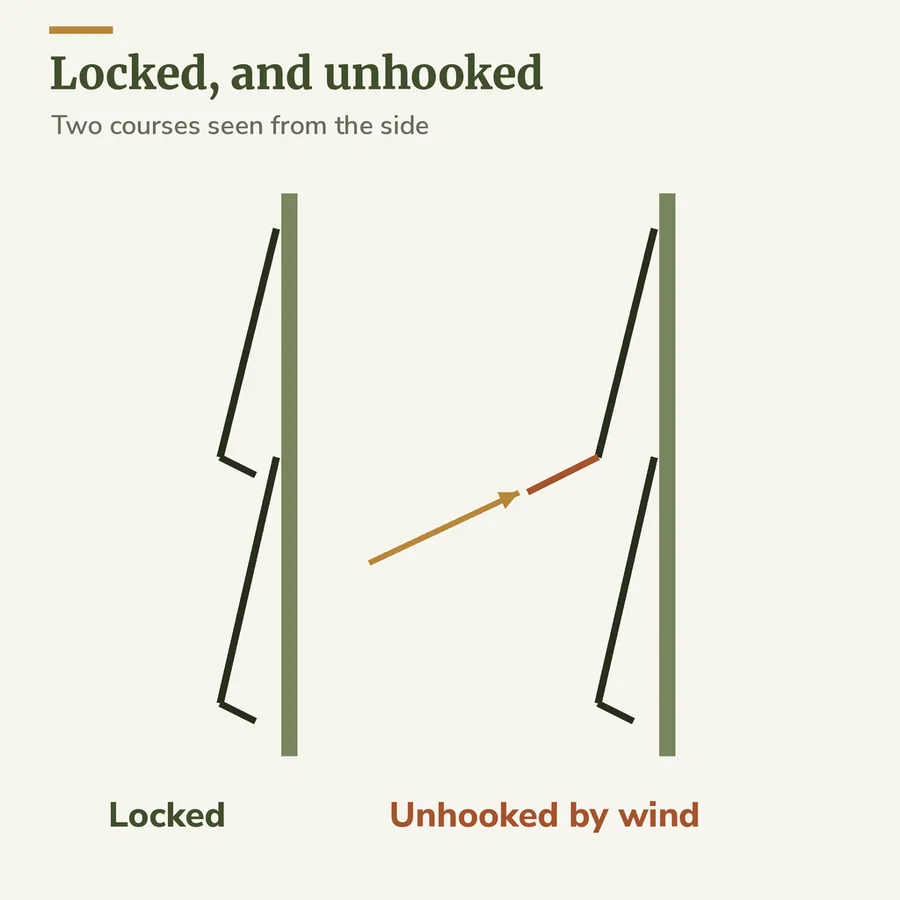
A course that has come out of its lock shows as a lip hanging away from the panel below, often near a corner, where the wind gets under it. If the panel is undamaged, it is a relock with a zip tool and a few minutes.
Wind damage to siding
Repairing wind damage usually means a run of panels on the windward side, sometimes with the top piece torn at the nail line. The Storm Prediction Center calls a thunderstorm severe when it produces “hail that is at least 1 inch in diameter or larger, and/or wind gusts of 58 mph or greater.” Gusts well below that can still unzip a course that was loosely locked or short-nailed. The torn pieces are replaced; the ones that came off whole can often go back.
Loose at the top of the wall
The top course under a window or a soffit is cut, so it has no lock to hang from. The installer is meant to hold it with utility trim and snap-lock punches along the cut edge. Where that was skipped, the top piece works loose first. The repair is the trim and the punches, not more nails.
When the nails let go
Nails that missed the studs and went only into thin sheathing back out over a few seasons. The tips call for fasteners that reach at least an inch and a quarter into nailable material. Renailing into framing, or with longer nails, is the repair.
Waves And Bulges
Wavy, buckled and warped siding
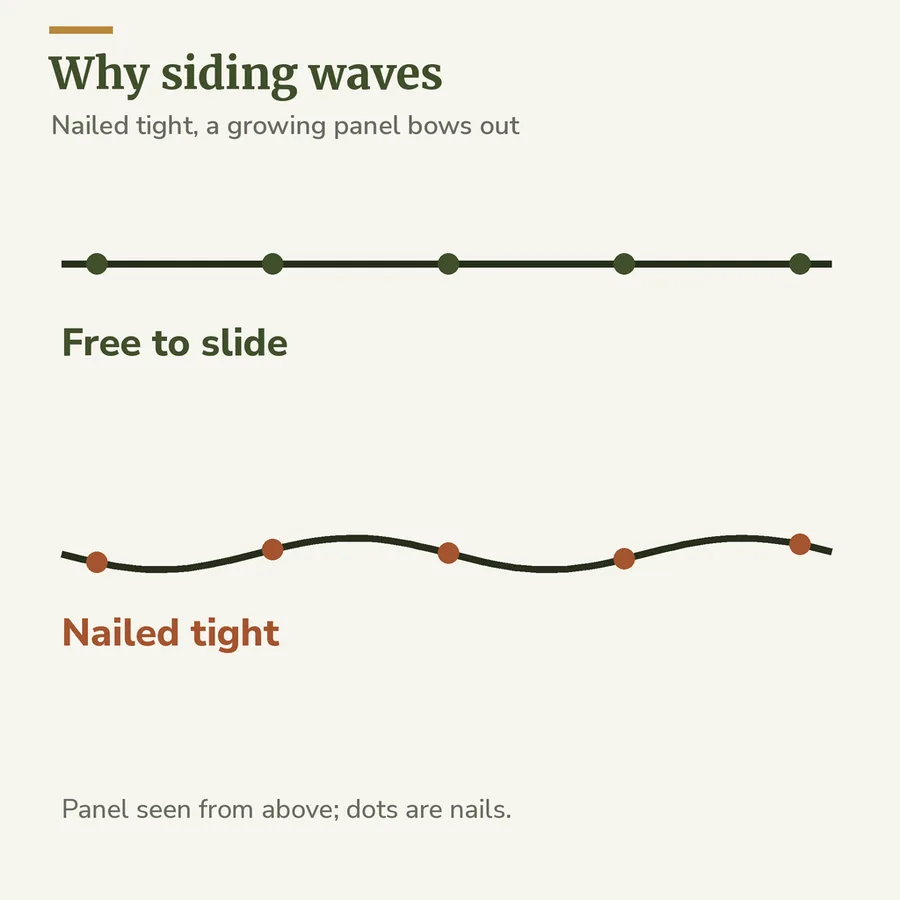
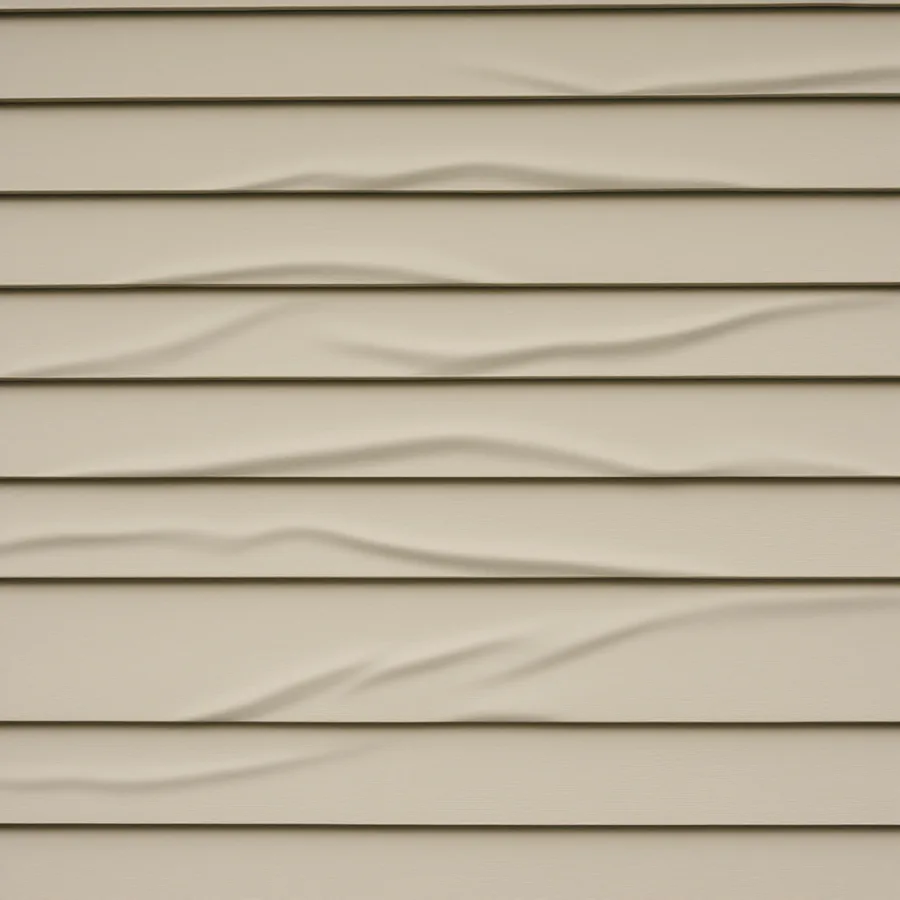
Wavy vinyl siding is almost always siding that cannot move: the nails are too tight, or the ends have no room. It is an installation fault more often than damage.
What the waves mean
A panel that grows by a third of an inch and cannot slide has to go somewhere. Nailed tight, it bows outward between the nails, and in the afternoon sun a whole wall can show a ripple that disappears at night. The bigger the swing in your city, the sooner it shows; the table above gives the scale.
How to fix warped vinyl siding
Unlock the wavy courses. Back each nail out until a dime fits under its head, or pull and renail it in the center of the slot. Trim the ends of any panel that is jammed against trim, to leave its gap. Lock the courses back and check that each panel slides. A panel that stays bent after it is freed has taken a set and is replaced.
When every wall waves
If all four walls show the same ripple, the same crew nailed them all the same way. That is a workmanship question for the installer, raised in writing, before anyone else is paid to fix it.
Melted siding
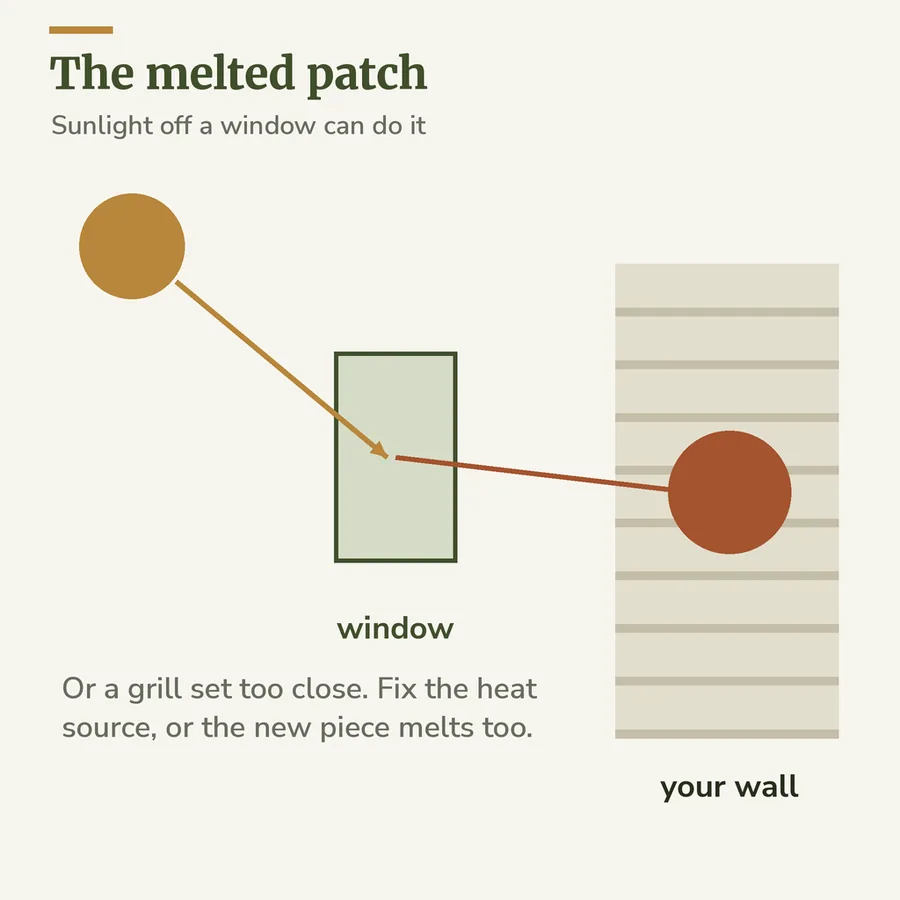
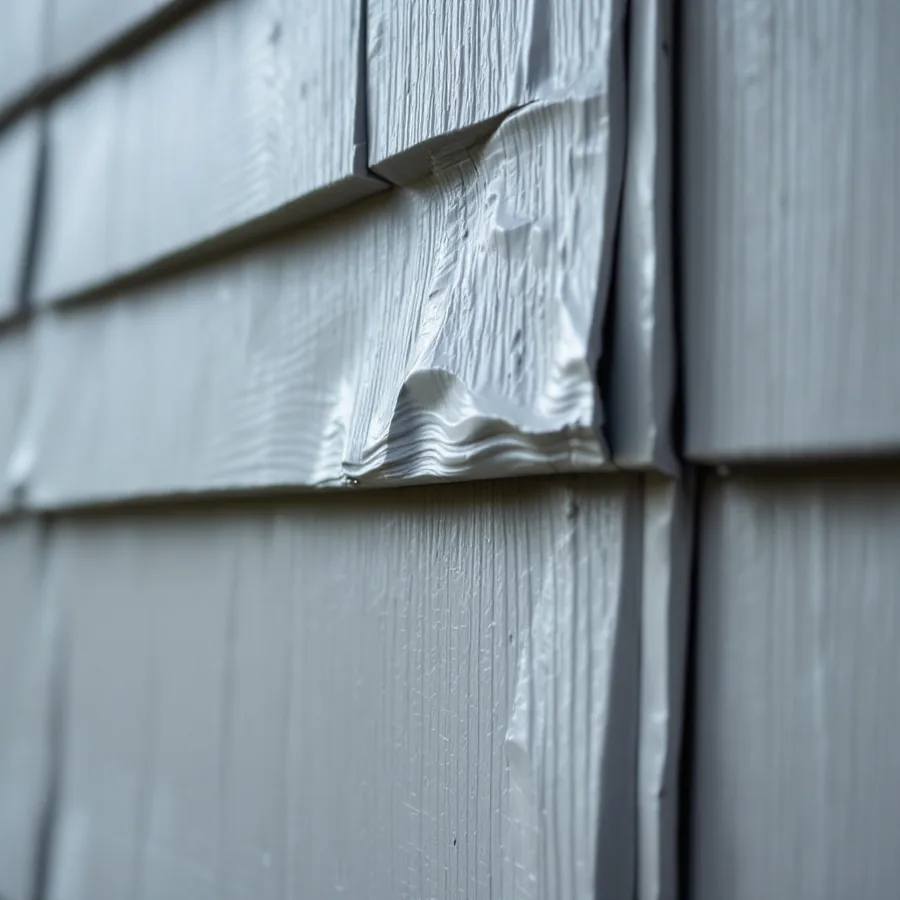
A glossy, sagging patch that looks melted usually is. The two usual causes are a grill too close to the wall and sunlight focused off an energy-efficient window, your own or a neighbor's. Replacing the pieces without dealing with the heat source means replacing them again next summer. A screen on the reflecting window, or moving the grill, is part of the repair.
After A Storm
Hail and storm damage on siding
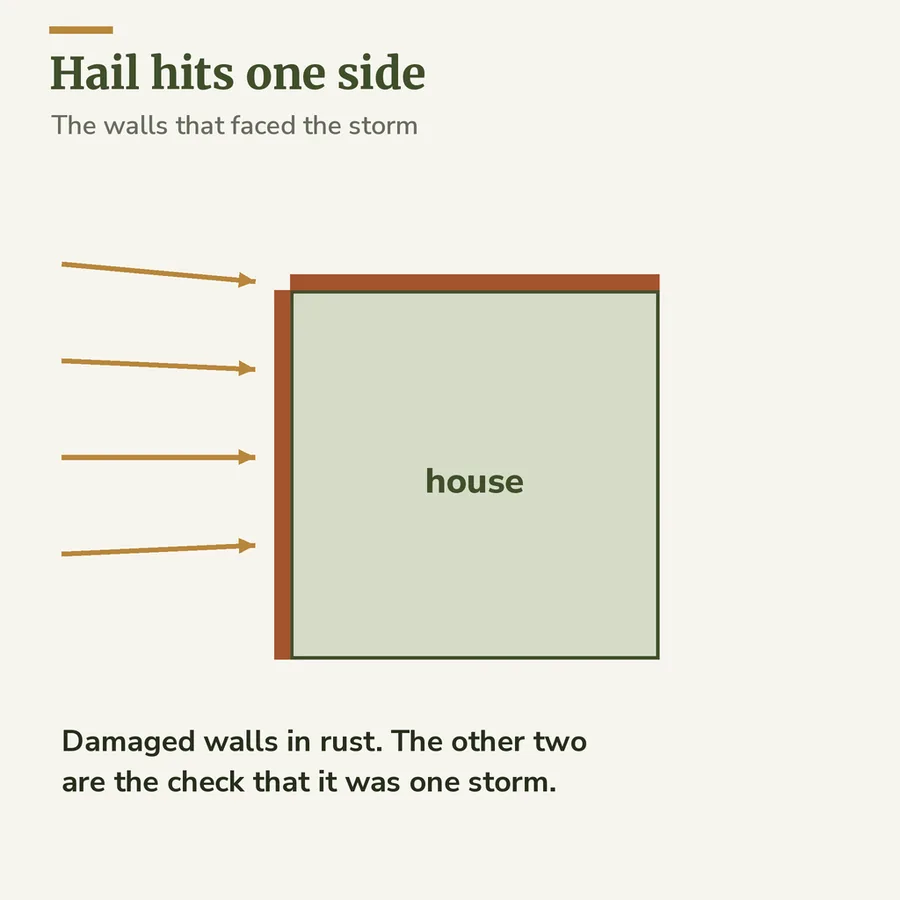
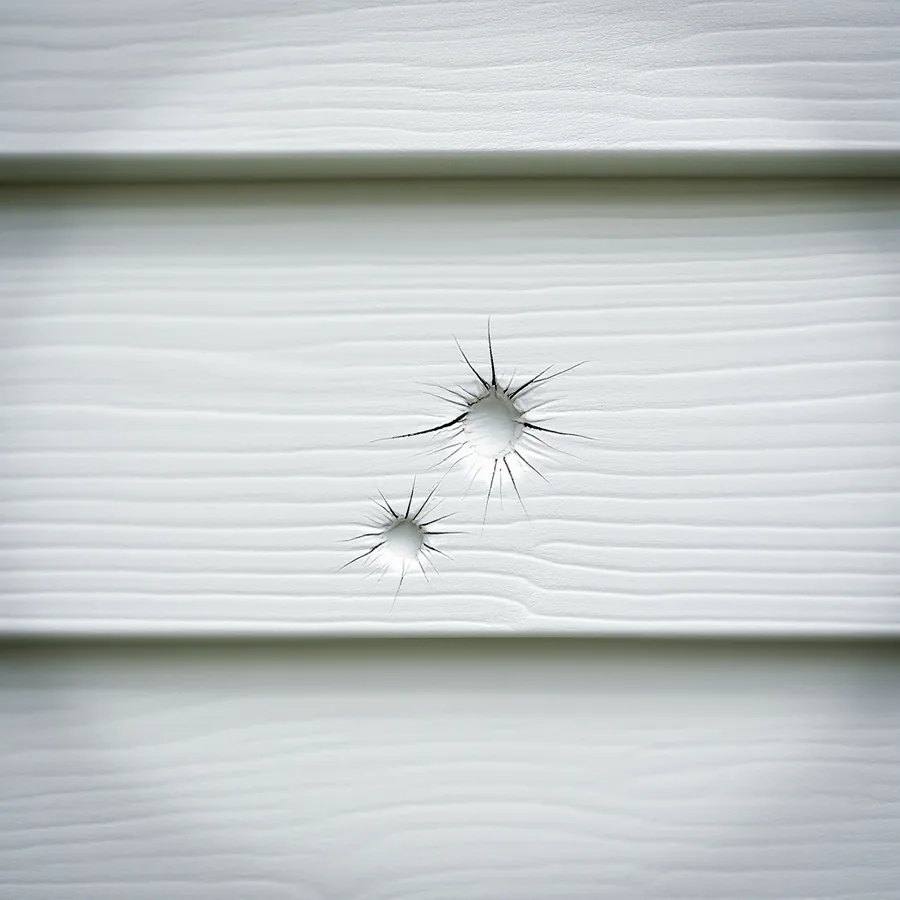
Hail damage to siding usually sits on the walls that faced the storm. On vinyl it shows as cracks, chips and holes; on aluminum as dents.
What hail damage looks like on vinyl siding
Look for holes and cracks in the panels, concentrated on one or two walls and absent on the others. The pattern matters more than any one mark: damage from one storm usually sits on the side that faced it, so damage spread evenly on all four sides points to some other cause.
Hail damage to aluminum siding
Aluminum is a soft metal and dents instead of breaking. Shallow dents can be left as long as the metal is not torn. Deep dents and tears are cut out and replaced, and matching old aluminum is harder than matching vinyl because profiles and factory finishes are long discontinued.
What makes it severe
The Storm Prediction Center draws its line for a severe storm at hail an inch across. It is a reference for dating the storm that hit your area, not proof that a wall was or was not damaged; smaller hail can still mark siding. For one metro, our count of severe hail reports around Denver shows how the season runs month by month. Around Dallas the spring run starts in March and a smaller one returns in September; our hail count for the five counties of the city of Dallas lays it out.
The storm damage inspection
Before anyone climbs a ladder, photograph every wall from the ground, with the date. Note which walls are damaged and which are not. An unrequested inspection that arrives the morning after a storm is a sales visit. If you plan an insurance claim, ask your insurer what it needs to see before anything is replaced; we make no promises about what an insurer will pay.
One wall, not four
Repairing hail damage normally means the walls that faced the storm. A proposal to re-side the whole house after a storm that marked one wall is worth a second quote and a look at what the cost page says about storm quotes.
Behind The Wall
Water damage behind siding
Water damage behind vinyl siding starts where water gets past the wall's flashing, and it shows up somewhere below that point.
The signs
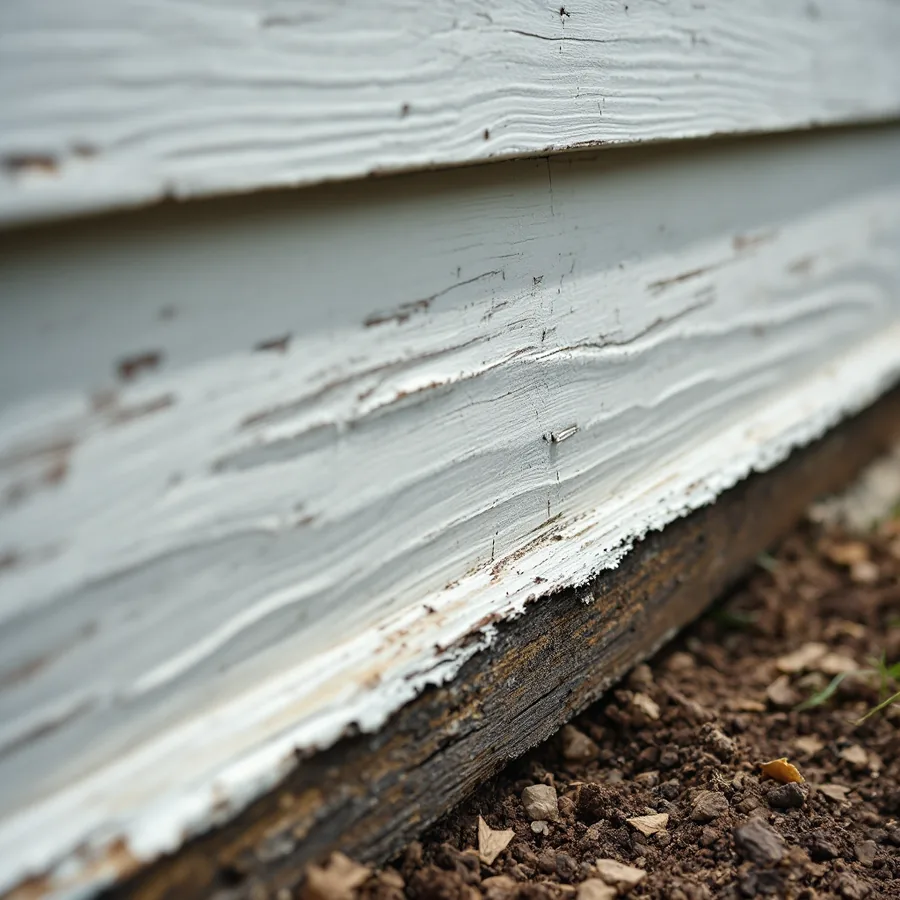
Streaks or stains running down from a window corner or a roof edge, a soft or hollow spot when you press the siding, paint blistering on the inside of the wall, a musty smell in one room, mold at the bottom of the wall. Siding is a rain screen, not a seal; some water always gets behind it, and the wall is built to drain it. Damage starts when water gets past the wrap and the flashing.
Where it gets in
At the top corners of windows and doors where the flashing is missing or lapped wrong. Where a roof edge meets a wall and there is no kick-out flashing to throw water into the gutter. Behind a deck ledger. Through holes cut for pipes, cables and lights that were never sealed. Under siding that runs down into soil or mulch.
Can roofing leaks damage siding?
Yes, and it is a frequent cause. Water running off a roof edge without a kick-out flashing goes behind the siding at the wall below, and a gutter that overflows does the same. The siding there is the symptom; the roof edge is the leak.
What the repair involves
The siding below and around the stain comes off, the sheathing is probed for rot, the entry point is found and flashed, the wrap is repaired and lapped correctly, and the siding goes back. How much sheathing is rotten is not knowable from outside, so a quote for this job should carry a written allowance for it rather than a figure for the whole wall.
Everyday Damage
Woodpeckers, pressure washers and other everyday damage
Some siding damage comes from birds, cleaning and plants rather than weather. Each has a cause worth removing before the repair.
Woodpecker damage to house siding
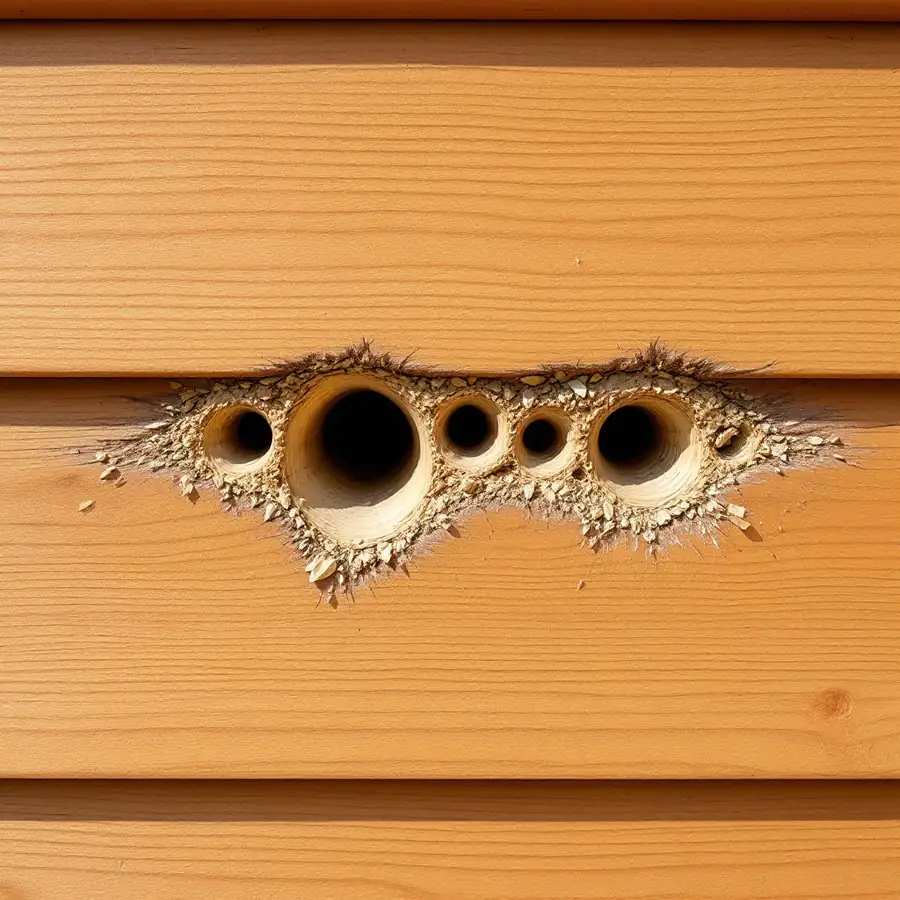
Woodpeckers drum on siding to announce territory, dig after insects living behind it, or carve a nest. Holes in vinyl or wood are patched or the pieces replaced. A hollow-sounding spot or insect activity behind the siding is the thing to look for, because a bird that found food will come back to the new panel. On cedar walls around Dayton and Cincinnati, our cedar page tells woodpecker, carpenter bee and hail marks apart.
Does power washing damage vinyl siding?
It can. Lap siding is built to shed water running down; a jet aimed upward pushes it under the laps toward the wall, and a jet held close can unlock or mark a panel. Washing downward at a low setting with a brush avoids both, and the siding maker's care instructions are the rule to follow.
Does bleach damage vinyl siding?
We found no federal source on bleach and vinyl siding, so we give no rule of our own. Siding makers publish care instructions that name the cleaners their warranty allows; use those for your product, and rinse plants and trim nearby.
Vines and ivy
Climbing plants hold moisture against the wall and work their tendrils into laps and joints. Pulling established ivy off vinyl can unlock panels; on wood it pulls paint. Cut the vine at the base, let it die back, and then remove it.
Other Materials
Repairing other kinds of siding
The repair follows the material. Vinyl unlocks and slides; wood, fiber cement and engineered wood are cut out and nailed; aluminum is replaced or left dented.
| Material | How a piece comes out | What to watch |
|---|---|---|
| Vinyl | Unlocked with a zip tool, nails pulled from the hem | Gaps at the ends; nails loose in the slot |
| Aluminum | Cut out and replaced, or a matching piece slipped under the course above | Old profiles and finishes are hard to match |
| Wood | Nails cut, the board split or cut out between studs | Why it rotted; prime the back and cut ends |
| Fiber cement | Cut out and replaced; not filled | The maker's fastening and joint rules; silica dust when cutting |
| Engineered wood | Cut out and replaced | Sealed cut edges; clearance to the ground and roof |
How to repair aluminum siding
Small dents can be left alone or pulled with a screw and a dent puller, then filled and painted, which shows. Holed or badly bent pieces are cut out and a matching piece is fitted under the course above. The difficulty is matching: old aluminum profiles and finishes are often no longer made, and the pieces you need may have to come from a hidden wall.
How to repair wood siding on a house
One split or rotten board is the classic wood repair: cut the nails or split out the board, cut the new one to fit, prime its back and ends, and nail it in place. Laps matter here too; the Forest Service siding bulletin says that “Bevel siding that is 6 inches wide should have at least 1 inch of overlap between courses.” Rot near the ground or under a window means water is reaching that board, and replacing it without stopping the water buys a few years. Our wood siding page covers species, finishes and how boards move with moisture. For wood walls in Houston, we mapped when hail and rot arrive through the year.
How to repair Hardie board siding
Fiber cement planks such as Hardie board are replaced, not filled: a cracked plank is cut out and a new one is fitted and fastened as the maker's installation instructions specify, including how the butt joints are treated. Cutting fiber cement makes dust that contains silica, which is why makers and OSHA set rules for dust control. Our fiber cement page covers those rules and compares three makers' code reports.
Engineered wood siding
Engineered wood fails where water sits at its edges: the bottom of the wall, cut ends at trim, and just above a roof. Swollen pieces are replaced, each cut edge is sealed as the maker specifies, and the clearance to the ground or roof is restored, because that is where the water came from.
Siding and fascia repair
Fascia is the board along the roof edge, and it is often repaired in the same visit because the same water rots both. It is trim, not siding, and a fascia that rotted from an overflowing gutter is a gutter repair as much as a carpentry one.
Color And Profile
Matching old siding
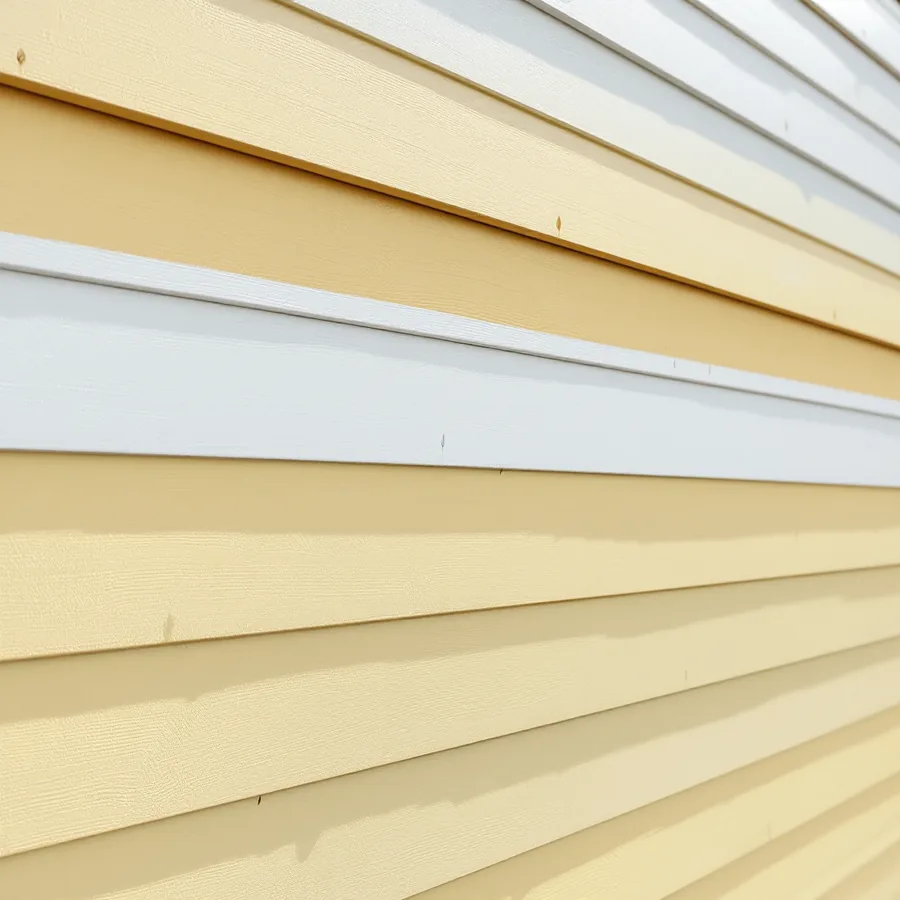
The hardest part of a siding repair is usually the match. Old vinyl fades and profiles are discontinued, so a new panel can stand out on an old wall.
The profile first
A panel that is the right color but the wrong profile looks wrong from the street. Measure the exposure of each course and note whether the panel is single or double, smooth or grained, with or without a bead. A supplier can often identify the line from a sample cut from a hidden spot.
The faded wall
The walls that get the most sun fade first. A new panel in the original color will look darker than the wall around it, sometimes for years. Repairs on a faded wall are matched to the wall, not to the box.
Borrowing from a hidden wall
The neatest trick in siding repair is to take matching pieces from a wall nobody sees, behind a deck, a fence or a shrub, use them for the repair, and put the new stock on the hidden wall. The weathered pieces match because they have weathered together.
Paint as a last resort
Vinyl can be painted, within limits the siding and paint makers set, mainly on how dark a color is allowed. Painting a whole wall to hide one repair is a larger job than the repair. Our vinyl siding page covers profiles, colors and thickness.
What You Need
Vinyl siding repair kits, tape and tools
A vinyl siding repair kit is usually a zip tool, a filler or patch, and sometimes a short length of panel. The zip tool is the part that matters.
| Item | What it does | Its limit |
|---|---|---|
| Zip tool | Unlocks and relocks courses | None; it is the one tool every vinyl repair uses |
| Filler or patching compound | Closes small holes | Shows up close; fails on cracks |
| Repair tape | Holds a crack or a loose edge closed | Temporary; comes off as the panel moves |
| Snap-lock punch | Raises lugs on a cut top edge so it holds in utility trim | Only for the top course |
| Nail slot punch | Makes a new slot where a cut piece needs one | Slots must still be nailed in the center |
| Tin snips and a fine-tooth blade | Cut the panel to length | Cut slowly in cold weather; vinyl cracks |
The vinyl siding repair tool
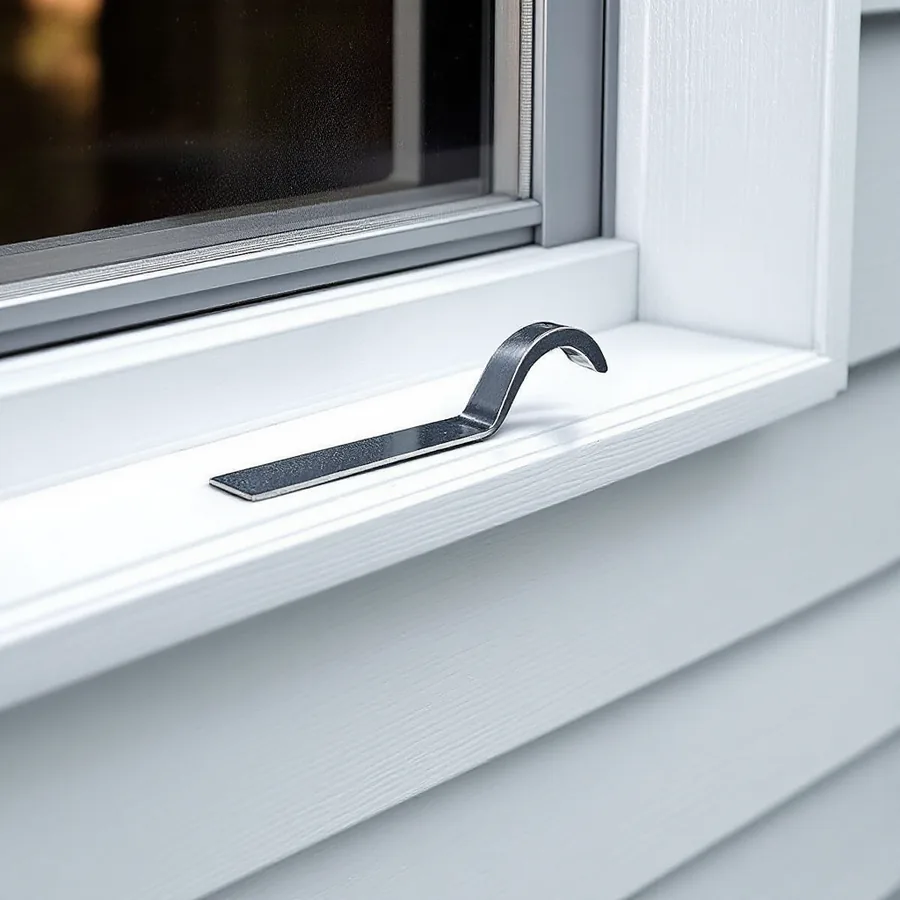
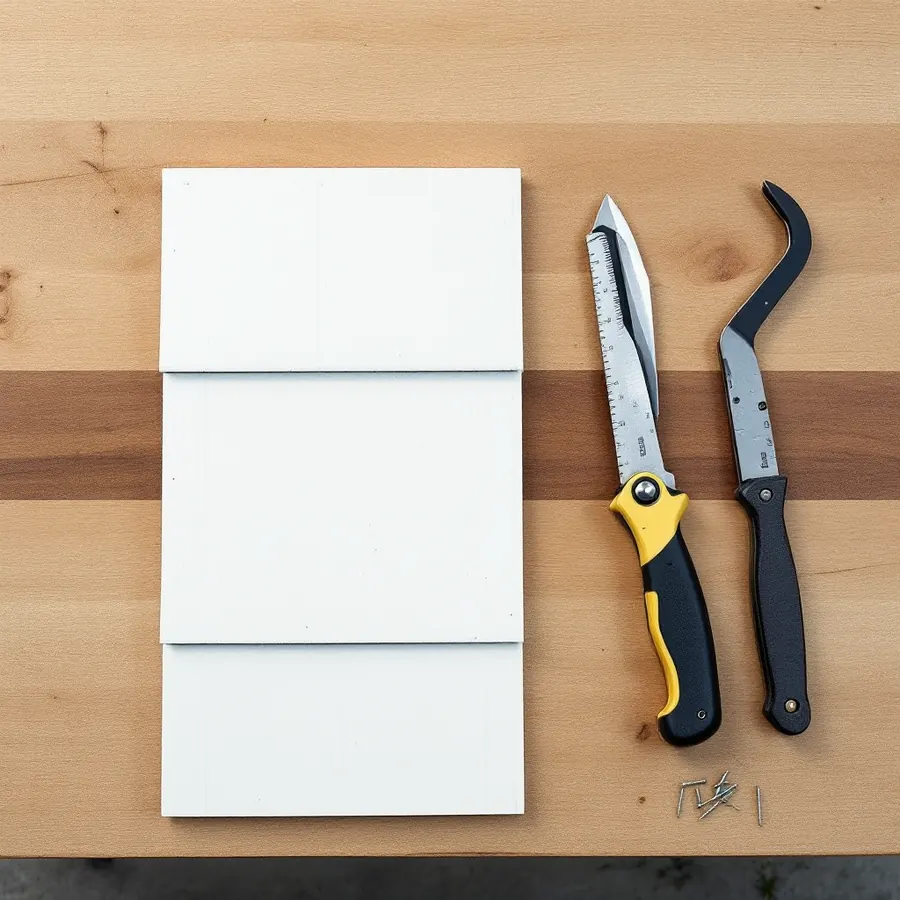
The zip tool, also called a siding removal or unlock tool, is a flat steel blade with a hook at the end. It costs little and is the difference between a clean repair and a bent panel above it. Every repair in this page's step-by-step section uses it.
Vinyl siding repair tape
Repair tape holds a crack or a flapping edge until a proper repair. It is useful the day after a storm. Left in place, it peels and shows, and the crack under it keeps moving.
What a kit cannot do
No kit matches your color, and none fixes waves, water or a wall nailed tight. A kit with a panel in a stock color is only a match if your wall has not faded, which after a few years is rare.
How Big Is The Job
One piece, one wall or the whole house
Most siding repair is one piece or one run. It becomes a wall when the damage repeats across it, and a house when every wall shares the same failure.
One piece
A hole, a crack, a melted patch, an unlocked course. The siding around it is sound, and the only question is matching.
One wall
Hail on the side that faced the storm, waves on the sunny wall, rot under one failed window. The wall is opened to its corners so the new work meets old work at a corner post, where a slight difference in color reads as a change of plane.
When the whole house is the real job
When every wall is the same age and condition and the damaged one is simply the first to show it: vinyl gone brittle everywhere, waves on every wall from the same nailing, wood failing at every sill. A contractor who says so should be able to show it on the other walls. What each size of job is made of, line by line, is on our cost page, and its calculator counts the squares on a wall or a house.
Doing It, Or Not
Can you repair siding yourself, and who fixes it
You can repair siding yourself when the damage is one piece on a wall you can reach from the ground or a short ladder. Water, second stories and old painted houses are jobs for a pro.
What is reasonable to do yourself
Relocking an unlocked course, filling a small hole, replacing one vinyl panel on a ground-floor wall, swapping a damaged board on a low wall. Most need a flat bar, snips, a hammer and an hour, and the vinyl ones a zip tool.
What is not
Anything that needs a tall ladder, anything near an overhead service line, anything where water is behind the wall, and anything that disturbs old paint on a house built before 1978. Those are not about skill so much as about what a mistake costs.
Who fixes siding
For residential vinyl siding repair, a siding contractor is the usual answer, and many take small jobs. Handymen take single panels. Roofers often do siding when the damage came with a roof job, and painters often fix wood siding before they paint it. Ask any of them whether they have the matching panels, or know where to find them, before you book a visit.
Does siding repair need a permit?
It depends on where you live, and we publish no rule of our own. Requirements differ between towns and between a small repair and re-siding a wall. Ask your local building department before work starts.
Older Houses
Old houses: lead paint and asbestos siding
On a house built before 1978, a siding repair may disturb lead paint, and the old siding itself may be cement-asbestos. Both change who can do the work.
Lead paint and the 20-square-foot line
The EPA's lead program says: “Approximately three-quarters of the homes in the United States built before 1978 still contain some lead-based paint.” Paid work that disturbs that paint falls under its Renovation, Repair and Painting Rule. The rule's own exemption for minor repairs, in 40 CFR 745.83, covers work that disturbs “20 square feet or less of painted surface for exterior activities,” provided the work does not involve window replacement or demolition and uses none of the practices the rule prohibits. Replacing a couple of clapboards fits. Opening a wall to chase water usually does not, and then the firm must be certified and use lead-safe practices.
Vinyl over old paint
Vinyl and aluminum siding on an old house often hide the original painted wood siding underneath. A repair that stays in the vinyl does not touch it. A repair that opens the wall to the sheathing does, and the rule follows the old paint, not the new siding.
Asbestos cement shingles
The EPA lists “Roofing and siding shingles” among products that may contain asbestos. The brittle, flat, often embossed shingles on many mid-century houses are the usual case. The agency's advice is that “Material that is in good condition and will not be disturbed (by remodeling, for example) should be left alone.” Cutting, drilling or breaking them is the risk, so a cracked one is a job for a professional who handles asbestos, not for snips.
Read Your Damage
Work out what your siding damage needs
Choose what you see, the material, when the house was built and the nearest city. It runs in your browser and names no price: just the likely cause, the size of the job, how it is fixed, whether it suits a homeowner, the federal lines and how far a panel moves there.
General guidance from this page, not an inspection. A look at the wall itself is what settles the cause.
Before Anyone Starts
Questions for whoever repairs it
Five questions that tell a careful repair from a quick one, and the replies that should make you hesitate.
| Ask | What it tests | A worrying reply |
|---|---|---|
| Where will the matching panels come from? | Whether matching was thought about | “It’ll be close enough.” |
| How tight will you drive the nails? | Whether the new piece can move | “Tight, so it won’t blow off.” |
| What caused it, and will this stop it? | Whether the cause was looked for | “Siding just does that.” |
| If the wall is wet behind, what then? | Whether the quote allows for what the opening finds | A fixed figure for the whole wall, sight unseen |
| Is your firm certified for lead-safe work? | Whether the firm can lawfully take a paid job on a house built before 1978 | “That doesn’t apply to siding.” |
For damage that spans a wall or more, two written quotes are worth the wait unless water is getting in. The questions above work with any contractor you find; our contact page says when our own introduction line opens.
Who Wrote This
Our fee does not grow with the repair
Siding Pros USA is a referral service. We do not repair, install or sell siding. Our model is an introduction to an independent local contractor for a fixed fee, the same for one panel as for a house, and our introduction line is not open yet. That is why this page can tell you a repair is one piece when it is. Our about page explains the fee, and our editorial standards explain how we check what we publish.
Straight Answers
Siding repair questions, answered
Can damaged siding be repaired, or does it have to be replaced?
Most damaged siding can be repaired by replacing only the damaged pieces. Vinyl unlocks from the course above, wood and fiber cement are cut out piece by piece, and aluminum is cut out or left dented. A wall needs replacing only when the damage repeats across it or the wall behind is wet, and a house only when every wall shares the failure.
How do you fix a hole in vinyl siding?
For a small hole, fill it with an exterior sealant or patching compound rated for vinyl, in a close color, and trim it flush when cured. For anything larger, or anything in plain view, cut out the damaged length and splice in a matching piece using a zip tool, overlapping each end by an inch. The splice is the repair that does not show.
How do you replace one piece of vinyl siding?
Unlock the course above with a zip tool, pull the nails from the damaged piece, cut the new piece with room at any end that meets trim, lock its bottom into the course below, nail it through the center of the slots without driving the nails tight, and relock the course above. Then check that both panels still slide by hand. The steps are above.
Why is my vinyl siding wavy?
Almost always because the panels cannot move. Nails driven tight against the hem, nails through the face, or ends jammed against trim stop a panel from sliding as it grows in the heat, so it bows. By our calculation a standard panel moves between 0.21 inch and 0.42 inch a year on air temperature alone, depending on the city. Loosening the nails and trimming the ends usually fixes it.
Why does vinyl siding come loose?
Wind gets under a bottom edge that was not fully locked, the top course was never held by utility trim, or the nails missed the framing and backed out of thin sheathing. An undamaged panel can be relocked with a zip tool; nails that pulled out are reset into framing in the center of the slot, loose enough for the panel to slide.
What does hail damage look like on siding?
On vinyl, small round holes, star cracks and chipped bottom edges, concentrated on the walls that faced the storm. On aluminum, dents in the same one-sided pattern. Damage spread evenly on every side of a house usually has another cause. Photograph every wall from the ground, dated, before anyone climbs, and ask your insurer what it needs before repairs.
Is a vinyl siding repair kit worth buying?
The zip tool in it is, because every vinyl repair uses one. The filler handles small holes and nothing more, the tape is a stopgap, and a stock-color panel only matches a wall that has not faded. Buy the tool, and find the panel by matching your wall's profile and its weathered color, or by borrowing from a hidden wall.
Can water get behind vinyl siding?
Yes, and some always does; siding sheds most rain and the wrap and flashing behind it handle the rest. Damage starts where water gets past the flashing, usually at window corners, roof edges without kick-out flashing and unsealed holes. Stains, soft spots and blistering paint inside are the signs, and the repair starts by opening the wall below them.
Do roofers or painters fix siding?
Some do. Roofers often repair siding damaged along with a roof, and painters often replace rotten wood boards before painting. For vinyl, a siding contractor or a handyman with a zip tool is the usual choice. Whoever you call, ask whether they can source matching panels before the visit. Our contact page says when our introduction line opens.
Do you repair siding?
No. Siding Pros USA is a referral service and does no repair, installation or sales. Our model is to introduce homeowners to independent local siding contractors for the same fixed fee whether the job turns out to be one panel or a house. The research on this page is ours; the repair is the contractor's.
Where This Comes From
Sources and method
- Temperatures for the movement table: NOAA National Centers for Environmental Information, U.S. Climate Normals 1991–2020, monthly normals for 24 airport stations. The movement per city is our own calculation.
- Expansion figure and impact strength for vinyl: Mitten Building Products, vinyl siding three-part specification (section 2.2; ASTM D696 is among its referenced test methods).
- Gaps, nailing and overlaps: Vinyl Siding Institute, Quick Tips for Installing Horizontal Vinyl Siding (2020), and the Polymeric Exterior Products Association's installation tips.
- Severe storm definition: NOAA Storm Prediction Center, SPC FAQ.
- Lead paint and the minor-repair exemption: U.S. Environmental Protection Agency, Lead Renovation, Repair and Painting Program, and 40 CFR 745.83.
- Asbestos in siding shingles: EPA, Learn About Asbestos, and EPA, Protect Your Family from Exposures to Asbestos.
- Wood siding laps: USDA Forest Service, Forest Products Laboratory, Wood Siding: Installing, Finishing, Maintaining.
How we source and check facts is set out in our editorial standards. Quotations are taken word for word from the source linked beside them, and this page carries no price averages. We refer homeowners to contractors and do no work on houses. Last updated .
Before you call anyone
The flat-fee match — we are paid for the introduction, not for the size of your job
Most siding advice is written by the company that wants to do the work or the company that makes the product. That is not a failing of the people who read it; it is a defect in who is talking: the measurement, the estimate and the invoice come from one party, and no amount of care on your side fixes that.
We are built the other way round. We do not install, repair or sell anything, so the payment reaches us when you are connected to a licensed, insured siding contractor — the same amount whether you need one panel replaced or four walls re-clad. Nobody here has a reason to talk you into the larger number. You can check that rather than take it on trust: how we make money is written down, and this site keeps telling readers when one wall is enough. Why does not everyone work this way? Because a flat fee leaves money on the table every time the job turns out to be big.
Waiting is the one thing that actually costs money. A wall that is open to the weather does not get better and does not wait for a convenient week; the water that gets behind the siding finds the sheathing, the framing and the drywall inside. A cracked panel over a window lets the next storm in. And if it turns out to be one panel and a quarter-hour, say so when you ask. We will tell you, and that answer earns us nothing.
Not for you if: you want a price over the phone — nobody honest gives one without measuring the house; you need a guarantee of arrival within the hour — we cannot promise that for a company we do not run; the building is commercial; or you would rather do it yourself, in which case the pages on this site are written so that you can.