Siding Repair · Minneapolis, Minnesota
Siding repair in Minneapolis: hail seasons, cold months and Minnesota rules
Home › Siding repair › Minneapolis · Reviewed by the Siding Pros USA editorial team · · 17 min read
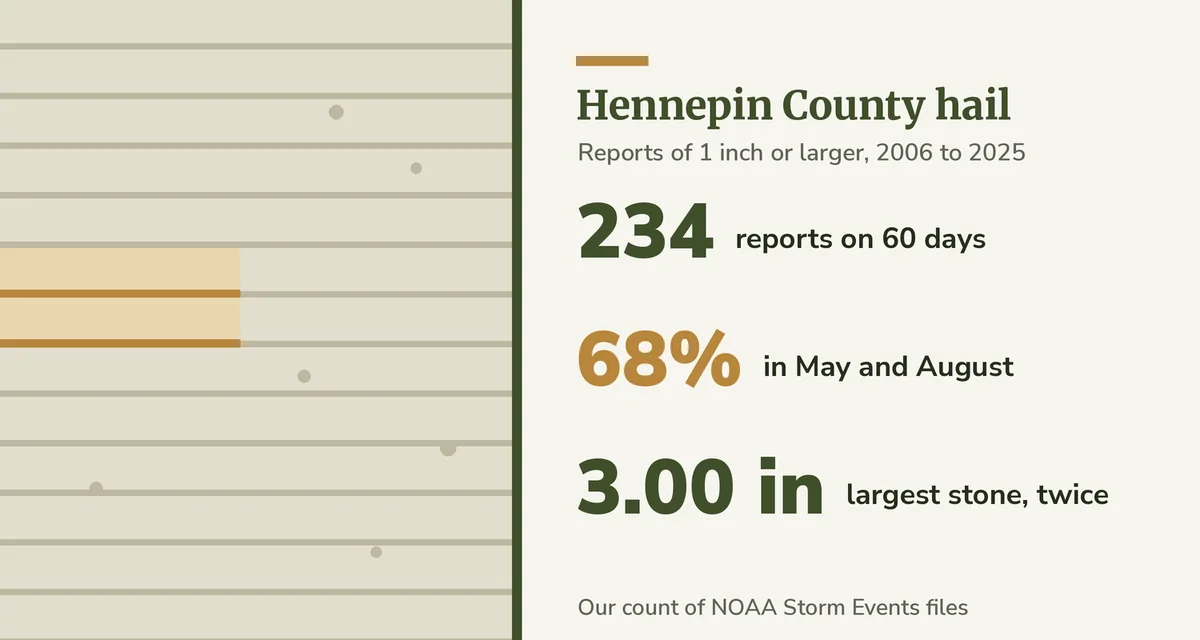
Siding repair in Minneapolis follows two hail seasons. Hennepin County, which holds the whole city, logged 234 reports of hail an inch or larger from 2006 to 2025, and 68 percent fell in May or August. Below: when the damage comes, which months suit the work, and the Minnesota rules for a repair.
Siding repair in Minneapolis: the short answer
Most search results for siding minneapolis mn are contractor pages. This one is research: what a Minneapolis siding repair runs into here, from the data and the rule books.
- Hail comes twice a year. May (76 reports) and August (84) hold 68 percent of the county's large-hail reports.
- Winter limits the work, it does not forbid it. Normal highs stay below 40°F from December to February; vinyl then needs a wider gap.
- Re-siding takes a permit. The state fact sheet says so; a few boards are a question for the city.
- Siding alone needs a registration, not a license. Add windows or a roof, and Minnesota wants a license.
- The state fund covers licensed firms only. A registered siding company is outside it.
- After a storm, three laws set the terms. No deductible offers, 72 hours to cancel after a denial, three days after a sale at the door.
Our Count
Hennepin County hail, 2006–2025: our NOAA count
The Census Bureau places all of Minneapolis in Hennepin County. We counted its hail reports of an inch or more in twenty yearly NOAA Storm Events files, and three neighbors beside it.
| County | Cities in it | Hail, 1 inch or larger | Days with such hail | 1.75 inches or larger | Two top months | Wind, 50 knots or more | Wind, 65 knots or more |
|---|---|---|---|---|---|---|---|
| Hennepin | All of Minneapolis, Bloomington, Edina | 234 | 60 | 74 | August and May, 68% | 247 | 5 |
| Ramsey | St. Paul | 102 | 31 | 19 | May and July, 66% | 81 | 0 |
| Anoka | Coon Rapids, part of Blaine | 107 | 30 | 40 | August and May, 61% | 107 | 6 |
| Dakota | Eagan, Burnsville | 142 | 55 | 30 | May and August, 51% | 135 | 8 |
234 reports on 60 days in the county that holds Minneapolis
The Storm Prediction Center calls “Hail 1 inch in diameter or larger” severe, and that is our line. Hennepin County crossed it on 60 separate days and in every one of the twenty years. The largest stones measured 3.00 inches, on August 5, 2019 and again on August 11, 2023. Of all reports, 73 percent began between 2 and 10 p.m. standard time.
St. Paul, Anoka and Dakota beside it
Ramsey County, home to St. Paul, logged 102 reports and had five years with none. Anoka logged 107 and Dakota 142. Each of the four saw a 3-inch stone at least once. Hennepin logged more reports than Ramsey and Anoka together.
Our Count
May and August: the two hail peaks
Minneapolis hail does not build to one summer peak. May brought 76 reports (32 percent) and August 84 (36 percent), while June and July together brought only 52 (22 percent). September added 18. From November through March there was a single report, in November.

For a repair, this means two queues. Walls hit in May can be fixed in the same summer. Damage from August often lands in a fall schedule that runs into cold weather.
Our Count
Stone sizes in the Hennepin reports
| Hail size | Reports | Share of reports |
|---|---|---|
| 1 to 1.74 inches | 160 | 68% |
| 1.75 to 2.49 inches | 59 | 25% |
| 2.50 to 2.99 inches | 12 | 5% |
| 3 inches or larger | 3 | 1% |

Two in three reports were under 1.75 inches. Still, 74 reached 1.75 inches or more, on 21 days. Stones of 2.50 inches and up fell on seven days, and three reports hit 3 inches.
Our Count
August 11, 2023, and the other big days
A few storms carry much of the record. The five busiest days in Hennepin County:
| Date | Reports that day | Share of twenty years | Largest stone |
|---|---|---|---|
| August 11, 2023 | 27 | 12% | 3.00 in |
| May 31, 2008 | 24 | 10% | 1.75 in |
| August 6, 2013 | 20 | 9% | 2.00 in |
| May 10, 2011 | 16 | 7% | 2.50 in |
| August 5, 2019 | 15 | 6% | 3.00 in |

Minneapolis hail storm, August 11, 2023
That evening produced 27 reports in one county, 12 percent of twenty years, with stones to 3 inches. It stayed narrow: Ramsey logged five reports that day, Anoka and Dakota three each.
Three days, nearly a third of the record
The top three days hold 30 percent of all reports. Read any Minneapolis hail storm count with that in mind: a quiet decade on one street can end in an afternoon.
Our Count
Thunderstorm wind reports in Hennepin County
The SPC counts “Damaging winds or speeds of 58 mph (50 knots) or greater” as severe. Hennepin County logged 247 such reports on 83 days. Wind peaks between the two hail seasons: June alone has 72.
Of these, five reached the top class, “Wind speeds of 75 mph (65 knots) or greater.” All five are estimates, not measured gusts. The highest, 70 knots, dates from July 5, 2016. Wind tears loose panels and trim more often than it breaks them, so a wind repair often starts with nails and laps.
Method
What the NOAA reports can and cannot tell you
Each row in the files is a report that reached the National Weather Service. A storm over an empty field may have none; a busy street may have five. We read the files in October 2026 and drew no trend by year and no damage totals. The count tells you the season and the scale, not the fate of one house.
Timing
A month-by-month repair calendar for Minneapolis
We set the hail and wind count beside NOAA climate normals for 1991–2020 at Minneapolis/St Paul airport.
| Month | Hail reports | Wind reports | Normal high | Days with a high of 50°F or more | Days that stay below freezing | For a repair |
|---|---|---|---|---|---|---|
| January | 0 | 0 | 23.6°F | 0.1 | 22.7 | Frozen most days |
| February | 0 | 0 | 28.5°F | 0.8 | 17.3 | Frozen most days |
| March | 0 | 0 | 41.7°F | 7.6 | 6.7 | Thaw, no hail yet |
| April | 2 | 1 | 56.6°F | 21.1 | 0.6 | Thaw ends |
| May | 76 | 33 | 69.2°F | 30.1 | 0.0 | First hail peak |
| June | 26 | 72 | 79.0°F | 30.0 | 0.0 | Wind peak |
| July | 26 | 64 | 83.4°F | 31.0 | 0.0 | Storms continue |
| August | 84 | 64 | 80.7°F | 31.0 | 0.0 | Second hail peak |
| September | 18 | 11 | 72.9°F | 29.8 | 0.0 | Last storms, mild |
| October | 1 | 2 | 58.1°F | 23.8 | 0.2 | Mild days, cold nights |
| November | 1 | 0 | 41.9°F | 8.1 | 6.6 | Cold returns |
| December | 0 | 0 | 28.8°F | 0.7 | 18.3 | Frozen most days |
| Year | 234 | 247 | — | 214.1 | 72.4 | Storms: twenty-year totals; days: a normal year |

May through September
Every material can be worked, and these months hold 98.3 percent of the hail. Book the repair soon after a storm; the next one may come within weeks. For most siding in minneapolis mn, these are the easy months.
April and October
Days are mild, nights are not: April has 9.0 nights below freezing in a normal year, October 5.8. Good months for the jobs that waited.
November through March
A normal year has 72.4 days that never reach 32°F, nearly all in these months. December, January and February add only 1.6 days of 50°F or more between them.
Timing
Can you replace siding in winter?
Yes, with care. Can you do siding in the winter here? Normal highs are 28.8°F in December, 23.6°F in January and 28.5°F in February, so materials behave differently.
Can you install vinyl siding in the winter?
You can, with a wider gap. The Vinyl Siding Institute manual raises the minimum clearance at openings and stops from 1/4 inch to 3/8 inch below 40°F, leaving room for the panel to expand. It also warns: “In extremely cold weather, move the saw through the material slowly to prevent chipping or cracking”. Cold vinyl is brittle, so a crew handles it slowly.
Fiber cement, paint and sealant
James Hardie sells an HZ5 line for “climates with freezing temperatures, extreme seasonal temperature variations, and snow and ice”, which is the maker's own claim. The boards go up in cold weather; primer, paint and caulk may not. Each label gives its own lowest temperature, so ask which product goes on and read it.

After the Storm
How to tell if your siding has hail damage
Walk the wall that faced the storm first, then the others. Hail damage to vinyl siding shows as cracks and holes, often at the lower edge. Hail damage to wood siding is dents and split boards, with paint knocked off. Hail damage to hardie board siding shows as chips and cracks at edges and corners.



Is hail damage worth fixing? A hole or crack lets water reach the wall, so yes. Dents in steel or wood are cosmetic until paint fails. Our guide to siding repair covers each sign and the hail damage siding repair steps by material.
Housing Stock
Minneapolis houses are old: what that means for a repair
The Census Bureau's survey for 2019–2023 counts 203,217 homes in the city. 43.6 percent were built in 1939 or earlier, 64.8 percent by 1969 and 73.0 percent by 1979. Single-unit houses are 44.2 percent of the stock and buildings with two to four units 12.3 percent.
| Built | Share of homes | What it can mean for the siding |
|---|---|---|
| 1939 or earlier | 43.6 percent | Wood lap or cedar shingles, often covered later |
| 1969 or earlier | 64.8 percent | Painted layers that may contain lead |
| 1979 or earlier | 73.0 percent | Most homes predate the 1978 lead paint line |
Masonite, cracked vinyl and cedar
Old walls carry many materials. Masonite siding repair means hardboard that swells at the lower edge once water gets in; sound boards can stay. Can cracked vinyl siding be repaired? A single panel is swapped, not glued. For cedar siding minneapolis houses still wear, the boards are cut out and replaced.

Material guides: wood, vinyl, fiber cement and every type side by side.
Older Paint
Lead paint: the pre-1978 rule for paid repairs
Federal law reaches most Minneapolis houses. The EPA requires that “anyone paid to perform work that disturbs painted surfaces in homes, childcare facilities and preschools built before 1978 be certified”. The Minnesota Department of Health repeats it: “All firms performing RRP work for compensation must become EPA-certified as a renovator and firm in order to work on pre-1978 properties.”
Doing it yourself is different: “the RRP Rule does not apply to homeowners doing RRP projects in their own pre-1978 homes”. Rentals and homes for sale have their own terms. The city's Property Information Search shows a lead paint status tab for each address.
City Rules
Does siding replacement require a permit in Minneapolis?
For re-siding, yes. Is a permit required for siding repair of a few boards? The city's list does not say, so ask.
Re-siding is permit work
The Minnesota Department of Labor and Industry (DLI) fact sheet on re-siding states: “Building permits are required for the re-siding of existing dwellings and structures.” The city's building requirements page sends the siding line to that same sheet. A Minneapolis siding permit comes from Construction Code Services.
Trim, soffits and emergency repairs
The city's exempt list names “Soffits, fascia, trim and other accessories”, but not siding. Its own advice: “Contact us to confirm you do not need a permit”. A storm repair can start first: “Emergency repairs can be done before you apply for a permit. You must apply within the next working business day.”
Pre-approved licensed contractors can also get an express permit for siding. The condition reads: “The permit is for work on an existing one-or two-family home.” For a Minneapolis building permit lookup, the Property Information Search lists building and zoning records and inspection history.
City Rules
What the re-siding inspection looks at
Minnesota builds to the 2020 Minnesota Residential Code, which adopts the 2018 International Residential Code under rule 1309.0010. The DLI sheet lists what an inspector checks.
Rotted sheathing and the water-resistive barrier
“When the siding has been removed, any rotted or damaged sheathing, framing and insulation must be replaced.” Then: “Inspection is required for WRB and flashing installation.” The water-resistive barrier (WRB) is the layer behind the siding that sheds water the cladding lets through.
Kick-out flashing and electrical items
“Kick-out flashings shall be installed when re-siding or simultaneously re-siding and re-roofing existing buildings and structures.” That small diverter sits where a roof edge meets a wall. Meter sockets, lights and receptacles taken off the wall have electrical rules of their own. “A final re-siding inspection is required when the project is complete.”

State Rules
Do I need a contractors license in Minnesota for siding?
It depends on what else the job includes. DLI groups residential work into eight special skills, and siding sits in exterior finishing with soffit, fascia and trim, stucco, painting and gutters.
One special skill: a registration
DLI: “Specialty contractors who provide only one special skill are not required to have a state license (except residential roofers).” They register instead: “The Contractor Registration Program is for those who provide one specialty skill for residential projects”. A company doing only siding repair is in this group.
Siding plus windows: a license
Windows and doors fall under carpentry, a second skill. A company that offers more than one special skill needs a residential building contractor or remodeler license. Roofers always need a license.
| Job | What the company needs | Recovery Fund |
|---|---|---|
| Siding only | Registration (one special skill) | Not covered |
| Siding and windows or doors | Residential building contractor or remodeler license | Covered if licensed |
| Siding and roofing | License, including the roofer license for the roof | Ask DLI |

State Rules
Looking up a Minnesota contractor in iMS
DLI's license and registration lookup runs on iMS. Search by name or number; license numbers start with BC (building contractor) or CR (remodeler). The minnesota contractor license lookup is the same tool, whatever city you live in, so a minneapolis contractor license lookup ends there too. DLI also advises to “ask for a Minnesota business address other than a post office box”.
State Rules
The Contractor Recovery Fund covers licensed companies only
The fund pays homeowners some losses after a licensed contractor fails them. The firm must have “held an active residential building contractor or residential remodeler license at the time you signed the contract and when the work was performed”. You first need a final, docketed court judgment, and you apply within two years of it. A registered siding-only company is outside the fund.
After a Storm
Minnesota's storm-claim law and who it names
Section 325E.66 of Minnesota Statutes governs a residential contractor's role in a property insurance claim.
The deductible and the reward offers
The contractor may not advertise or promise to pay “all or part of any applicable insurance deductible”, or offer you anything for “allowing the residential contractor to conduct an inspection of the covered property”. DLI's tip sheet warns of firms that “offer to pay your deductible or offer discounts or other rewards for hiring them”.
Estimates, adjusters and the word “residential contractor”
The firm owes you “a good faith estimate of the itemized and detailed cost of services and materials”. It may not interpret your policy “unless the contractor has a license as a public adjuster under chapter 72B”. And: “The residential contractor must provide a written notification of the requirements of this section with its initial estimate.” The law takes its terms from section 326B.802, where building contractors and remodelers offer two or more special skills. Whether it binds a siding-only firm is a question for DLI.
After a Storm
72 hours to cancel after a claim denial
Section 326B.811 covers a contract with “a residential building contractor, residential remodeler, or residential roofer” that is paid from a claim. You may cancel “within 72 hours after the insured has been notified by the insurer that the claim has been denied”. Money paid “will be returned within ten business days”. Emergency work already done is still owed.

Insurance
Insurance and matching siding after hail
Does homeowners insurance cover hail damage to siding? That depends on your policy, and we cannot answer it. What Minnesota law does say is narrower than many hail damage siding insurance claims pages suggest.
What the statutes say
For a matching siding insurance claim, no Minnesota statute in our sources uses the word. Do insurance companies have to match siding? Section 72A.201 bars settling under replacement value provisions “for less than the sum necessary to replace the damaged item with one of like kind and quality”. Section 65A.10 requires replacement-cost cover to rebuild “in accordance with the minimum code as required by state or local authorities”. Section 65A.28, often cited for matching, is a filing rule for insurers.
How to match vinyl siding on a house
Find the maker and profile first; a supplier can compare an offcut. Faded panels rarely match new ones. One option is to move sound panels from a hidden wall to the front and put the new ones where they show least. In the manual's panel swap, a zip tool unlocks the panel above the damaged one, and the new piece locks in its place.
After a Storm
A knock on the door after the storm: the three-day rule
Minnesota's home solicitation law covers a sale made at your home “with a purchase price of more than $25”. That is the statute's threshold, not a price. You can cancel “until midnight of the third business day after the day on which the home solicitation sale occurs”. The federal rule, 16 CFR 429, gives the same three business days.
One exception matters after hail: if “the buyer has initiated the contact and specifically requested the seller to visit the buyer's home for the purpose of repairing or performing maintenance upon the buyer's property”, the right does not apply. If you called them, read the contract before signing.
City Rules
Historic districts and landmarks: review before the permit
The city states: “We've identified over 200 locally-designated landmarks and historic districts.” Our count of its list: 20 entries under Districts, including Lowry Hill East Residential, Lynnhurst Residential and Tilsenbilt Homes.
In any minneapolis historic district or on a landmark, “You must request and get approval before altering or nominating a historic landmark or district.” Review is administrative or by public hearing, and city staff support the Minneapolis Heritage Preservation Commission. The rules are in Chapter 599 of the city code.
Planning
Repair or replace siding in Minneapolis?
Repair or replace siding? Start with the count of bad boards and whether the wall behind is dry. How much hail damage to replace siding? There is no rule by percent: insurers, matching and the permit decide.
If a whole wall goes, the job becomes siding replacement minneapolis permit rules cover. Our squares calculator measures the walls before you ask about siding replacements in minneapolis mn. Siding installation minneapolis bids follow the same calendar and the same permit. A siding installation in minneapolis mn job in vinyl siding minneapolis houses use needs the cold gap after October.
Search Record
Who showed up in the Minneapolis map results
On October 23, 2026 we searched siding repair minneapolis from six points in the metro. A map of local firms topped all six. The minneapolis siding contractors on it changed a little by location; it showed Krech Exteriors, Twin Cities Siding & Roofing, Craftsmen Home Improvements, Inc. and Joey Roofing and Siding. Searches for siding contractors minneapolis and siding companies minneapolis showed much the same. We record who appeared; we do not rate them.
Before You Sign
Questions for a Minneapolis siding repair company
Whether you call a minneapolis siding contractor or a siding company minneapolis homeowners recommend, ask these in writing. Every one comes from a rule above, and any siding contractor minneapolis homeowners hire can answer them.
- Is your company registered or licensed with DLI, and under which number?
- Will the job include windows, doors or roofing, and does your license cover them?
- Who applies for the permit, and when are the inspections?
- Our house predates 1978: does your firm hold EPA lead-safe certification?
- If it is cold, what gap will the vinyl get, and when can paint and caulk go on?
- Is the house a landmark or in a historic district?
- If insurance pays: where is the itemized estimate and the written notice the law requires?
Work It Out
Check your Minneapolis repair
Pick the month, material and house; see the storm record and the rules for that job. No prices.
Every repair starts with one check: the company's DLI number in iMS.
How We Help
How Siding Pros USA works with Minneapolis homeowners
We have no crews and do no siding work. We research siding and connect homeowners with independent companies offering siding services in minneapolis mn; the estimate, the work and any warranty stay between you and them. Read how we are paid.
Questions
Minneapolis siding repair questions
When is hail season in Minneapolis?
In our Hennepin County count, May and August hold 68 percent of reports of hail an inch or larger; June and July are quieter for hail and busier for wind.
What is the best month for siding repair in Minneapolis?
September pairs mild weather with few storms, and the August damage is already visible. May to October all work.
Can a siding repair wait until spring?
A sealed wall can. A hole or crack lets water reach the sheathing, so cover it now and repair it when the weather allows.
Do I need a permit to replace a few siding boards in Minneapolis?
The city's exempt list does not name siding. Call Construction Code Services before work; re-siding a wall always needs a permit.
Does a siding company in Minnesota need a license?
Siding alone is one special skill and needs a DLI registration. A company that also does windows, doors or roofing needs a license.
Do you repair siding?
No. We connect Minneapolis homeowners with independent siding companies; we do no siding work ourselves.
Where This Comes From
Where each Minneapolis number comes from
- Storm reports: NOAA NCEI Storm Events, bulk files, 2006 to 2025, revisions c20260323 for 2006-2016, 2018-2021, 2023; c20260519 for 2017; c20260625 for 2022; c20260728 for 2024; c20260819 for 2025; our count. Thresholds: NOAA SPC.
- County, climate, housing: Census Bureau 2020 place file; NOAA normals 1991–2020, MSP airport; ACS 2023 5-year, B25034 and B25024.
- Materials: VSI Installation Manual, 2022; Hardie Zone System.
- City of Minneapolis: Building requirements, work exempt from permit, express permits, Property Information Search, Historic Preservation and its district list (our count).
- Minnesota DLI: re-siding fact sheet, contractor licensing, registration, lookup, Recovery Fund, hiring tips; Minn. R. 1309.0010.
- Minnesota law: Minn. Stat. 325E.66, 326B.802, 326B.811, 325G.06, 325G.07, 72A.201, 65A.10, 65A.28.
- Federal rules: 16 CFR 429; EPA RRP; MDH RRP FAQ.
See our editorial standards. The storm count, calendar and district count are ours and repeatable from the files above. Other cities: Omaha, Denver. Last updated .
Before you call anyone
The flat-fee match — we are paid for the introduction, not for the size of your job
Most siding advice is written by the company that wants to do the work or the company that makes the product. That is not a failing of the people who read it; it is a defect in who is talking: the measurement, the estimate and the invoice come from one party, and no amount of care on your side fixes that.
We are built the other way round. We do not install, repair or sell anything, so the payment reaches us when you are connected to a licensed, insured siding contractor — the same amount whether you need one panel replaced or four walls re-clad. Nobody here has a reason to talk you into the larger number. You can check that rather than take it on trust: how we make money is written down, and this site keeps telling readers when one wall is enough. Why does not everyone work this way? Because a flat fee leaves money on the table every time the job turns out to be big.
Waiting is the one thing that actually costs money. A wall that is open to the weather does not get better and does not wait for a convenient week; the water that gets behind the siding finds the sheathing, the framing and the drywall inside. A cracked panel over a window lets the next storm in. And if it turns out to be one panel and a quarter-hour, say so when you ask. We will tell you, and that answer earns us nothing.
Not for you if: you want a price over the phone — nobody honest gives one without measuring the house; you need a guarantee of arrival within the hour — we cannot promise that for a company we do not run; the building is commercial; or you would rather do it yourself, in which case the pages on this site are written so that you can.